
If you are shopping for a home right now, someone has probably shown you an adjustable-rate mortgage. And the rate looked a lot better than the fixed one.
So the question is simple. Should we take the lower rate?
Here is my answer. The rate is not the decision. The payment after the reset is.
An adjustable-rate mortgage can be a smart tool in 2026. It can also be the most expensive shortcut a couple ever takes. The difference is whether you planned for year 6 before you signed in year 1.
I want to show you why more buyers are choosing ARMs right now, what the data says, and the one test I run before anyone takes one.
An adjustable-rate mortgage lowers your starting payment, not your risk. Take one only if your household can still carry the payment after the rate is allowed to change.
First, Why More Buyers Are Choosing an Adjustable-Rate Mortgage in 2026.
Fixed rates moved up through 2026, and affordability got tighter with them.
Freddie Mac's Primary Mortgage Market Survey put the average 30-year fixed rate at 7.32% for the week of October 22, 2026.
When the fixed rate climbs, buyers start hunting for any lever that brings the monthly number down. The ARM is the most obvious one, because the starting rate is lower.
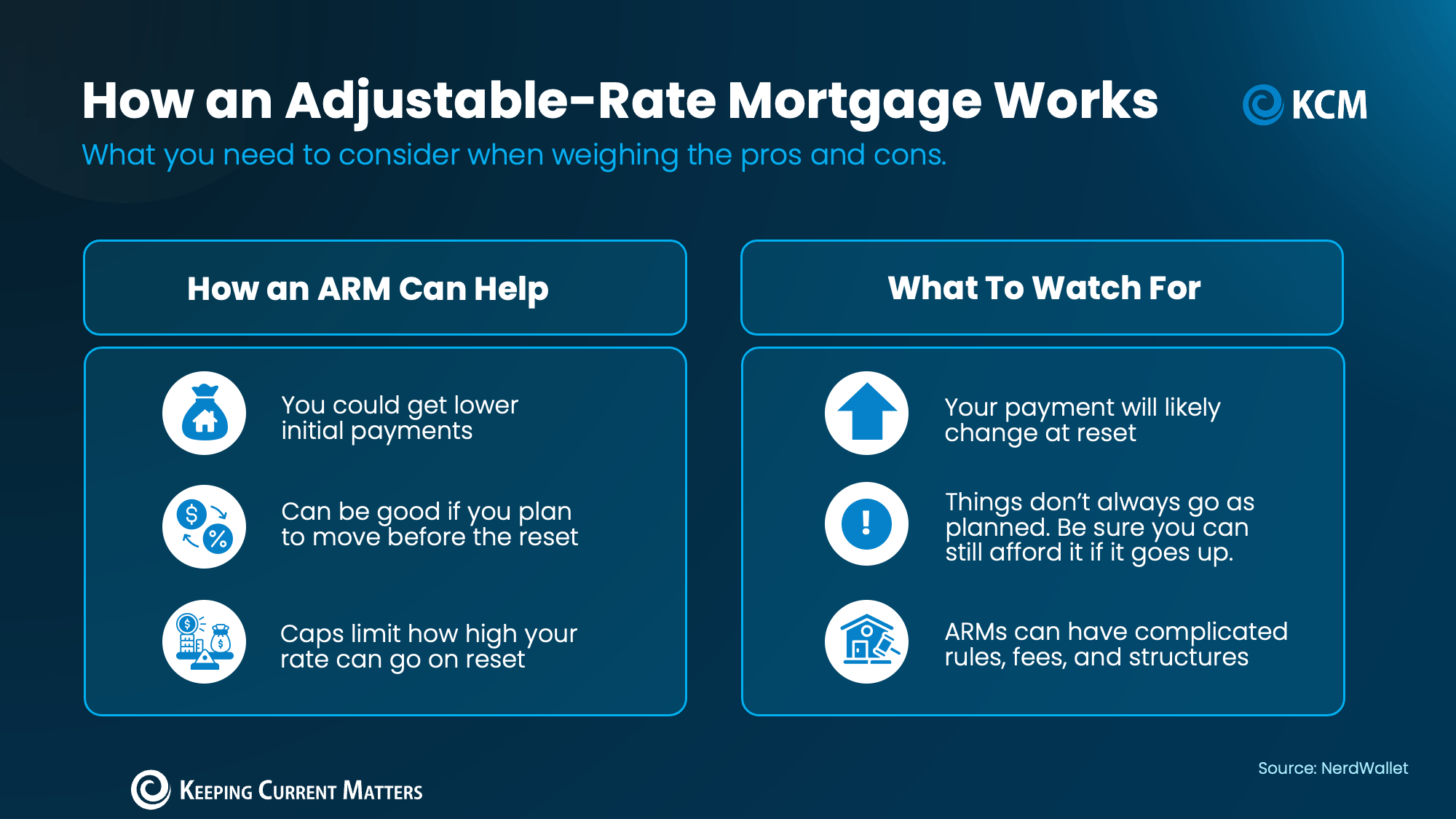
Here is how it works. On a 5/1 ARM, the rate is fixed for the first 5 years. After that, it can adjust once a year based on the market index the loan is tied to. Most ARMs carry caps that limit how far the rate can rise at each adjustment and over the life of the loan.
If you want to understand what moves those market rates in the first place, read what the spread between the 10-year Treasury and mortgage rates is telling you.
Here Is What the Data Is Showing Right Now.
The gap between ARM rates and fixed rates is real.
In the Mortgage Bankers Association's weekly survey for the week ending October 16, 2026, the average 30-year fixed contract rate was 7.41%. The average 5/1 ARM rate was 6.46%.
That is close to a full point. Bankrate data cited by Keeping Current Matters showed ARM rates more than a full percentage point below fixed rates in September 2026.
And buyers are acting on it. The ARM share of mortgage applications held at 10.5% in that same MBA survey. Roughly 1 in 10.
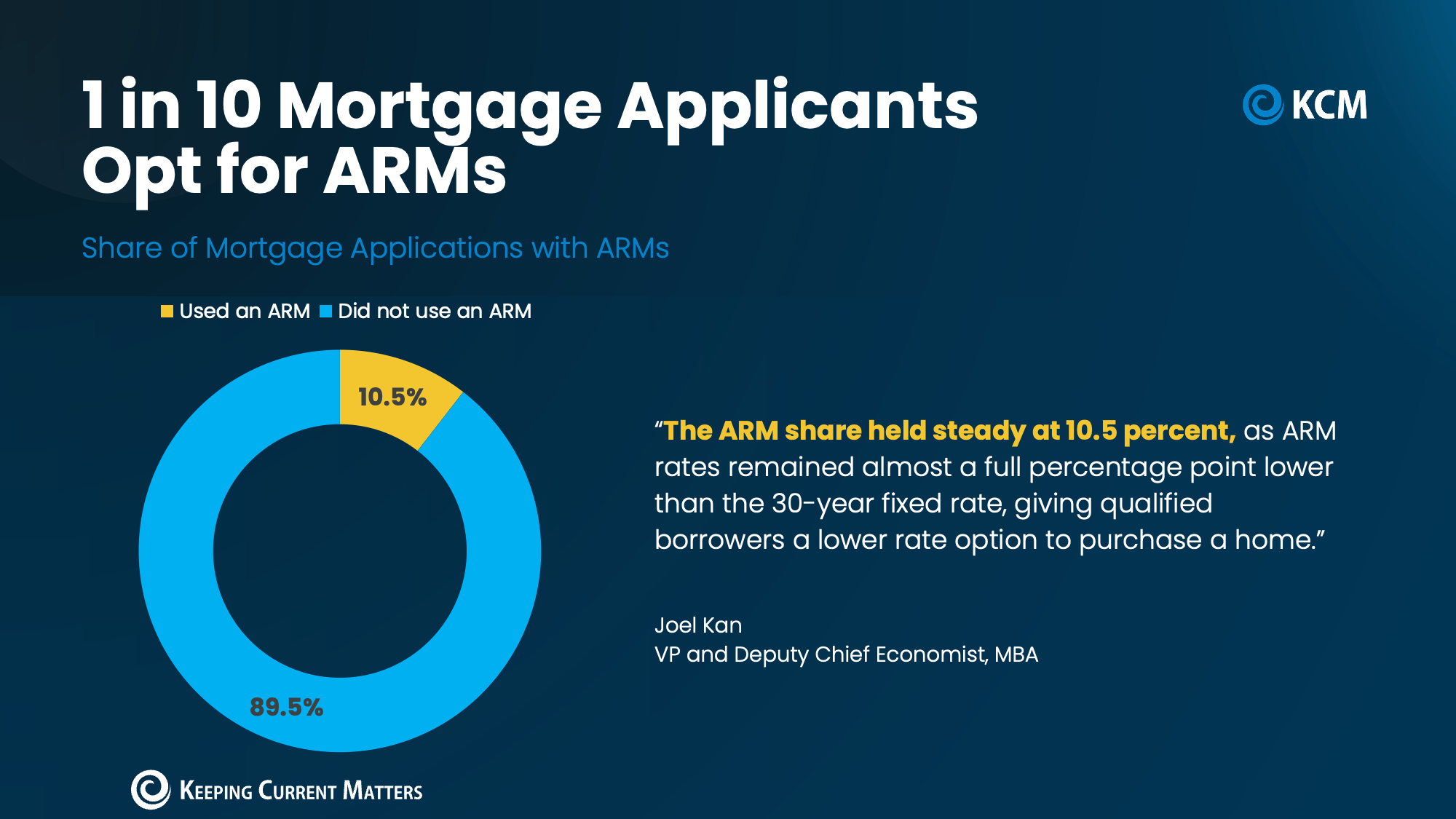
Joel Kan, MBA's Vice President and Deputy Chief Economist, said ARM rates "remained almost a full percentage point lower" than the 30-year fixed rate.
Now put that gap into a payment.
Say a couple borrows $400,000. At 7.41% fixed for 30 years, principal and interest is about $2,772 a month. At 6.46% on a 5/1 ARM, it is about $2,518.
That is about $254 a month, or roughly $15,270 over the first 5 years.
That is real money. I am not going to pretend it is not.
What the Headlines Always Leave Out.
Every ARM headline is about the starting rate. Very few talk about month 61.
Same couple. After 5 years of payments, they still owe about $374,270. Now say the rate adjusts up 2 points at the first reset, to 8.46%.
Their principal and interest jumps to about $3,004 a month.
That is $486 more than they paid the month before. It is also about $231 more than the fixed-rate payment they turned down.
Say the loan carries a 5-point lifetime cap and rates keep climbing. The ceiling on that same balance is 11.46%, and the payment is about $3,793.
I am not predicting that happens. I am telling you the loan allows it, and your plan has to survive it.
Three more things the headlines skip.
A refinance is not a guarantee. Refinancing into a fixed rate later means qualifying again, with your income, credit, and home value at that time, and at whatever rates the market is offering then.
Selling is not a guarantee either. "We will move before the reset" only works if the house sells on your timeline, at a price that works.
The fine print matters. Caps, margins, index choices, and adjustment schedules differ by loan and by lender. The CFPB's Consumer Handbook on Adjustable-Rate Mortgages walks through every one of them.
Here is the good news. The guardrails are stronger than they were before 2008. Under the federal Ability-to-Repay rule, lenders have to verify income and consider whether you can repay the loan, including how the payment can change.
That protects you from the worst loans. It does not decide what is comfortable for your household. That part is yours.
What This Means For Your Plan.
Run the reset payment first. Then decide.
If you are buying:
Qualify yourself at the higher number, not the starting one. My target for housing is 30% or less of gross monthly income, and that includes principal, interest, taxes, insurance, and any mortgage insurance or HOA dues. Test the reset payment against it.
Back to our couple. Add about $700 a month for taxes and insurance. At the starting rate, their housing cost is about $3,218. That fits the 30% target on a gross income of about $10,730 a month.
At the 8.46% reset, their housing cost is about $3,704. Now they need about $12,350 a month to stay inside the same target.
If your income does not cover the reset payment inside that target, the ARM is not saving you money. It is borrowing against your future budget.
Keep your total debt-to-income ratio at 35% or below, and have your full emergency fund in place before you rely on a payment that can change.
Then put the savings to work. If an ARM lowers your payment by $254 a month, send that $254 somewhere on purpose: extra principal, reserves, or the cash you would need for a refinance. Do not let it disappear into the budget.
Run both payments through the DTI calculator before you decide.
If you are selling:
If you are selling and buying your next home, the same test applies to your next loan. And if you know you will be in that next home only a few years, compare a fixed period that outlasts your plans. My breakdown on whether to buy first or sell first walks through the timing side.
Here is where I land. An ARM makes sense when three things are true: you have a clear reason to expect a shorter stay or higher income, you can carry the reset payment today, and you have reserves. Miss one, and the fixed rate is the safer plan.
Compare the alternatives on the same page, too: a longer fixed period such as a 7- or 10-year ARM, a builder rate buydown, a larger down payment, or a less expensive home. I covered more of those levers in the three things you can control about your mortgage rate.
Then get more than one quote. Ask each lender for the start rate, margin, index, caps, and the worst-case payment, in writing.
Compare the fixed payment, the ARM payment, and the reset payment before you choose.
We can run your numbers at the starting rate, the first adjustment, and the lifetime cap, then check each one against your DTI and housing targets.
Talk With PatThe Question You Should Be Asking Together Right Now.
Not, how low is the starting rate?
The better question is: if our payment went up by $500 in year 6, would we be fine, or would we be scrambling?
Answer that honestly, together, before a lender ever pulls your credit.
Ask for the payment at the first adjustment and at the lifetime cap, in writing, on the exact loan you are considering.
Housing at 30% or less of gross monthly income. Total DTI at 35% or less. Reserves in place.
Name where the monthly difference goes before you close, so the lower payment builds something.
Put it on the agenda for your next Money Meeting. Sit down together, run both payments, and decide as a team.
A lower rate is only a deal if you can afford the higher one.
Bottom Line
About 1 in 10 mortgage applicants are choosing an adjustable rate, because the starting rate is close to a full point below fixed. That gap saves real money in the first years.
But the reset payment decides whether an ARM fits your life. Plan for it, test it against your numbers, and keep your reserves strong.
Choose the loan you can carry in year 6, not just the one that looks best in year 1.
Your next step: ask your lender for the reset payment and the lifetime-cap payment in writing, then talk it through with me before you lock anything in.
Pat Collins, Mortgage Advisor | NMLS #1628553
Educational disclosure: This article is for general educational purposes and is not individualized mortgage, financial, legal, tax, insurance, credit, investment, or real estate advice. It is not a loan offer or a commitment to lend. Mortgage rates, adjustable-rate terms, indexes, margins, caps, adjustment schedules, loan availability, and qualification standards vary by borrower, property, occupancy, loan program, lender, market, and timing. National average rates are not a quote or guarantee. Adjustable-rate mortgage payments can increase after the initial fixed period, and a future refinance or sale is not guaranteed. Payment examples are hypothetical, show principal and interest unless noted, and are rounded. Review current written loan terms with the appropriate licensed professionals before making a decision.
Reference sources: Keeping Current Matters — “Why More Buyers Are Turning To Adjustable-Rate Mortgages Today”, October 23, 2026. Rate and application data verified against the Mortgage Bankers Association weekly survey (week ending October 16, 2026) and Freddie Mac PMMS (October 22, 2026).