 Skip to content


If you already own a home and you are getting ready to move, there is one question that comes before every other question.
Do you buy first, or do you sell first?
Most couples do not think about it in that order. They start browsing listings, fall in love with a house, and only then begin doing the math on the home they already own.
I want to walk you through why that order matters—and why, in today’s market, selling first is often the stronger move.
Before you shop for the next house, know your current equity, your debt-to-income ratio, the payment you can comfortably carry, and what happens if your present home takes longer to sell than expected.
First, what is actually happening right now.
Nationally, buyers have more choices than they did during the most competitive years of the market, and homes are generally taking longer to sell. The exact balance still depends on your city, price range, property condition, and local demand, so your agent should confirm what is happening in your specific market.
That can be good news when you are buying. But it changes the risk if you also have a home to sell.
When a property takes longer to sell, the overlap between two homes can last longer too. That is why the sequence of the move deserves attention before you start touring properties. Buyers may have more time to compare homes and negotiate, while sellers need a realistic pricing and timing plan from the beginning.
You secure the next home sooner
You may avoid temporary housing and move directly into the new property, but you could carry two housing payments or make your offer dependent on selling your current home.
You know your cash position
You know the actual sale proceeds available for the next purchase, remove the risk of two mortgages, and can often write a cleaner offer.
Here is what the data is showing.
You could end up carrying two mortgages at once.
Buy before you sell, and you are exposed—not in theory, but in your monthly numbers.
If your old house takes longer to sell, the overlap can continue for months. Add repairs, utilities, insurance, taxes, maintenance, staging, or another price adjustment on the old property, and the cost can climb quickly.
That does not automatically mean buying first is wrong. Some households have the income, reserves, or financing strategy to handle it. But the decision should be based on verified numbers, not the hope that the old house will sell immediately.
Your equity may be larger than you think.
Home equity is the current value of your property minus the mortgage debt still secured by it. According to Realtor.com, median home equity is about $180,000 during the first five years after purchase and rises to more than $340,000 during years six through ten.
That is not pocket change. Depending on your mortgage balance, selling expenses, taxes, and the final sales price, it may become the down payment for your next home, help you reach 20% down, reduce mortgage insurance, strengthen your reserves, or even make a cash purchase possible.
Knowing that figure before you write an offer is different from estimating it and hoping everything closes on schedule. You can also review the broader role of equity in building homeowner wealth.
A sold house can make your next offer harder to beat.
When your current home is already sold, your next offer does not need to depend on that sale. A seller often sees that as a cleaner path to closing.
If the next property has been sitting on the market, that certainty may also give you more room to negotiate repairs, credits, timing, or other terms. I explain that larger strategy in How To Find the Best Deal Possible on a Home Right Now.
Why selling first can put you in a stronger position.
Your current mortgage is paid off through the sale, so the move is not dependent on carrying two full housing payments for an unknown period.
Instead of estimating your proceeds, you know the final amount available for the next down payment, closing costs, reserves, moving expenses, and repairs.
Removing a home-sale contingency can reduce uncertainty for the seller and strengthen your negotiating position.
You know how much cash you have, how large the new loan may be, and what total payment needs to fit your household plan.
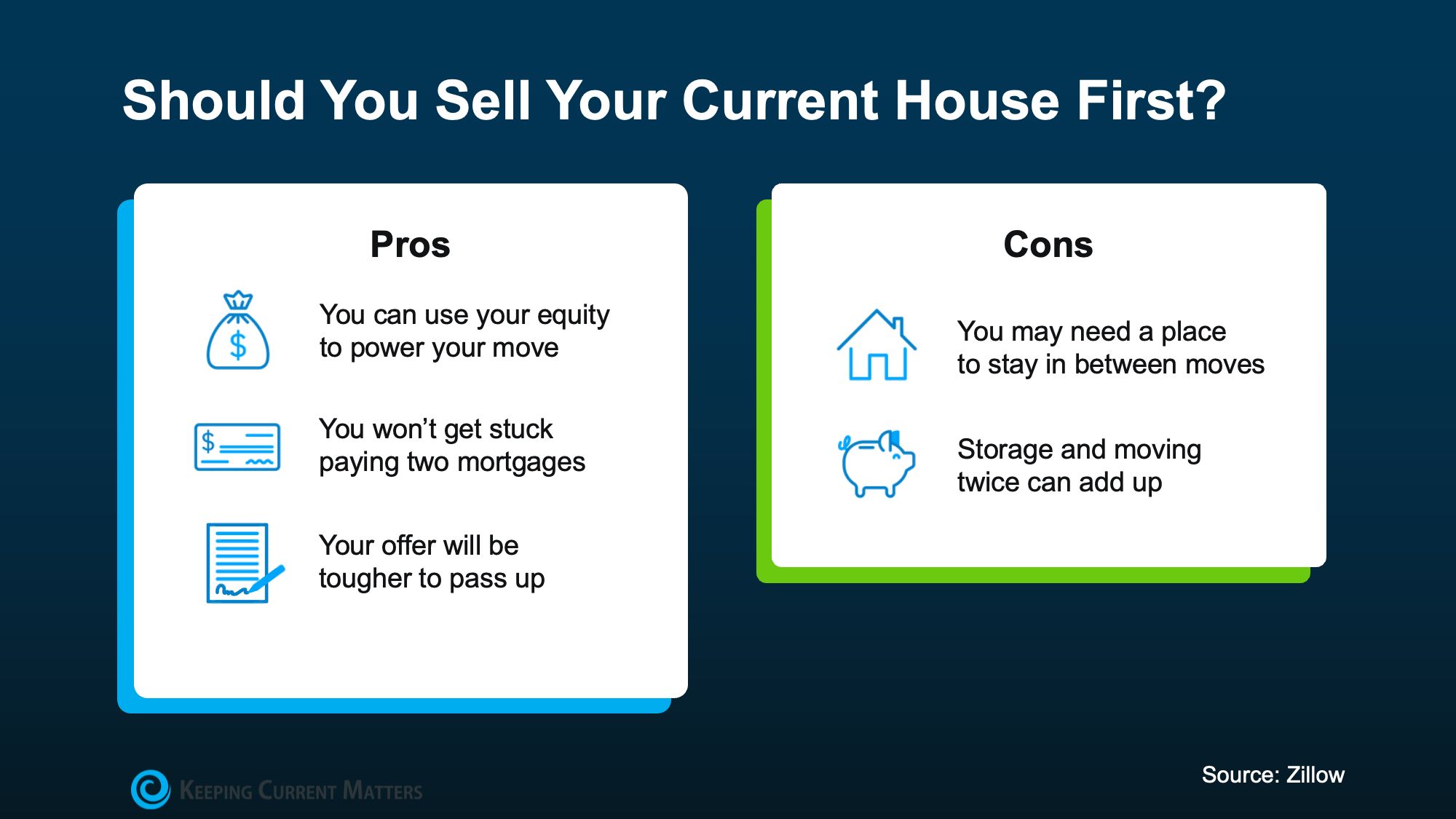
Selling first does not remove every risk.
You may need a place to stay between transactions. Storage and moving twice can add cost. You may also feel pressure to choose the next home quickly once the sale is complete.
Those are real tradeoffs, but they can often be planned for.
Negotiate a rent-back
A rent-back may allow you to remain in the home for an agreed period after closing while you complete the purchase of the next property.
Coordinate flexible closings
Your agent and settlement professionals may be able to align closing dates, possession, storage, and moving plans to reduce the gap.
The right option depends on your contract, local practices, the buyers and sellers involved, and whether your finances can tolerate delays. Talk through those details with qualified real estate, mortgage, legal, tax, and financial professionals before relying on a specific structure.
“A temporary housing plan is an inconvenience you can budget for. Two mortgages with no clear end date can become a financial problem.”
Pat Collins
What the headlines always leave out.
This is not only a real estate question. It is a Big 7 question.
If you buy before you sell
You risk placing two full housing payments inside the household budget at the same time. Under Rule 2, housing and the other core essentials need to remain within a manageable share of take-home pay. For many couples, two mortgages do not fit that ceiling.
The existing mortgage may also affect your debt-to-income ratio while you qualify for the next loan. Depending on the loan program and documentation, a lender may not be able to ignore the current payment merely because you intend to sell later.
Existing car loans, credit cards, personal loans, and other monthly obligations matter too. Those costs can create the kind of self-inflicted inflation that quietly reduces buying power.
If you sell first
Your equity check can begin doing the work for you. You know the actual funds available for the Rule 6 down payment instead of guessing. Depending on the purchase price and proceeds, you may have enough to reach 20% down and avoid monthly mortgage insurance, while preserving cash for closing costs and reserves.
You also know the approximate new loan amount before you begin negotiating, which makes it easier to compare the next purchase with the monthly payment you want to live with after closing.
Either way, this is where Rule 11 earns its keep.
A full emergency fund makes the in-between stretch survivable. Temporary housing, storage, moving, repairs, appraisal issues, closing delays, or a rent-back that lasts longer than planned should not erase everything else you have built.
This decision is also bigger than one transaction. The equity in your current home is one of the primary vehicles for the generational wealth you are building together. How you move it into the next property—cleanly, deliberately, and without unnecessary payment pressure—is part of that larger plan.
Know your equity, DTI, cash position, and new payment before you shop.
I can help you review the mortgage side of the move, including your current payment, estimated equity, debts, possible down payment, reserves, and what the next housing payment may look like.
Talk With PatThe question you should be asking together right now.
Not only: “Which house do we want next?”
The real question is: What is our current equity, what does it do to our down payment and DTI, and can we complete this move without stacking two mortgages on top of each other?
Before you call an agent, sit down together and answer these questions:
Use current local comparable sales and account for the condition, price range, competition, selling costs, and likely time on market.
Subtract mortgage balances and expected selling costs from a realistic sale price. Do not build the next purchase around the highest possible number.
Review income, recurring debts, reserves, loan-program rules, and how the lender will treat the existing property and payment.
Plan for housing, storage, moving, repairs, rate changes, appraisal issues, and the cash needed if the timeline stretches.
My wife and I have moved more than once in 34 years of marriage and real estate. The moves that went smoothly were never the ones where we found the house first and figured out the rest later. They were the ones where we knew our number before we ever called an agent.
Talk to a local agent about the selling market in your area. Talk with a mortgage professional about qualification, DTI, reserves, and the payment on the next home. But before those conversations, have the first one with your spouse.
Know your equity. Know your DTI. Know what your Big 7 looks like if the move takes longer than you hope.
That clarity is what turns a stressful move into a smart one.
Bottom line
There is no one-size-fits-all answer. Buying first may work when your income, assets, approval, timeline, and tolerance for risk are strong enough to support it.
But for many homeowners, selling first creates a cleaner financial position. It removes the uncertainty of two mortgages, converts estimated equity into known funds, and may make the next offer more attractive.
Do not begin with the next listing. Begin with the numbers behind the home you already own.
Educational disclosure: This article is for general educational purposes and is not individualized mortgage, financial, legal, tax, insurance, credit, or real estate advice. Market conditions, property values, selling costs, net proceeds, rent-back arrangements, underwriting treatment of existing housing payments, debt-to-income calculations, mortgage qualification, and available financing vary by location, property, contract, lender, loan program, and individual circumstances. Consult qualified mortgage, real estate, legal, tax, insurance, and financial professionals regarding your situation.
Reference sources: Keeping Current Matters and Realtor.com.