
“Should I buy now or wait for mortgage rates to come down?” sounds like a rate question. It is actually a decision about rates, home prices, competition, negotiating power, timing, and your personal finances.
A lower mortgage rate can absolutely improve affordability. But waiting for that rate may also mean shopping in a different market—with more buyers, fewer seller concessions, and possibly higher home prices.
That is the tradeoff. You are not deciding between today’s rate and tomorrow’s rate in a vacuum. You are deciding between today’s entire opportunity and whatever the market looks like later.
Do not ask only, “Will rates fall?” Ask, “Will waiting improve my complete financial position enough to justify the risks and costs of waiting?”
The real question is not whether rates will move
Mortgage rates move constantly. They can rise or fall after inflation reports, employment data, Federal Reserve expectations, Treasury-market changes, and other economic news.
The problem is that no one can consistently identify the lowest rate in advance. You usually recognize the bottom only after rates have already moved away from it.
So the goal is not to perfectly time the mortgage market. The goal is to buy when the home, payment, cash requirement, and timing work for you—and when the risks are understood.
You can refinance a mortgage rate later. You cannot refinance the price you paid for the home.
Pat Collins
That does not mean you should buy a house you cannot comfortably afford. It means the interest rate is one part of the decision, not the entire decision.
Where mortgage rates are today—and what the forecast shows
Freddie Mac reported that the average 30-year fixed mortgage rate was 6.55% for the week ending July 16, 2026. That was up from 6.49% one week earlier but below the 6.75% average from the same week a year ago.
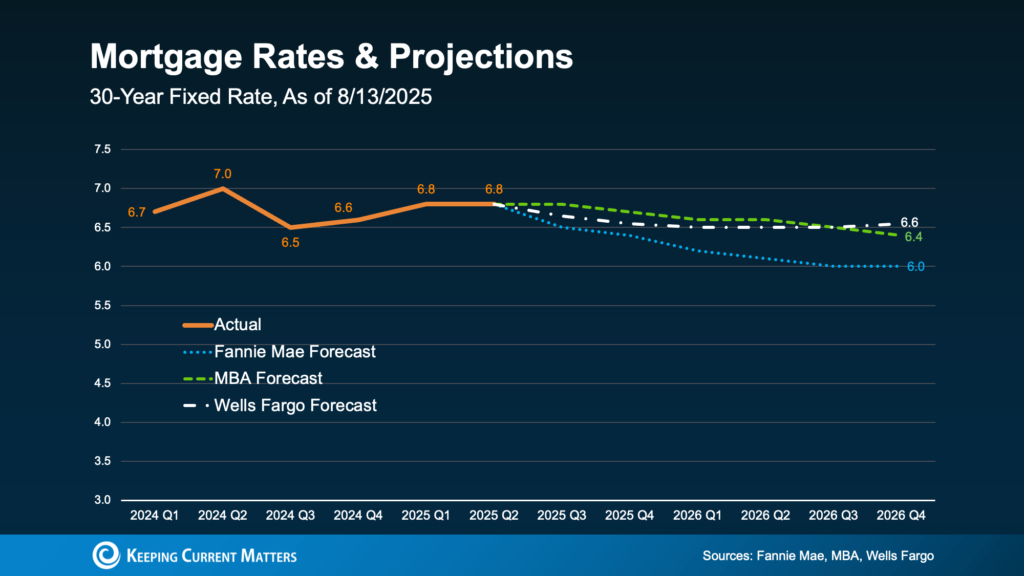
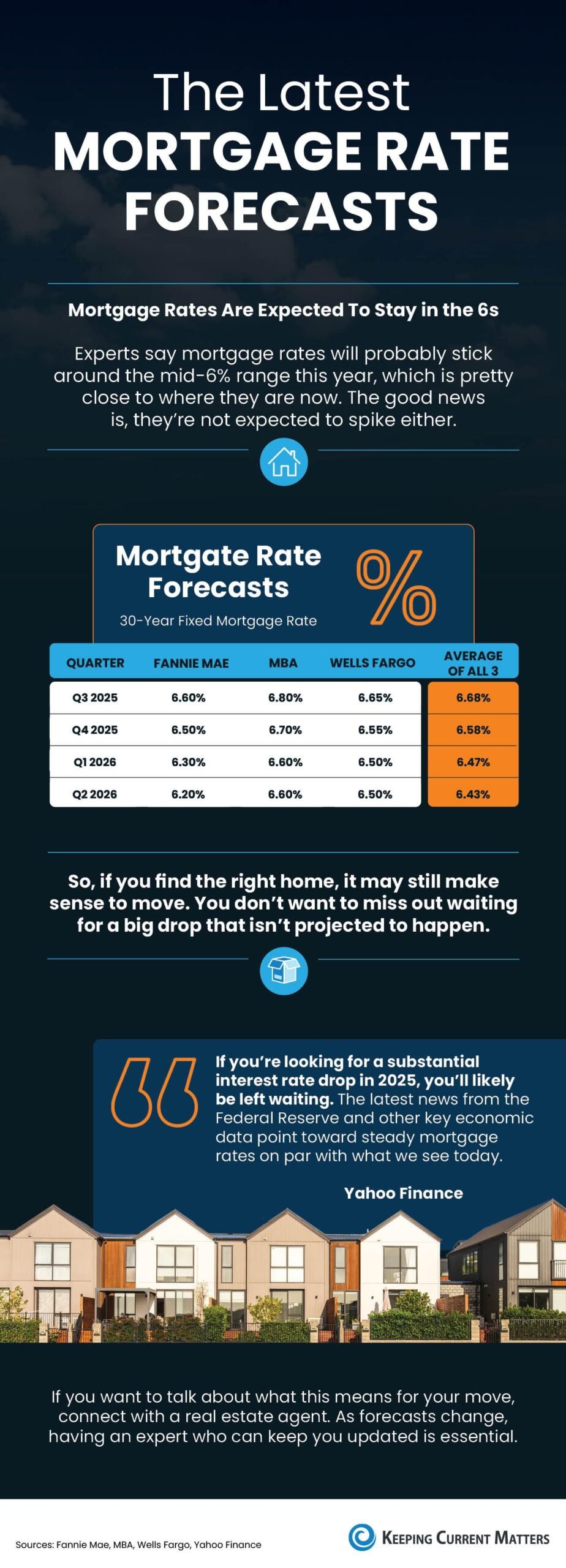
Fannie Mae’s July 2026 housing forecast projects the 30-year fixed rate to average approximately 6.4% during the third and fourth quarters of 2026. Forecasts can change, but the current outlook does not assume an immediate or dramatic collapse in rates.
The National Association of REALTORS® has estimated that a decline from roughly 7% to 6% could allow about 5.5 million additional households to qualify for a mortgage, including approximately 1.6 million renters. NAR estimated that roughly 550,000 of those newly qualified households could enter the market within 12 to 18 months.
That is important because the same rate improvement that helps your payment may also help hundreds of thousands of competing buyers.
What waiting for a lower rate may save
Let’s use a simplified example with a $400,000 loan and a 30-year fixed mortgage. Principal and interest at 6.55% is approximately $2,541 per month. At 6.00%, it is approximately $2,398 per month.
About $2,541
Estimated monthly principal and interest on a $400,000, 30-year fixed-rate loan.
About $2,398
Approximately $143 less per month if the loan amount and all other assumptions remain unchanged.
A $143 monthly reduction is meaningful. It can improve qualification, cash flow, and comfort. But the phrase “all other assumptions remain unchanged” is doing a lot of work.
While you wait, the price of the home, loan amount, available inventory, seller concessions, rent payments, and competition may all change.
If the loan amount increased by 3% to $412,000 while the rate fell to 6.00%, principal and interest would be about $2,470—not $2,398. The payment advantage compared with buying at 6.55% would shrink to roughly $71 per month.
This example is not a prediction that prices will rise 3%. It simply shows why the rate should never be analyzed without the future purchase price and loan amount.
What waiting may cost
More buyers may qualify at the same time
When rates improve, buyers who were previously priced out can return. Buyers who were waiting on the sidelines may also decide that the moment has arrived. That can increase showings, offers, and competition.
You may lose seller concessions
In a slower market, a seller may be more willing to pay closing costs, fund a temporary rate buydown, make repairs, or accept a lower price. When demand increases, those concessions can become harder to obtain.
The home price may change
A lower rate does not guarantee a lower payment if the future home costs more. Even modest price growth can offset part of the rate savings.
You continue paying for your current housing
Waiting may mean additional rent or remaining in a home that no longer fits your needs. Rent is not “wasted,” because it provides housing, but it should still be included in the cost of delaying the purchase.
Your personal situation may change
Employment, income, debt, credit, savings, family needs, and property availability can all change. A future rate may be better while your future qualification is not.

When buying now may make sense—and when waiting may be smarter
You are financially ready
You have stable income, adequate reserves, a comfortable payment, and you expect to remain in the home long enough for ownership to make sense.
Your foundation needs work
You need to reduce high monthly debt, improve credit, build emergency savings, stabilize income, or clarify where you want to live.
Buying now can be reasonable when the payment is affordable today—not only after a hoped-for refinance. A future refinance should be treated as a potential benefit, not the plan required to survive the payment.
Waiting can be the right decision when it meaningfully improves your finances. Paying off a car loan, reducing credit-card minimums, increasing reserves, or correcting credit issues may improve your buying power more than a small rate decline.
Waiting only because you are trying to predict the exact bottom in rates is different. That is market timing, and market timing comes with risks.
Build your decision plan before choosing
Include principal, interest, property taxes, homeowners insurance, mortgage insurance, HOA dues, utilities, and a realistic maintenance allowance.
Run today’s rate and price, a lower-rate scenario with the same price, and a lower-rate scenario with a higher purchase price.
Review days on market, price reductions, multiple-offer activity, and the concessions sellers are currently accepting in your target area.
Put a measurable goal behind the delay: eliminate a payment, save a specific amount, improve credit, or stabilize employment. “I hope rates fall” is not a complete plan.
Make sure buying still works if rates do not fall soon, the home needs repairs, or your monthly expenses increase. A good purchase should leave room for real life.
Let’s run your “buy now versus wait” numbers side by side.
We can compare payments, cash needed, debt-to-income ratio, possible seller concessions, and realistic future-rate scenarios so you can make the decision with facts.
Talk With PatBottom line
Waiting for lower mortgage rates may produce a lower payment. But it may also bring more competition, fewer concessions, and a higher purchase price. Buying now may offer negotiating advantages, but only when the payment is comfortable and your finances are ready.
There is no universal answer. The right answer comes from comparing the complete cost of buying today with the complete cost—and uncertainty—of waiting.
Do not buy because you fear missing out. Do not wait because you expect a perfect rate. Build a plan that works under today’s conditions, understand what could change, and act when the numbers support your life.
Freddie Mac’s published rate is a national survey average and is not an advertised or guaranteed rate. This article is for educational purposes only and is not a commitment to lend. Qualification, available programs, rates, payments, and terms depend on the borrower’s complete financial profile, property, credit, income, assets, and underwriting approval. Forecasts and market conditions may change without notice.