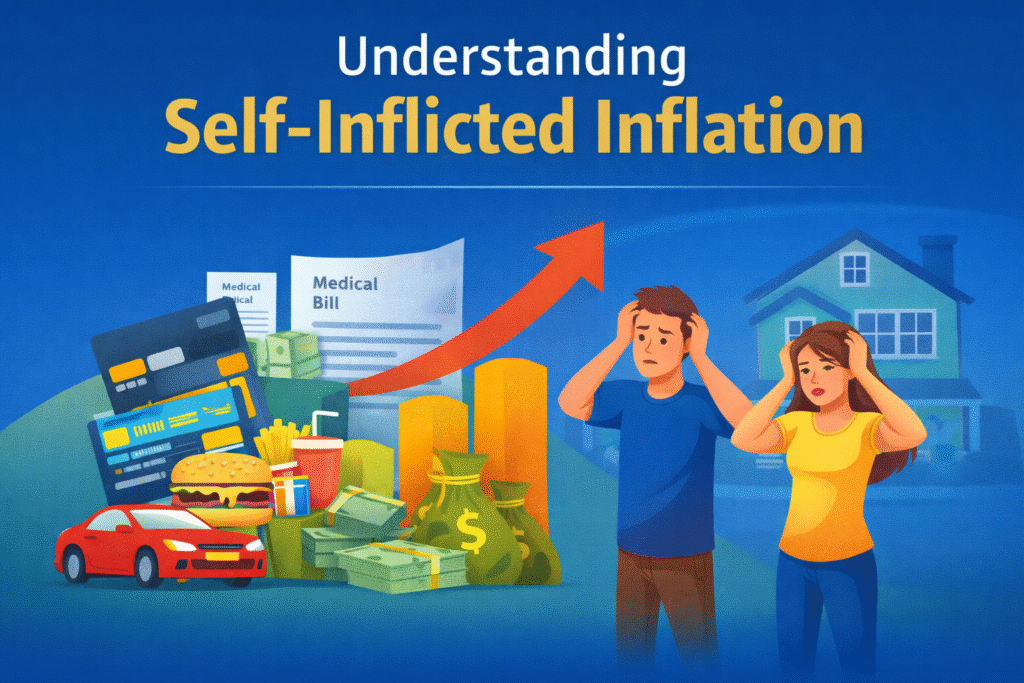


We all know what economic inflation feels like. Groceries cost more. Insurance costs more. Gas, utilities, repairs, and eating out cost more. But there is another kind of inflation that does not show up in the Consumer Price Index.
I call it self-inflicted inflation.
It happens when your income rises, your lifestyle rises with it, and the new monthly obligations slowly consume the raise. A newer car. A second car payment. Furniture on credit. A personal loan. More subscriptions. More dining out. A vacation balance that never quite goes away.
Each decision may feel manageable by itself. Together, they can reduce your savings, raise your debt-to-income ratio, and quietly move homeownership farther away.
The bank does not care whether a payment feels normal for your income. It cares that the payment must be made every month before the new mortgage is added.
There are two kinds of inflation affecting your budget.
The first is economic inflation. The Bureau of Labor Statistics uses the Consumer Price Index to measure the average change over time in prices paid by consumers for a market basket of goods and services.
You cannot personally control the price of food, electricity, insurance, or gasoline.
The second is lifestyle inflation. That is the increase in your own standard of living as income grows. Lifestyle improvement is not automatically bad. You work hard. You should enjoy your life.
The problem begins when every improvement becomes a permanent monthly payment.
“A raise should create more choices. It should not automatically create more bills.”
Pat Collins
Self-inflicted inflation is not about blaming people for enjoying their money. It is about recognizing the difference between a lifestyle you can afford today and a collection of payments that blocks the life you say you want tomorrow.
Prices rise around you
Food, housing, energy, transportation, insurance, and services become more expensive across the broader economy.
Your obligations rise with you
New car loans, card balances, personal loans, financing plans, and recurring spending absorb income that could support savings and a mortgage.
The monthly-payment trap
Most big purchases are not sold by total cost anymore. They are sold by monthly payment.
“It is only $699 a month.”
“The furniture is interest-free for 24 months.”
“The phone is just another $42.”
“The vacation can go on the card, and we will pay it off later.”
That language makes the purchase feel smaller. But your budget experiences the total of every payment at the same time.
A $700 car payment may fit. A $350 second car payment may fit. A $175 personal loan may fit. A $240 minimum credit-card payment may fit. A few subscriptions may fit.
Then you add them together.
Now the household has more than $1,500 in monthly obligations before rent, food, utilities, insurance, childcare, savings, retirement, or a future mortgage payment.
Affordable individually does not always mean affordable collectively.
The balance is not the only number that matters
People often focus on how much debt they owe. Mortgage lenders also focus on the required monthly payment.
A large debt with a small required payment may affect qualification less than a smaller debt with a large payment. That is why paying off debt strategically can matter more than simply sending extra money to the account with the highest balance.
The question is not only, “How much do I owe?”
It is also, “How much of my gross monthly income is already committed before the mortgage begins?”
How lenders see your lifestyle debt
One of the numbers lenders evaluate is your debt-to-income ratio, commonly called DTI.
The Consumer Financial Protection Bureau defines DTI as your total monthly debt payments divided by your gross monthly income. It is one way lenders evaluate your ability to manage the monthly payments on the money you want to borrow.
The general calculation looks like this:
Total monthly debt obligations ÷ gross monthly income = debt-to-income ratio.
Depending on the loan program and underwriting rules, monthly obligations may include:
- Car and other installment-loan payments.
- Required minimum credit-card payments.
- Student-loan payments calculated under the applicable loan guidelines.
- Personal loans and financed purchases.
- Alimony or child-support obligations when applicable.
- The proposed housing payment, including principal, interest, taxes, insurance, mortgage insurance, and homeowners association dues when applicable.
Every recurring debt payment leaves less room for the proposed housing payment.
This is why two couples with the same income and similar credit scores can receive very different mortgage results. One may have $500 in monthly debt. The other may have $2,000.
The income looks the same.
The available mortgage capacity is not.
The affordability math can be surprising.
Consider a household earning $130,000 per year.
That is approximately $10,833 in gross monthly income.
Now imagine the household has:
- $825 in car payments.
- $425 in minimum credit-card payments.
- $275 in student-loan payments.
- $180 for a personal loan.
That is $1,705 in monthly debt before a mortgage payment is added.
Those debts do not necessarily mean the household cannot buy. The exact result depends on the loan program, credit profile, reserves, down payment, property taxes, insurance, interest rate, and underwriting.
But the example shows the problem: a six-figure income can look strong while a significant part of it has already been promised to previous purchases.
“We make good money.”
The income feels high enough for homeownership because the household earns considerably more than it did a few years ago.
“A large share is already committed.”
The lender must account for required monthly obligations before determining how much housing payment may fit.
The down payment is only one side of readiness
Many couples save aggressively for a down payment while ignoring the payments reducing their qualification.
Saving is important. But there are situations where eliminating a monthly debt payment may improve the mortgage picture more than adding the same dollars to the down payment fund.
That does not mean everyone should drain savings to pay off debt. Cash reserves matter. Emergency savings matter. Closing costs matter. The correct sequence depends on the complete financial profile.
This is exactly why the decision should be calculated before the money is moved.
Find out which monthly payments are reducing your buying power.
I can help you review your income, minimum payments, estimated housing expense, cash available, and the debts that may make the biggest difference.
Talk With PatHow to reverse self-inflicted inflation
You do not need to stop enjoying your life. You need to make sure your lifestyle and your homeownership goal are moving in the same direction.
Include the payments that feel too small to matter. The mortgage calculation sees the total, not the story behind each account.
Groceries and utilities affect your real-life budget. Car loans, credit cards, and installment debts may also affect mortgage underwriting.
Before paying extra, determine which account could be eliminated and how much required monthly payment would disappear.
A new car, furniture financing, personal loan, or credit-card balance can change qualification—even after preapproval.
Direct part of increased income toward debt reduction, reserves, the down payment, retirement, or another intentional goal before the lifestyle expands.
Do not close accounts, transfer balances, pay off loans, or move large amounts of cash without understanding the credit, reserve, and underwriting effects.
A practical rule for future raises
When income rises, decide in advance how much will improve your life today and how much will improve your financial position tomorrow.
For example, you might direct part of every raise toward debt reduction or home savings before increasing recurring spending. The exact percentage is personal. The principle is what matters.
Do not allow every dollar of new income to become a new monthly obligation.
Bottom line
Economic inflation may be outside your control.
Self-inflicted inflation is different.
It is the quiet expansion of monthly payments that can make a strong income feel weak, reduce your savings, and limit the mortgage payment a lender can approve.
The answer is not guilt. It is awareness.
Know the payments. Understand the mortgage math. Decide which debts are costing you the most buying power. Then create a plan that supports both the home you want and the life you want after closing.
Because earning more money should move you closer to homeownership—not make you wonder where all the money went.
Educational disclosure: This article is for general educational purposes and is not individualized financial, tax, legal, credit, or mortgage advice. It is not a commitment to lend or a guarantee of qualification, approval, rate, payment, property value, or loan amount. Debt treatment and debt-to-income calculations vary by loan program and underwriting requirements. Consult qualified professionals before changing credit accounts, paying off debt, moving funds, or applying for financing.
Reference sources: The U.S. Bureau of Labor Statistics Consumer Price Index and the Consumer Financial Protection Bureau’s explanation of debt-to-income ratio.