 Skip to content



When is the last time someone told you what your house is actually worth? Not a Zillow guess. Not what your neighbor down the street got last spring. What your home is worth, right now, from someone who actually looked at it.
If you cannot answer that with a real number, I want you to keep reading before you make any decision about moving, staying, or renovating.
There is a good chance you are sitting on more home equity than you think, and that number can change what is actually possible for your next move.
First, Why the Number You Are Guessing Is Probably Wrong.
Most people price their own equity the same way: an online estimate, a neighbor's sale price, or a number they calculated years ago and never updated.
None of that is your equity. Home values have moved enough over the last several years that a number from even two years ago is already stale.
Equity is not what you paid. It is not what you think your house would sell for. It is what a professional, looking at your specific house today, says it is actually worth, minus what you still owe. If you are thinking about selling, this is also why current comparable sales and real buyer behavior matter more than an old estimate.
Until someone runs that number for you, you are guessing. And most people are guessing low.
Here Is What the Data Is Showing Right Now.
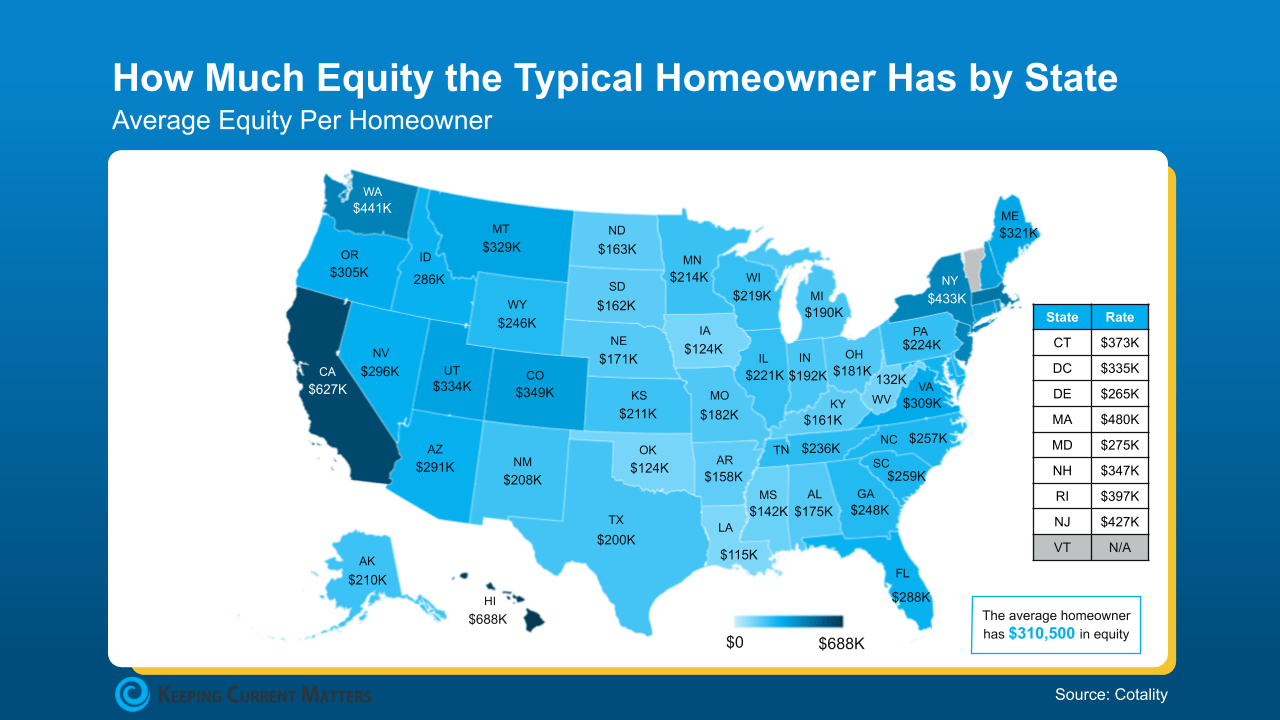
The typical homeowner with a mortgage is now sitting on $310,500 in equity, according to Cotality's latest numbers.
Read that again. Six figures. Sitting in a house, doing nothing, for a homeowner who has probably never had someone put an actual number on it.
And people are already using that number at scale. The National Association of Realtors reports that more than one out of every four repeat buyers, 26%, paid all cash for their next home in July. Not because they are wealthy in the way you might picture. Because they had equity, and they used it.
What the Headlines Always Leave Out.
Here is the part that never makes the headline: knowing your number and using your number are two different steps, and almost everyone stops after the first one, if they even get that far.
Equity sitting in your house can do three things for you. It can lower the payment on your next home through a bigger down payment. It can let you skip the mortgage altogether if the numbers work. Or it can fund the renovation that turns the house you already have into the house you actually want, instead of moving at all.
If staying put is the better choice, there are several ways homeowners sometimes access equity. A home equity loan is one option worth understanding, but any new debt should be evaluated against the payment, reserves, and long-term plan.
None of those choices happen automatically. They happen because someone got a real number, and then made a decision with it.
What This Means For Your Plan.
If you are moving:
Your equity is not a bonus. It is the down payment strategy on your next house. Under Rule 6 in our system, 10% down is good, 20% is better because it eliminates PMI outright. A six-figure equity number can be the difference between scraping together the minimum and walking in with 20% down, or walking in with no mortgage at all.
Before you assume you cannot afford to move up, find out what you are actually sitting on. The math changes completely once you have a real number instead of a guess. Then compare that number with your local buyer-versus-seller leverage and the payment you would actually carry on the next home.
If you are staying put:
That same equity can fund the renovation instead of the move. But do not treat it as free money the way people treat a windfall. Under Rule 11 in our system, a full emergency fund still comes first, six months at minimum, twelve if your income has any unpredictability to it.
Pulling equity for a kitchen or a bathroom should never mean draining the cash reserve that protects your household if something goes wrong. Fund the project. Protect the reserve. Do both, in that order. If you are thinking about how renovations could affect future resale, the right kind of flexible space and layout can matter to buyers.
Start with your home's value. Then build the plan around it.
Once you have a realistic equity estimate, we can connect it with your mortgage balance, debts, DTI, down payment, reserves, and the payment you want to live with after closing.
Talk With PatThe Question You Should Be Asking Together Right Now.
Not, what do you think our house is worth.
The real question is: what does someone who actually looks at our house, today, say it is worth, and what could we do with that number that we assumed we could not do?
I have spent 34 years on both sides of this exact conversation, as a homeowner with my wife and as the person other couples call to get the real number. The couples who end up ahead are never the ones who guess right. They are the ones who stop guessing, get the actual number, and sit down together to decide what to do with it.
Call a local agent and ask for a free Home Equity Assessment. It costs you nothing and takes one conversation. Then have the talk with your spouse about what that number changes for your next move.
Pat Collins
Financial Coach | Mortgage Professional | Realtor
34 Years of Marriage and Real Estate — I have been on both sides of every table.
Educational disclosure: This article is for general educational purposes and is not individualized mortgage, financial, legal, tax, insurance, credit, investment, appraisal, construction, or real estate advice. Home values and equity estimates vary by property, location, condition, market conditions, liens, selling costs, appraisal methods, and timing. A comparative market analysis or Home Equity Assessment is an estimate and is not a guarantee of sale price or an appraisal. Mortgage-insurance requirements, down-payment options, home-equity financing, qualification standards, renovation costs, and cash-purchase strategies vary by loan program and individual circumstances. Consult qualified mortgage, real estate, appraisal, legal, tax, insurance, construction, and financial professionals regarding your situation.
Reference sources: Keeping Current Matters — “One Number Could Change Everything About Your Next Move”, August 20, 2026; Cotality — U.S. Homeowner Equity Insights; and National Association of Realtors — July 2026 existing-home market coverage.