 Skip to content



That spare room on the main floor. The finished basement with its own entrance. The bonus room you use for storage because you never figured out what else to do with it.
To you, it is extra space.
To a growing number of buyers, it is the entire reason they would pick your house over the one next door.
I want to walk you through what is actually happening in this market right now — and why it matters whether you are selling, buying, or just deciding if Mom moves in with you next year.
Multigenerational-friendly homes are attracting real buyer demand. The premium is not only about having a larger house. Features such as in-law suites, secondary kitchens, finished basements, and separate entrances can make the layout itself more valuable to the right buyer.
First, What Is Actually Happening Right Now.
More families are living under one roof. And not the way it used to work.
This is multi-generational living — three or more generations, grandparents, parents, and kids, sharing one house on purpose. Not a temporary squeeze. A plan.
According to Realtor.com Economic Research, the number of owner-occupied multigenerational households grew from about 3.2 million in 2014 to 3.9 million in 2024.
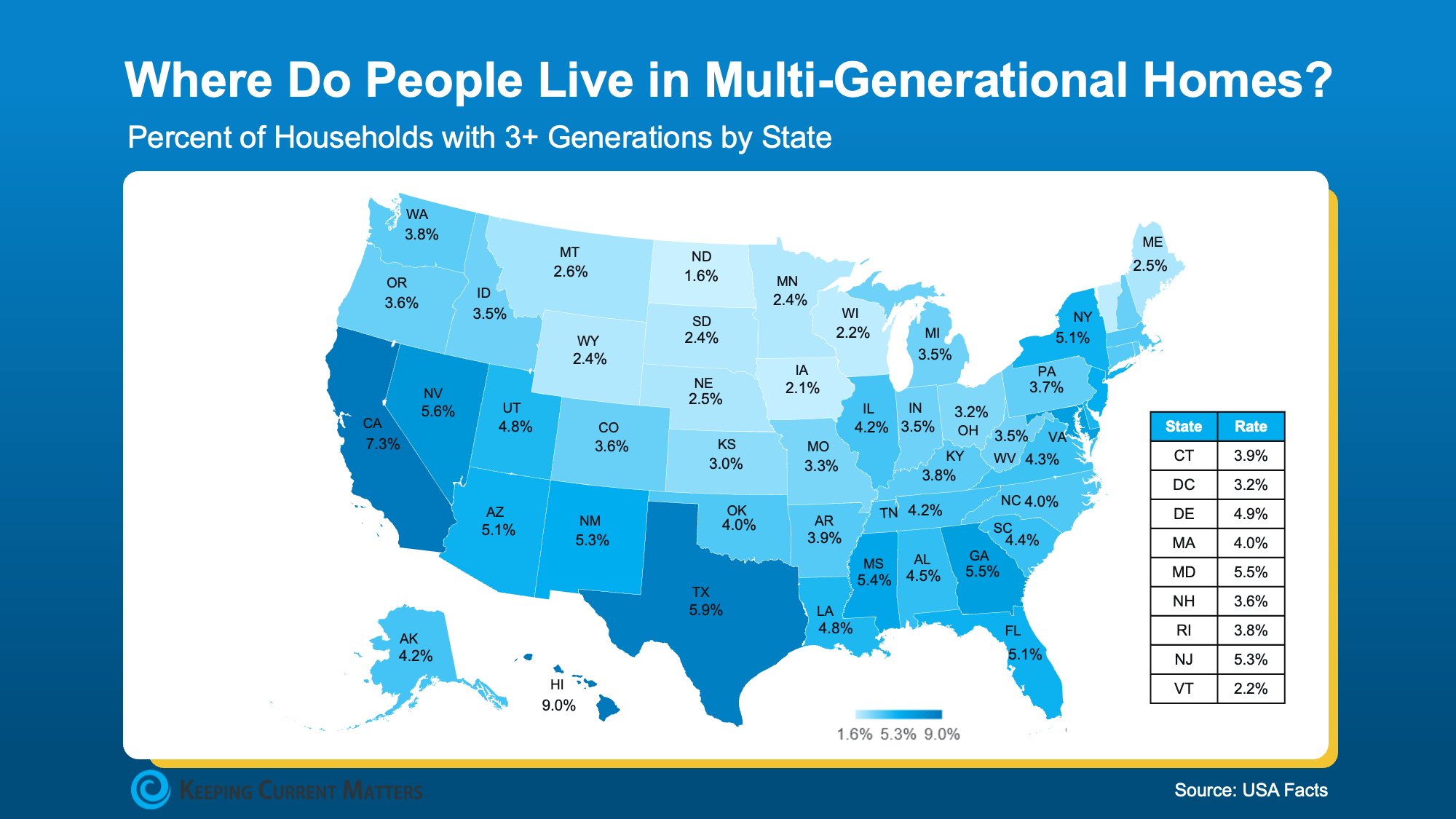
That is not a niche housing choice anymore. That is a real, growing market. And it is more common in some states than others — which matters if you are trying to figure out whether your house fits the demand where you live.
Here Is What the Data Is Showing.
This is the number that got my attention.
The gap is enormous. According to Realtor.com, the median asking price for a multi-generational house in 2025 was $709,000. The median for a standard house was $429,900. That is roughly 65% higher — about $279,000 more, sitting in a house that, on paper, may simply have a few extra rooms and the right features.
$709,000 median asking price
Homes marketed for multigenerational living carried a substantially higher national median list price in 2025.
$429,900 median asking price
The national median for standard listings was far lower, creating an asking-price gap of roughly $279,000.
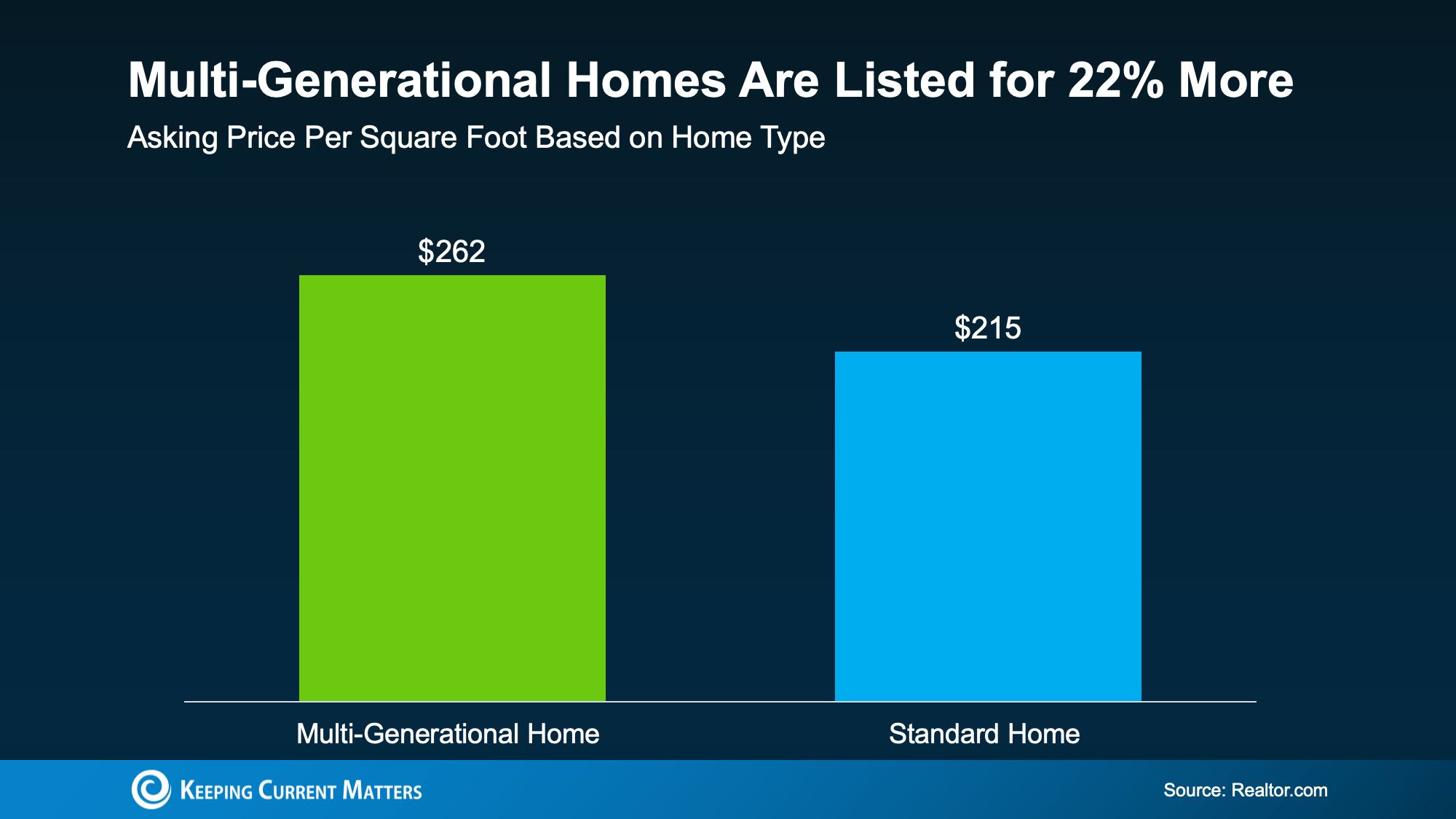
And it is not just about size. Strip out square footage and compare apples to apples. Multigenerational homes still listed for about $262 per square foot, versus $215 for standard homes. That is about a 22% premium per square foot — a sign that layout and specialized features matter too.
Buyers are not flinching at the price. These houses drew 13.5% more online views than standard listings, and they still moved in essentially the same timeframe — a median of about 59 days on market for both types.
$709,000 for multigenerational listings versus $429,900 for standard listings nationally in 2025.
About $262 per square foot versus $215, showing the premium is not explained by size alone.
Multigenerational listings received more page views while selling in essentially the same median timeframe.
“The strong demand and steep premiums we are seeing in inventory-constrained markets point to a real mismatch between what buyers are looking for and what is actually available.”
Hannah Jones · Senior Economic Research Analyst, Realtor.com
Translation: there are not enough of these houses in some markets. That is exactly why the ones that exist can get paid for.
What the Headlines Always Leave Out.
This premium is not spread evenly across the country.
Some states have a much bigger pool of buyers looking for this exact layout than others. Realtor.com’s research shows especially high shares of multigenerational listings in Western markets, including several California metros, while some Midwestern and Southern markets show more scarcity and much larger premiums.
That is why I tell every couple I work with the same thing, no matter what we are talking about: stop reading the national headline and start finding out what is true where you actually live.
The same principle applies when you look at home-price trends in your local market. National averages are useful context, but your city, neighborhood, price range, property condition, and buyer pool determine the strategy.
If you are selling, this is also why pricing and timing your home correctly still matter. A valuable feature only helps if buyers understand it and the listing is positioned properly.
What This Means For Your Plan.
If you already own a house with a finished basement, an in-law suite, a bonus room, or a separate entrance — you are not necessarily sitting on storage. You may be sitting on home equity you have not priced correctly.
Under Rule 6 in our system, your down payment and your home equity are two sides of the same coin. A premium on the sale of your current house does not just pad your pocket. Depending on your numbers, it can be the difference between putting 10% down on your next home and putting 20% down — and potentially eliminating private mortgage insurance on a conventional loan.
That is why, before you sell and buy at the same time, you should know what the current house may realistically produce. I break that process down in the decision between buying first or selling first, including how equity, DTI, reserves, and two possible mortgage payments can affect the move.
This is also bigger than one sale. A house that can genuinely hold more than one generation is one of the clearest, most literal versions of the generational wealth we talk about constantly. It is not just where your kids grow up. It is where your parents may be able to age in place instead of paying thousands a month somewhere else. It is one housing plan doing the work that might otherwise require two households.
If your property already has multigenerational-friendly features, do not assume buyers see them as “extra rooms.” Ask a local agent to compare your home with properties marketed around in-law suites, ADUs, guest houses, second kitchens, finished basements, or separate entries.
If you are still house hunting and multi-generational living is even a possibility for your family in the next 5 to 10 years, that changes what you should be looking at right now. Not just bedroom count. Layout. Separate entrances. A kitchenette that turns a basement into an apartment instead of a rec room.
For a lot of families, that is not a want on a list. That is the plan.
And if the right multigenerational home has been sitting on the market, the same layout that makes it valuable can still be negotiated. Your agent can help you look for homes with longer days on market, price adjustments, and more negotiating room.
Know what your current equity could do for the next move.
If you are thinking about selling, buying, or creating room for another generation, we can review your estimated equity, down payment, debts, DTI, reserves, and the payment you want to live with after closing.
Talk With PatThe Question You Should Be Asking Together Right Now.
Not: “Do we need a bigger house?”
The real question is: Does our family need room for more than one generation sometime in the next decade — and if the answer is yes, are we buying or building for it now, while it is still cheap to plan for, instead of retrofitting for it later at full price?
My wife and I have been on both sides of this table for 34 years — as a couple building our own life, and as professionals helping other families build theirs. The families who use a house like this well are rarely the ones who stumbled into an in-law suite by accident. They are the ones who talked about it before they needed it.
Talk to a local agent about what a house like this is worth in your specific market. But have the conversation with your spouse first. Is this your family’s next ten years? If it is, that changes what you look for, what you offer, and what you protect when you eventually sell.
That clarity is what turns extra space into extra wealth.
Educational disclosure: This article is for general educational purposes and is not individualized mortgage, financial, legal, tax, insurance, credit, investment, appraisal, construction, or real estate advice. Property values, buyer demand, listing premiums, days on market, mortgage-insurance requirements, and financing options vary by location, property, market conditions, loan program, and individual circumstances. The national figures cited here describe Realtor.com’s 2025 listing analysis and should not be interpreted as a guaranteed premium for any individual property. Consult qualified mortgage, real estate, appraisal, legal, tax, insurance, and financial professionals regarding your situation.
Reference sources: Realtor.com Economic Research — Under the Same Roof: Multigenerational Living in the U.S. and Realtor.com Newsroom.