
Your house has been on the market longer than you planned. The offers are not coming in where you hoped. So someone says it out loud: why not just rent it out?
It sounds like the safe backup plan. Keep the house, let the rent cover the mortgage, sell later.
Here is my answer. Renting is not the safe option. It is a second job with a second budget. Before you decide whether to sell or rent your house, you need to run two sets of numbers: the real landlord math and the loan math on your next home.
I want to show you why more owners are asking this question right now, what the data says, and the test I run before anyone turns a listing into a lease.
Rent that covers the mortgage on paper often loses money once management, vacancy, repairs, and insurance are counted. Keep the house only if the full numbers work and your next loan still fits your guardrails with zero rent coming in.
First, Why So Many Owners Are Asking: Sell or Rent Your House?
Because the market changed speed.
Kara Ng, Senior Economist at Zillow, put it this way in research cited by Keeping Current Matters: "Bargaining power is tilting toward buyers and homes are taking longer to sell."
When a house sits, sellers start looking for an exit that does not involve a price cut. Renting is the obvious one. You keep the house. You keep the equity. You wait for a better market.
The people who do this have a name. Accidental landlords. They never planned to own a rental. The listing just did not go the way they expected.
If you want the bigger picture on why some houses are moving and others are sitting, read which side of the housing market split your house is on.
Here Is What the Data Is Showing Right Now.
Most sellers are not taking the rental route.
According to Parcl Labs data cited by Keeping Current Matters on October 22, 2026, about 9% of homes currently for rent were previously listed for sale.
That is roughly 1 in 11 rentals. A real trend. Not a stampede.
And it depends heavily on where you live.
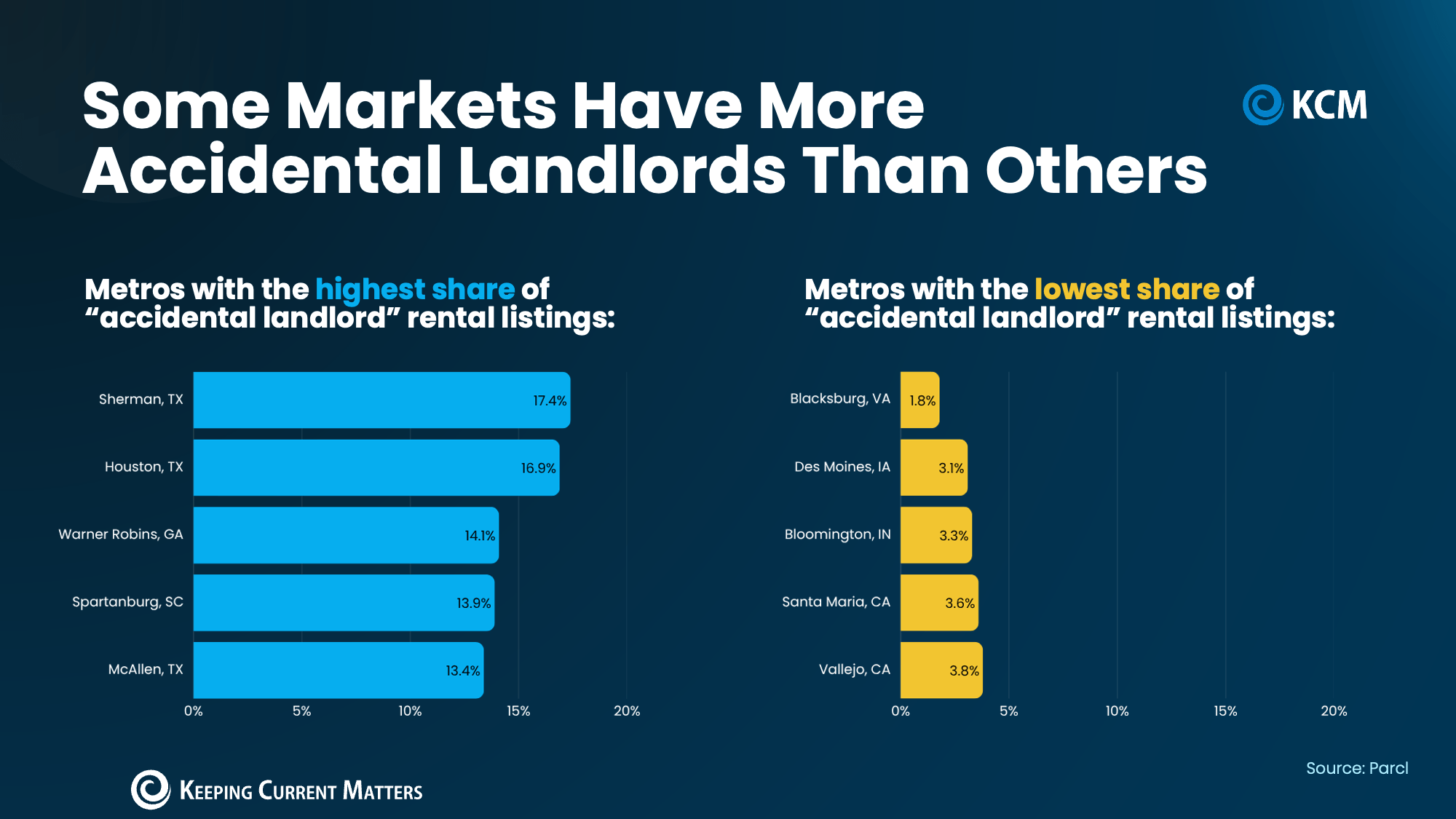
In Sherman, TX, 17.4% of rental listings were previously for sale. In Houston, 16.9%.
Here in California, the picture is different. Santa Maria sits at 3.6%. Vallejo at 3.8%.
So the question is not what the national headline says. It is what your local market is doing, and what your numbers are doing.
What the Headlines Always Leave Out.
The rental pitch always starts with one comparison. Rent versus mortgage.
That comparison is incomplete.
Say a couple has a total house payment of $2,400 a month, including a $150 homeowners insurance premium. The house would rent for $3,000.
On paper, that is $600 a month in their pocket.
Now add what landlords actually pay.
Management. Bankrate data cited by Keeping Current Matters puts property management at around 10% of rent. That is $300 a month.
Vacancy. One empty month a year averages out to $250 a month.
Repairs. Say they set aside $6,000 a year for maintenance and turnover. That is $500 a month.
Insurance. Bankrate data cited by Keeping Current Matters shows landlord coverage typically runs about 25% more than a standard homeowners policy. On a $150 premium, that is roughly $38 a month more.
That $600 profit just became a loss of about $488 a month. Roughly $5,850 a year.
Your numbers will be different. The pattern will not. Rent that covers the mortgage is not the same as rent that covers the house.
Two more things the headlines skip.
You are a landlord now, legally. As one property management firm told Keeping Current Matters, "Even if you never intended to become a landlord, the law still sees you as one." Leases, deposits, habitability, and fair housing rules all apply to you. Confirm your obligations with a real estate attorney before you sign a lease.
The tax picture changes. Turning a primary residence into a rental can change how a future sale is taxed. I am not going to give you a tax conclusion here. Confirm it with a tax professional before you decide.
What This Means For Your Plan.
Run the landlord math and the loan math. Then decide.
If you are selling:
Start with the reason the house is not moving. Most of the time, it is price, condition, or exposure. Fix those before you change the plan.
Sit down with your local agent and get a straight answer on pricing. Ask what the homes that actually sold in your area did differently from the ones that sat. Then ask what one price adjustment would cost you compared with a year of landlord losses.
Know your equity before that conversation. My breakdown on what your house is really worth for your next move walks through it.
If you are buying your next home:
This is the part most owners never test.
If you keep the old house, its mortgage stays on your credit report. Your lender will count it. Some lenders will credit part of the rent, and some will want a signed lease or landlord history first. The rules vary by loan program.
So I test it the conservative way. Zero rent.
Back to our couple. Say they earn $14,000 a month gross and carry $400 a month in other debts. Their next home would cost $3,800 a month.
Without the old house, their total debt-to-income ratio is 30%. Their new housing cost is about 27% of income. Both fit my guardrails: housing at 30% or less, total DTI at 35% or less.
Keep the old house, and their total DTI jumps to about 47%. That is a vacancy month away from real stress.
And one more rule I do not bend. Have a full emergency fund in place before you carry two house payments.
The timing side matters too. I covered it in whether to buy first or sell first.
Here is where I land. Renting makes sense when three things are true: the full numbers cash flow, your next loan fits your guardrails without the rent, and you want to be a landlord. Miss one, and selling with a sharper strategy is the stronger plan.
Compare selling now with keeping the house as a rental before you decide.
We can run your next loan with and without the old payment, check it against your DTI and housing targets, and show you what each path does to your cash.
Talk With PatThe Question You Should Be Asking Together Right Now.
Not, can the rent cover the mortgage?
The better question is: do we want to run a rental for the next 5 years, or do we want to move on?
Answer that honestly, together, before you pull the listing.
Rent minus the total payment, management, vacancy, repairs, and the higher insurance premium. Use a real rent estimate, not a hopeful one.
Housing at 30% or less of gross monthly income. Total DTI at 35% or less. Full emergency fund in place before two payments.
Ask your agent what one price adjustment would cost, and compare it with a year of landlord costs.
Put it on the agenda for your next Money Meeting. Lay both paths side by side and decide as a team.
A backup plan only works if you can afford it.
Bottom Line
About 9% of homes for rent right now were listed for sale first. Renting is a real option, and for the right owner and the right house, it works.
But the rent check is not the whole story. Management, vacancy, repairs, insurance, legal duties, taxes, and your next loan all belong in the decision.
Do not become a landlord by accident. Choose it on purpose, or sell with a better strategy.
Your next step: write down your real rental numbers and your next home's payment, then talk it through with me before you pull the listing.
Pat Collins, Mortgage Advisor | NMLS #1628553
Educational disclosure: This article is for general educational purposes and is not individualized mortgage, financial, legal, tax, insurance, credit, investment, or real estate advice. It is not a loan offer or a commitment to lend. Loan qualification, the treatment of rental income and existing mortgage payments, and program guidelines vary by borrower, property, occupancy, loan program, lender, market, and timing. Landlord costs, insurance premiums, vacancy, and rents vary by property and market. Landlord-tenant and fair housing obligations, and the tax treatment of a rental or a future sale, depend on your situation; confirm them with a qualified attorney and tax professional. Examples are hypothetical and rounded. Review current written terms with the appropriate licensed professionals before making a decision.
Reference sources: Keeping Current Matters — “To Sell or Rent? How To Choose the Best Path for Your House.”, October 22, 2026. Accidental-landlord data from Parcl Labs; landlord cost data from Bankrate, both as cited by Keeping Current Matters.