 Skip to content



If you are thinking about selling, you have probably heard three different answers to the same question.
How is the housing market doing?
One person says it is slow. Another says homes are flying off the shelf. Both of them can be telling the truth. That is the part the national headlines skip.
I want to walk you through why, because which side of this split your house lands on can influence how you price it, how long you wait, and what your own numbers need to look like before it ever hits the market.
The housing market is moving on two different tracks by price point. Entry-level demand is softer, while higher-priced homes are seeing stronger sales activity. Your local price range—not a national headline—should shape your selling strategy.
First, What Is Actually Happening Right Now.
The market is not running on one track. It is running on two, and the dividing line is price point.
At the entry level, buyers are pulling back. At the top, they are stepping up. Same country. Same month. Same rate environment. Two very different experiences.
The sharpest gap shows up at the two ends. Where a house in the middle lands is a local question, and that is exactly why you need to find out where yours sits. The same principle applies to the larger question of who has the upper hand in your local housing market: the national answer matters far less than the number in your own city, neighborhood, and price range.
Here Is What the Data Is Showing.
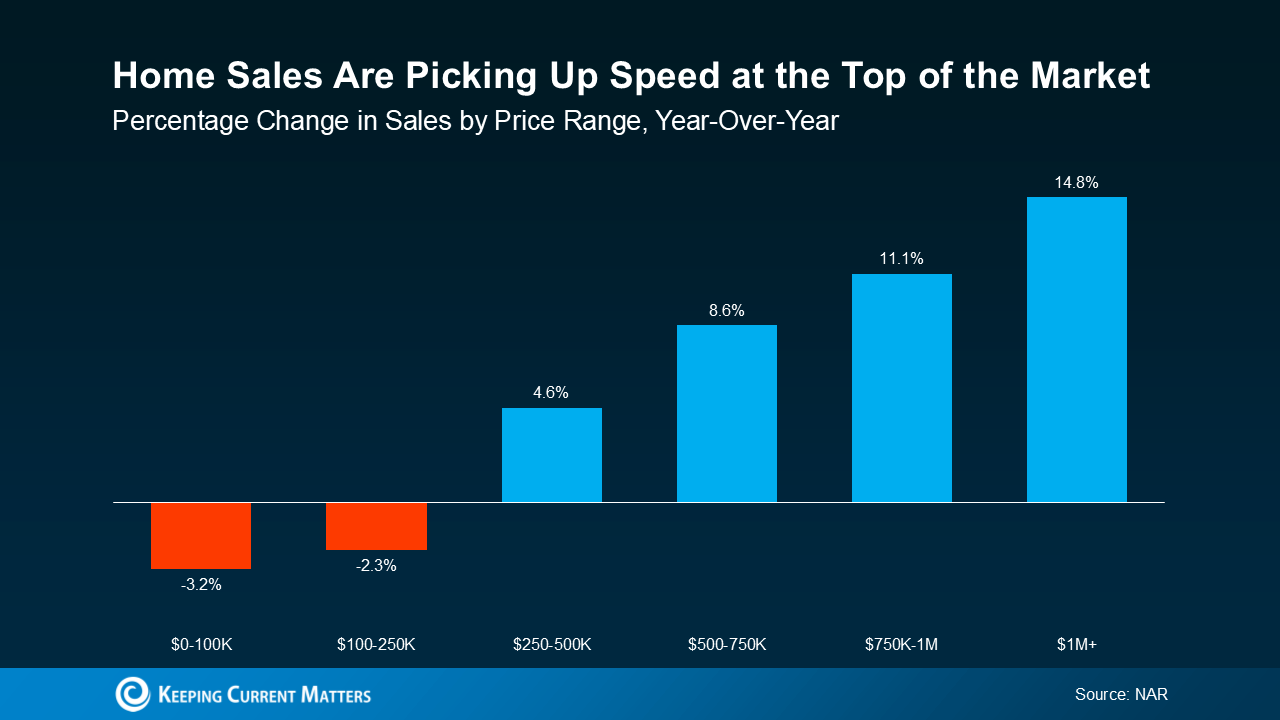
The entry level is slowing down. According to the National Association of Realtors data cited by Keeping Current Matters, sales of homes priced under $250,000 fell roughly 2% to 3% compared with a year earlier.
The top is speeding up. Over that same stretch, sales of homes priced above $750,000 climbed by double digits.
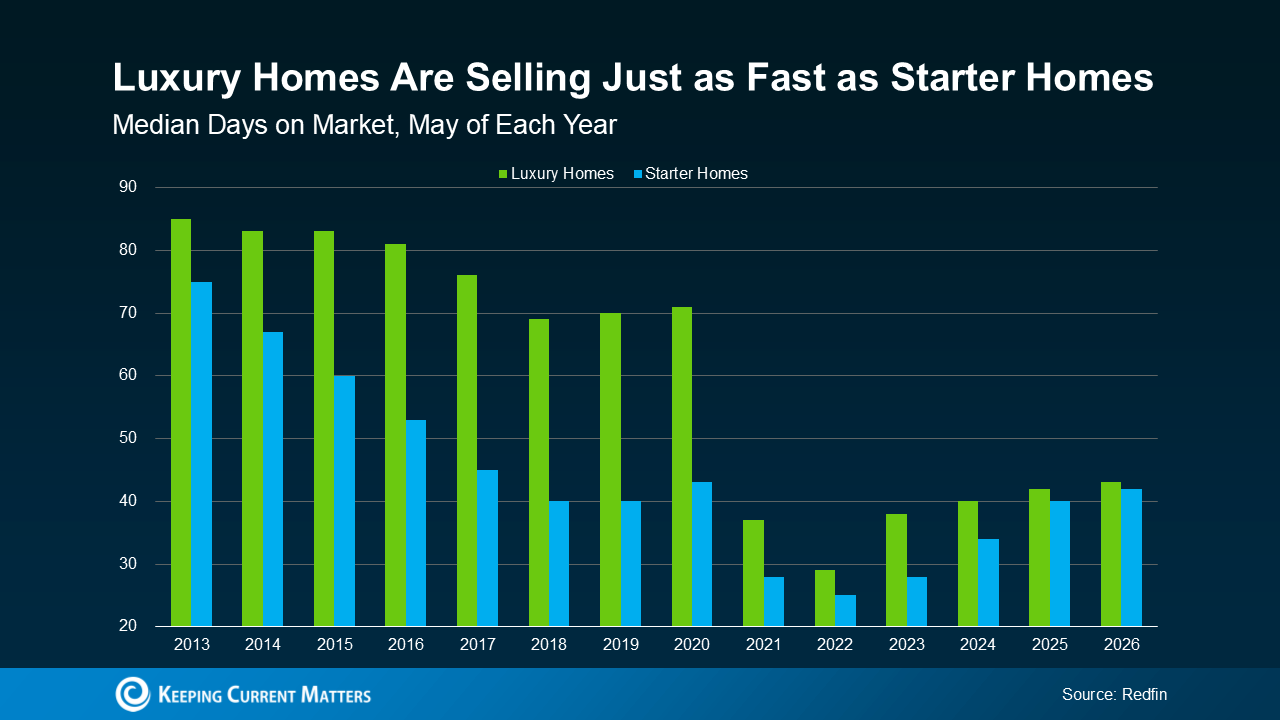
The gap in how long homes sit has nearly closed. For years, luxury homes took a lot longer to sell than starter homes. Redfin data cited in the source article shows that difference has almost disappeared. Zillow’s market read points in the same direction: luxury homes are moving faster than a year ago, supply at that level is shrinking, and bidding wars are growing.
Here is the why. Higher mortgage rates and several years of price growth have shrunk the pool of buyers who can comfortably afford an entry-level home, first-time buyers most of all. Buyers at the top are generally less sensitive to rates. They may have bigger budgets, investment gains, and substantial equity in the home they already own.
Read that last part again. Lower-priced homes are still selling. They are just selling to a smaller pool of buyers.
What the Headlines Always Leave Out.
Here is the part nobody puts in the headline. Every one of those numbers is really a story about a couple sitting at a kitchen table.
At the entry level, the couple across from you is often a first-time buyer stretched thin by rates and prices. Whether they can buy your house depends on their down payment, their debt-to-income ratio, their credit, and the payment they can carry. Price your house above what that couple can qualify for, and it does not matter how good it looks. They cannot get to yes.
That is why pricing your home correctly from day one matters even more when the buyer pool is thinner.
At the top, the leverage may sit more heavily with the seller, and that comes with its own risk. A stack of offers feels like winning. It is not a plan.
The split tells you where the buyers are. It does not tell you what to do with your own numbers. That part is on you.
Fewer buyers can stretch.
Affordability pressure makes the monthly payment, DTI, credit, and down payment more important. Price and presentation have to earn attention quickly.
Qualified buyers are more active.
Stronger budgets and existing equity can make higher-priced buyers less rate-sensitive, creating more competition for well-positioned homes.
If Your House Is on the Entry-Level Track.
Do not panic. Homes at your price are still selling. They are just selling more slowly, and that makes pricing and presentation matter more than they used to. Price it right from day one instead of testing a high number and chasing it down. Make sure it shows well online and in person. Lean on an agent who can put it in front of every buyer shopping in your range.
Then look at it through your buyer’s eyes. The couples who make it through this market are often the ones who saved 10% to 20% toward the home, kept their DTI around 35%, and kept their housing payment near 30% of gross income. That is the buyer you are trying to reach, so price for the payment that couple can actually carry.
If you want to see what that qualification math looks like from the other side of the table, use the DTI calculator. It is a useful reminder that buyers do not shop only by purchase price. They shop by the complete monthly payment and the debt load they are carrying into the transaction.
And protect yourself. A slower sale means a longer runway. If you are buying your next home at the same time, keep your DTI at 35% or below and do not stack two payments on top of each other unless the numbers support it. A 6 to 12 month emergency fund is what turns a longer wait into an inconvenience instead of a crisis.
This is also where current housing inventory and mortgage-rate conditions matter. More choices can give buyers time to compare your home with competing listings instead of feeling forced to take the first available option.
Know your likely sale proceeds before you choose the next payment.
We can review your estimated value, mortgage balance, likely equity, debts, DTI, down payment, reserves, and the payment you want to live with after the move.
Talk With PatIf Your House Is on the Move-Up or Luxury Track.
You are in a good spot. Buyers at your price are more active, and good listings are drawing real competition. That changes how your home should be marketed and priced from day one, so have that conversation with your agent before you list, not after the first offer lands.
But this is where couples get ahead of themselves. A strong sale makes it tempting to stretch on the next house. The question is not how much the lender will approve. The question is what payment lets you own the home and keep building your life.
Keep housing near 30% of your gross income. Keep your DTI around 35%. Put 20% down when you can and when it makes sense for the transaction, which may help eliminate conventional private mortgage insurance. Then decide how much of your sale proceeds belong in the next down payment, how much should remain in reserves, and whether extra principal fits the long-term plan.
Before making that decision, know what the current house is actually worth. Your home equity can change the math on the next move, including the down payment, reserves, loan size, and the amount of risk you carry between transactions.
The Question You Should Be Asking Together Right Now.
Not, “How is the housing market doing?”
The real question is: Which track is our house on, what does that do to our price and our timeline, and are our own numbers ready for it?
My wife and I have bought, sold, and helped other couples do both through 34 years of marriage and real estate. The couples who came out ahead were never the ones who read the national headline. They were the ones who knew exactly where their house sat and had their own numbers in order before the sign went in the yard.
Ask how homes in your price range are selling right now, how long they are taking, what sellers are conceding, and how much competition good listings are drawing.
Use a realistic value and mortgage balance to estimate the equity and cash that may actually be available after the sale.
Test the next purchase price, down payment, DTI, reserves, taxes, insurance, and complete housing payment before the current home goes on the market.
Then put it on the agenda for your next Money Meeting, one of the two you hold every month, and talk it through with your spouse.
That clarity is what turns a split market into a plan.
Bottom Line
Your home’s price point may tell you more about today’s selling environment than a national headline ever will. Entry-level sellers are dealing with a smaller affordability-constrained buyer pool, while many move-up and luxury sellers are seeing stronger activity.
So before you set a list price, determine which track your property is actually on. Then connect that local market reality with your equity, timeline, DTI, reserves, and the payment you want on the next home.
Know the market your house is in. Know the numbers your household is working with. Then build the sale around both.
Educational disclosure: This article is for general educational purposes and is not individualized mortgage, financial, legal, tax, insurance, credit, investment, appraisal, or real estate advice. Home values, buyer demand, days on market, seller leverage, bidding activity, mortgage qualification, mortgage-insurance requirements, and financing options vary by location, price range, property, market conditions, loan program, and individual circumstances. National data should not be treated as a substitute for current local market information or a professional property analysis. Consult qualified mortgage, real estate, appraisal, legal, tax, insurance, and financial professionals regarding your situation.
Reference source: Keeping Current Matters — “The Housing Market Split in 2. Which Side Is Your House On?”, September 9, 2026. Data cited in the source article includes National Association of Realtors and Redfin, with additional market commentary from Zillow.