 Skip to content

If new construction dropped off your list the moment you assumed it costs more than an existing home, I need to show you something before you keep skipping it.
Right now, in a lot of markets, that assumption runs backwards.
I want to walk you through why builders are pricing the way they are, what that actually does to your down payment and your monthly number, and the one mistake I see couples make the second they fall in love with a model home.
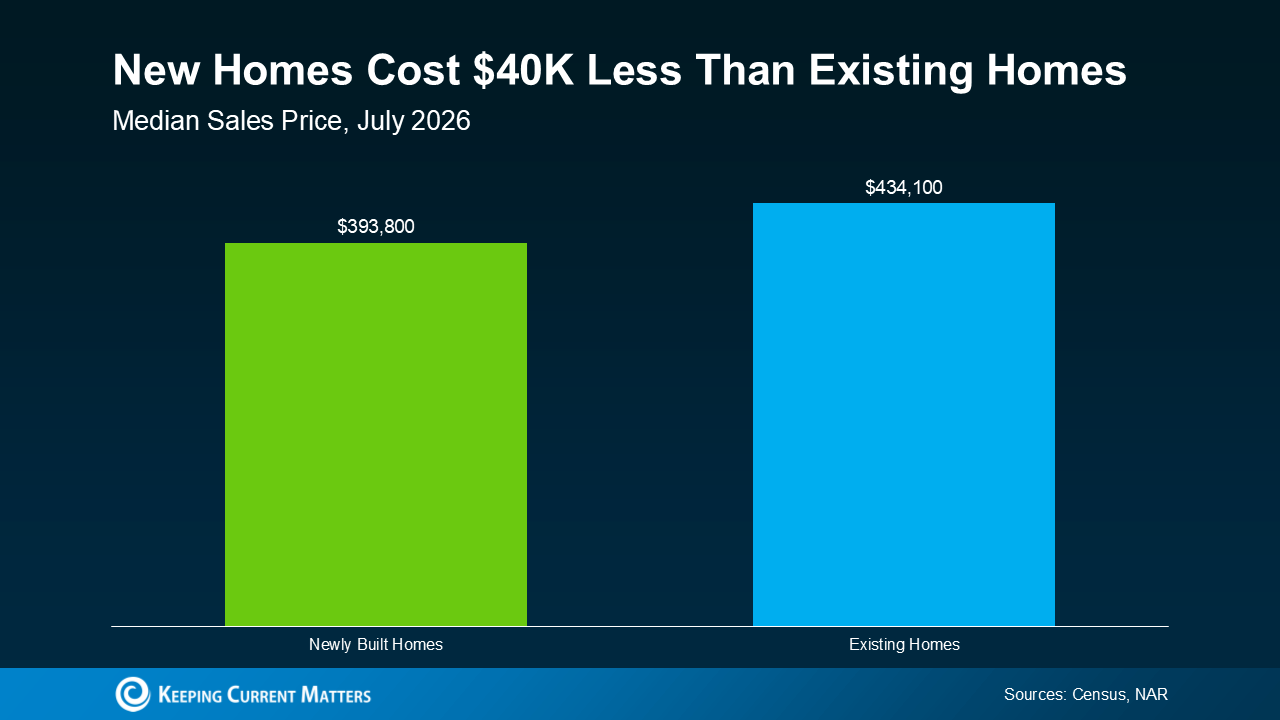
The latest national median-sales-price data shows newly built homes about $40,000 below existing homes, while many builders are also using price cuts and incentives to move inventory.
First, Why Builders Play a Different Game Than Homeowners Do.
A homeowner selling one house can afford to wait for the right offer. It is one property, usually one they still live in, and there is no clock running underneath it beyond their own patience.
A builder does not have that luxury.
Every vacant home sitting unsold on a builder's books is a cost, not a waiting game — construction financing, insurance, taxes, a sales team standing in an empty model home every day it does not close. That pressure does not exist for your neighbor selling their house down the street. It exists for the builder, every single day, on every unsold unit.
That difference in pressure is exactly why builders are pricing the way they are right now. It is also why I would compare a builder's offer with the negotiating leverage in your local housing market instead of assuming one side automatically has the better deal.
Here Is What the Data Is Showing Right Now.
According to the latest U.S. Census Bureau new-home sales data and National Association of Realtors existing-home data, newly built homes are currently running about $40,000 less than existing homes.
Read that twice. The assumption most people walk in with — new costs more — is currently backwards in the latest national median data.
And it is not just the sticker price. The National Association of Home Builders reports that 35% of builders cut prices in August, by an average of 6%. Sixty-three percent were using sales incentives on top of that — which can include closing-cost help or a mortgage rate buydown.
Add in the warranty that comes standard on many new homes and the maintenance costs you may not be paying in year one that you could face on a resale, and the real gap between "new" and "existing" can be wider than listing prices alone suggest. Just remember that your full monthly housing payment still needs to include taxes and insurance, not just principal and interest.
What the Headlines Always Leave Out.
Here is the part nobody puts on the sign out front of that model home.
The person sitting behind that beautiful desk works for the builder. Their paycheck depends on the builder's bottom line, not yours. That does not make them dishonest — it makes them exactly what their job title says: the builder's representative, not yours.
That is not a reason to skip new construction. It is a reason to never walk into one without understanding who represents you, what the builder is offering, and how the total deal compares with other homes nearby.
What This Means For Your Plan.
If new construction is on your list:
Do not rule it out on price before you actually run the numbers. If the gap and the incentives are real in your market, that $40,000-plus is not found money to spend on upgrades. It is down payment fuel.
Under Rule 6 in our system, 10% down is good, 20% is better because it can eliminate conventional PMI when the loan structure supports it. A price cut or a builder-paid rate buydown can be the difference between scraping together the minimum and walking in with a stronger down payment. If you want to understand the tradeoff, review how down payment and private mortgage insurance can affect a conventional loan.
Under Rule 8, keep your DTI at 35% or below as a household planning target. A lower purchase price, or a rate bought down before you even apply, can pull that number down without your income changing at all. Use the DTI calculator to see what the payment does to your front-end and back-end ratios.
If you're about to visit a model home:
Bring your own agent before you sign anything, not after you have already fallen for the layout. Buyer-agent compensation and builder policies can vary, so confirm in writing who pays what before you tour or sign an agreement.
Your agent's job is to compare the builder's price and upgrades against comparable homes nearby, negotiate the price, the upgrades, or the rate buydown, and push for an independent inspection, even on new construction. New does not mean flawless. The same principle behind finding the best deal possible on a home applies here: negotiate the whole transaction, not just the sticker price.
New build or resale? Put both offers on the same page.
Compare purchase price, builder or seller credits, rate buydowns, upgrades, taxes, insurance, HOA costs, down payment, DTI, reserves, and the monthly payment you actually want to live with after closing.
Talk With PatThe Question You Should Be Asking Together Right Now.
Not, does a new home cost more than an existing one.
The real question is: in our market, right now, what is a comparable new build actually priced at, incentives included, against the resale we've been looking at — and who is in the room representing us if we walk through that door?
My wife and I have watched builders and resale sellers compete for the same buyer in 34 years of marriage and real estate. The couples who came out ahead were never the ones who assumed they already knew which side had the better deal. They were the ones who made both sides prove it, with their own agent doing the math.
Call a local agent — one who works for you, not the builder — before you walk into that next model home. Then have the conversation with your spouse about what a $40,000 difference actually does to your down payment.
Pat Collins
Financial Coach | Mortgage Professional | Realtor
34 Years of Marriage and Real Estate — I have been on both sides of every table.
Educational disclosure: This article is for general educational purposes and is not individualized mortgage, financial, legal, tax, insurance, credit, investment, inspection, construction, appraisal, or real estate advice. National median sales prices do not mean a new home will cost less than a comparable existing home in every local market. Builder incentives, price reductions, warranties, upgrades, rate buydowns, closing-cost contributions, buyer-agent compensation, representation agreements, inspection rights, mortgage-insurance requirements, qualification standards, and loan pricing vary by builder, property, loan program, market, and individual circumstances. Confirm all builder incentives, compensation arrangements, contract terms, and financing details in writing with the appropriate licensed professionals before relying on them.
Reference sources: Keeping Current Matters — “Think New Homes Cost More? Not Right Now.”, September 2, 2026; U.S. Census Bureau — New Residential Sales historical data; National Association of Realtors — Existing-Home Sales; and NAHB Eye on Housing — August 2026 builder price cuts and incentives.