Author: Patrick Collins

  • The Top 2 Things Homeowners Need To Know Before Selling

    The Top 2 Things Homeowners Need To Know Before Selling

    The Top 2 Things Homeowners Need To Know Before Selling | Let’s Talk Home Mortgage

    The Top 2 Things Homeowners Need To Know Before Selling.

    The sale is often decided before the first showing. Your opening price shapes buyer attention, and your expectations determine whether you respond strategically or emotionally when the market gives you feedback.

    The seller’s
    two-part plan

    Start with clarity. Respond to the market with discipline.

    Homeowners often begin the selling process by asking one question: “How much can I get?” That is understandable. Your equity may fund the next home, retirement, debt reduction, an investment, or the next chapter of your life.

    But the strongest sale does not begin with the highest possible number.

    It begins with two decisions:

    Price the home correctly from the beginning.
    Give the market enough time to respond.

    These sound simple. They are also where many sellers get into trouble.

    The key takeaway

    You control the preparation, the pricing strategy, the presentation, and how you respond to feedback. You do not control what buyers are willing and able to pay.

    Before you list, separate your goals from the market value.

    You may need a certain amount of money to buy your next home. You may have invested heavily in improvements. A neighbor may have sold for more. An online estimate may show an exciting number.

    All of that is useful context.

    None of it independently determines what a buyer will pay for your property today.

    Market value is influenced by recent comparable sales, current competing listings, condition, location, lot, floor plan, upgrades, buyer demand, financing conditions, insurance costs, property taxes, and the number of realistic alternatives available to buyers.

    “The market does not know what you paid, what you spent, or what you need next. It responds to the value buyers see today.”

    Pat Collins
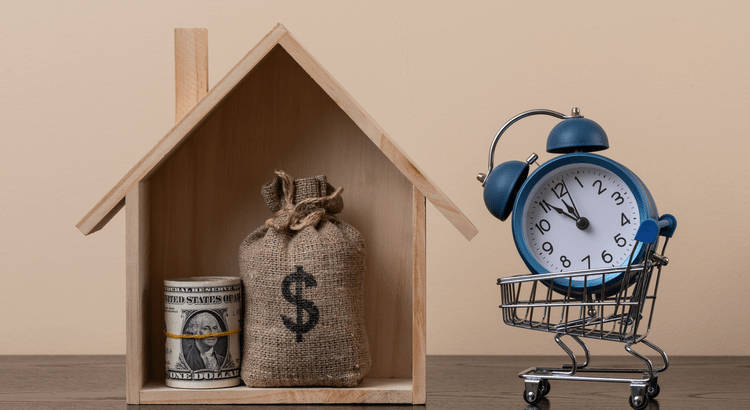
    Wooden house, money, and clock representing home value, pricing, and timing when selling
    A successful sale requires both value and timing: a price buyers understand and enough time for the right buyer to act.

    Number 1: Price it right from day one.

    The first days on the market are valuable.

    Your listing is new. Buyers receive alerts. Agents notice it. People who have been waiting for a home like yours may schedule showings quickly.

    That attention is strongest when the price makes sense.

    When the home is priced too high, buyers may not schedule a showing. They may compare it with better-equipped homes at the same price. They may wait for a reduction. Or they may assume the seller is not realistic and move on.

    Strategic pricing

    Creates a reason to act

    The home appears competitive beside recent sales and current alternatives, which can increase showings, interest, and useful buyer feedback.

    Overpricing

    Can waste the launch period

    The listing may sit while buyers choose other properties. Later reductions can help, but they cannot recreate the original first impression.

    Pricing high “to leave room” can create the opposite result

    Some sellers believe they should begin above market value because buyers will negotiate.

    Sometimes that works.

    But it can also reduce the number of people who see the home. Buyers search within price ranges. A property listed above its competitive range may appear beside homes with larger lots, newer renovations, better locations, or additional bedrooms.

    Instead of creating negotiating room, the higher price may create a weaker comparison.

    A buyer cannot negotiate on a home they never decide to visit.

    Online estimates are a starting point—not a pricing plan

    Automated estimates cannot fully evaluate the condition of your kitchen, the quality of a renovation, deferred maintenance, the view, the street, the floor plan, unpermitted work, or how buyers are responding to nearby listings this week.

    A thoughtful pricing analysis should include:

    • Recent closed sales that are genuinely comparable.
    • Active listings buyers will compare with your home.
    • Pending sales that show what is attracting offers.
    • Expired, canceled, or withdrawn listings that reveal what did not work.
    • Price reductions and days on market in your area.
    • Your home’s condition, improvements, location, and unique features.
    Important

    The best opening price is not designed to make the seller feel good for one day. It is designed to create the strongest possible buyer response.

    The market gives feedback. Read it early.

    Once the home is listed, buyer behavior becomes data.

    High online activity but very few showings may indicate the price or presentation is not strong enough to move buyers from interest to action.

    Showings without offers may point to condition, layout, location, price, or a mismatch between the photos and the in-person experience.

    Very little online engagement may mean the home is not reaching the right audience, the marketing needs work, or the price is outside the range buyers are searching.

    One comment does not determine value. Patterns matter.

    Your agent should help you review showing activity, online engagement, buyer feedback, competing listings, new sales, price changes, and any shifts in the local market.

    A price adjustment is not automatically a failure. It can be a strategic response to new information.

    The mistake is waiting so long that the listing becomes stale while competing homes continue to sell.

    Number 2: Give the selling process enough time.

    Many homeowners still compare every market with the unusually fast conditions of 2020 and 2021.

    Those years trained sellers to expect immediate showings, multiple offers, waived protections, and contracts within a few days.

    That is not the normal standard for every market.

    In a more balanced environment, buyers may take longer to compare properties, calculate the payment, review insurance costs, study the neighborhood, and decide whether the home fits their lives.

    That can be healthy.

    A home that does not sell during the first weekend is not automatically a failed listing.

    Useful patience

    Lets the plan work

    The home is properly priced and marketed, showings are occurring, feedback is being reviewed, and the seller is making measured decisions.

    Costly delay

    Ignores clear market signals

    Activity is weak, buyers consistently reject the value, competing homes sell, and no adjustment is made because the seller is waiting for one special buyer.

    Patience does not mean doing nothing

    Giving the market time means following a plan—not leaving the listing untouched indefinitely.

    Your agent should establish checkpoints before the home is listed:

    • When will you review online activity and showing volume?
    • How will buyer and agent feedback be evaluated?
    • What competing listings will be monitored?
    • What conditions would support a price or presentation change?
    • How will your timeline affect future decisions?

    This keeps you from reacting emotionally to one quiet weekend or ignoring several weeks of consistent feedback.

    Your carrying costs belong in the pricing conversation

    Every additional month may include mortgage payments, property taxes, insurance, utilities, maintenance, homeowners association dues, and the cost of delaying your next move.

    Holding out for a higher price can be reasonable when the data supports it.

    Holding out for an additional amount that is smaller than the cost and risk of waiting may not be.

    Plan the sale and the next purchase together

    Know what you need from the sale before you choose the list price.

    I can help you think through estimated proceeds, the next-home payment, available financing strategies, and the timing between selling and buying.

    Talk With Pat

    Use this seller action plan before the listing goes live.

    Calculate the estimated net proceeds

    Review the likely selling price, mortgage payoff, commissions, closing costs, repairs, credits, taxes, moving expenses, and cash needed for the next step.

    Study the real competition

    Compare your home with recent sales and the properties buyers can choose today—not only the highest sale in the neighborhood.

    Complete the highest-impact preparation

    Address cleanliness, clutter, lighting, curb appeal, minor repairs, staging, photography, and anything that could distract buyers from the home’s value.

    Choose the opening price strategically

    Use the local market, buyer search ranges, condition, competition, and your timeline to create a price that attracts serious attention.

    Create review checkpoints

    Decide in advance when activity, feedback, price, presentation, and strategy will be evaluated so you do not react from fear or frustration.

    Prepare the next-home financing plan

    Understand whether you must sell first, how much equity may be available, what payment is comfortable, and how temporary housing or overlapping ownership could affect you.

    Price and timing work together

    A well-priced home can still require patience.

    A home given plenty of time can still fail when the price is disconnected from the market.

    That is why these two lessons cannot be separated.

    Price determines whether buyers see the value.

    Time gives the right buyers an opportunity to act.

    Bottom line

    Before you sell, remember two things.

    Price the home for the market you have—not the market you remember or the number you hope to receive.

    Give the process enough time—but stay willing to respond when the market gives you consistent feedback.

    The listings that struggle are not always bad homes.

    Many are simply launched with the wrong price, the wrong expectations, or no clear plan for what happens when buyers respond differently than the seller expected.

    Start with facts. Prepare the property. Understand your proceeds. Set review points. Then work the plan.

    A successful sale is not about guessing the perfect day. It is about making disciplined decisions from the first day.

    Educational disclosure: This article is for general educational purposes and is not individualized mortgage, financial, tax, legal, real estate, appraisal, inspection, insurance, or contracting advice. It is not a guarantee of property value, marketability, selling price, timing, proceeds, financing approval, or transaction results. Real estate conditions vary by property and local market. Consult qualified professionals regarding your sale and future purchase.

    Article link copied.
    Wooden house structure holding a money bag and rolled cash next to a small shopping cart with a blue alarm clock, symbolizing home value and timing in real estate.

    Price It Right from Day One

    Before you sell your home, there’s one truth you should hold onto: the homeowners who succeed in today’s market aren’t the ones waiting for “the perfect moment.” They’re the ones who start with clarity, realistic expectations, and a plan that fits the real world not the highlight reels on social media.

    This year, a lot of homeowners walked away disappointed. Not because the market was broken… but because their expectations were.

    Realtor.com reports that 57% more homes were taken off the market compared to last year. These were homes that listed… but didn’t sell.

    And in most cases, it came down to two things:
    price and timing.

    The good news?
    When you understand these early, you step into the selling process feeling calmer, more confident, and more in control instead of stressed or blindsided later.

    Here are the top two lessons you can learn from the sellers who struggled this year.

    Let’s talk about pricing, the part most sellers wrestle with.

    Today, 8 in 10 sellers expect to get their asking price or more.
    But the reality is different.

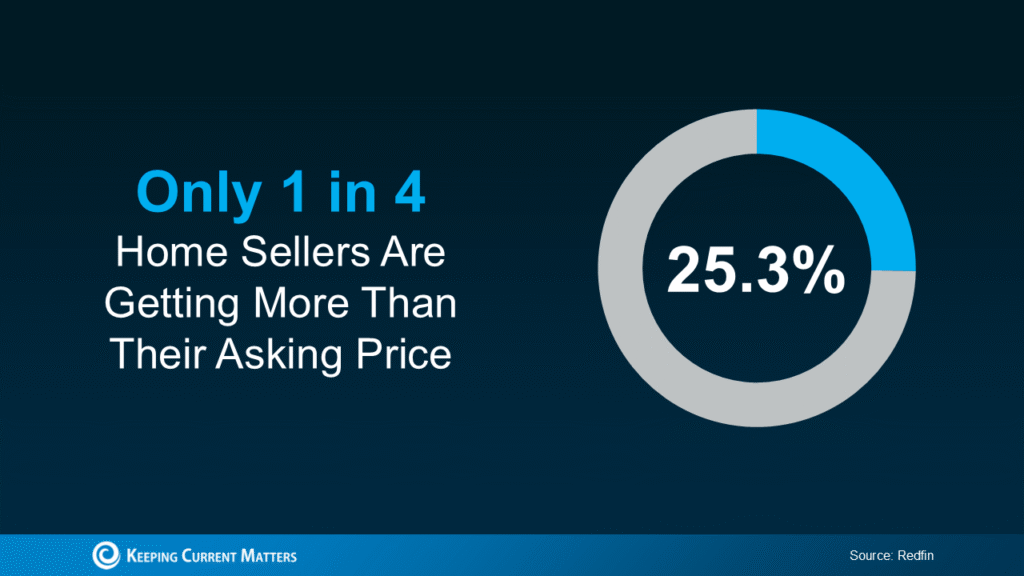
    Doughnut chart showing that only 25.3% of home sellers are receiving more than their asking price.

    Redfin shows that only 1 in 4 (25.3%) sellers actually end up selling for above list price.

    So where’s the gap?

    A few years ago, you could set almost any number and buyers would rush in. Homes were selling in hours, and bidding wars were the norm. Today, buyers have options more than they’ve had in years which means they can be selective.

    If your price feels even a little too high, buyers scroll right past it.

    That’s exactly what happened to many homeowners this year. Instead of making a small, strategic price adjustment, they pulled their listings entirely and missed out on real opportunities.

    Here’s the part most sellers never hear:

    According to HousingWire, the average price cut right now is just 4%.

    That’s it. Four percent is often the difference between “no activity” and “multiple showings.”

    If those sellers had priced strategically from the start or made a simple adjustment sooner they likely would’ve sold.

    And here’s the part that brings the pressure down. If you’ve built equity over the years, you can price competitively and still come out ahead financially.

    Before listing, work with a trusted real estate agent to analyze comparable homes in your area. Together, you can find a price that’s competitive, realistic, and aligned with your goals.

    Don’t Rush the Process — Selling Takes Time

    Another common mistake is expecting your home to sell in a weekend.

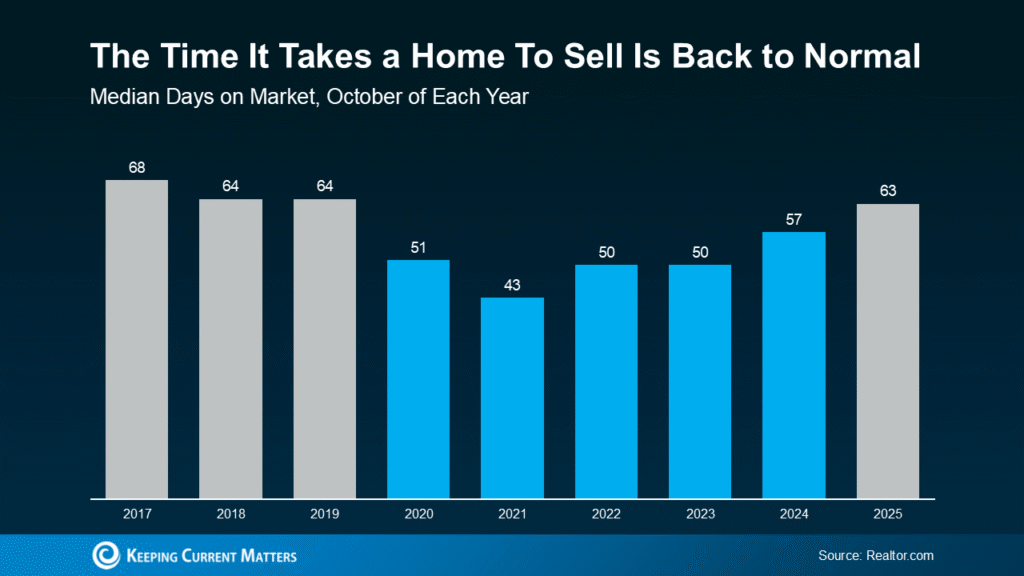
    Many sellers are still comparing today’s market to the lightning-fast pace of 2020 and 2021. But those days were the exception, not the rule.

    Bar chart showing median days on market for homes from 2017 to 2025, illustrating that home selling timelines are returning to normal.

    Right now, the average timeline is closer to 60 days from listed to sold.
    And that’s normal.

    Think of it like going from highway speed to neighborhood speed.
    You’re not going slow you’re going the right speed for where you are.

    Today’s buyers are more intentional. They’re slowing down, comparing homes, and making thoughtful decisions. This is actually healthier for the market, and for you.

    So if you’re planning to sell:

    • Don’t panic if your home doesn’t go under contract the first weekend.

    • Don’t assume something’s wrong if you don’t get an immediate offer.

    • Don’t rush the process and sabotage your own results.

    If you want your home to stand out, talk with your agent about strategic upgrades staging, photography, minor fixes, or value-driven pricing. Small improvements can create big momentum.

    With the right preparation and the right expectations, your home can still sell quickly.

    Bottom Line

    If you’re thinking about selling, don’t let fear shape your decisions let clarity guide them.

    The listings that struggled this year weren’t doomed…
    they were simply misaligned.

    You can still win in this market if you price with intention, stay patient, and work with an agent who understands what buyers are responding to right now.

    Success isn’t about waiting for the market to change.
    It’s about starting the process with the right plan and the right expectations from day one.

  • More Time to Buy a Home

    More Time to Buy a Home

    More Time to Buy a Home: Why Today’s Slower Market Helps Buyers | Let’s Talk Home Mortgage

    More Time to Buy a Home. More Room to Make a Smart Decision.

    Homes are not flying off the market the way they did during the pandemic frenzy. For buyers, that slower pace can mean more time to compare, inspect, negotiate, and buy with confidence.

    If the speed of the housing market made you step back a few years ago, take another look. Buyers now have something that was almost impossible to find during the pandemic housing rush: time.

    Time to tour a home more than once. Time to compare it with other listings. Time to read the disclosures, complete inspections, review the payment, and decide whether the house actually fits your life.

    That does not mean every home will sit on the market or every seller will accept a discount. Well-priced homes in desirable neighborhoods can still move quickly. But the national pace is much closer to normal, and that can create a healthier decision-making environment for prepared buyers.

    The key takeaway

    A slower market gives you breathing room—not permission to become unprepared. The buyers who benefit most are financially ready before the right home appears.

    The market has shifted back toward a more normal pace

    According to Realtor.com’s June 2026 housing report, the typical home spent 53 days on the market. That matched June of the previous year and was also in line with the pre-pandemic norm.

    The same report showed more than 1.1 million active listings nationwide, while the median listing price was down 2.5% from a year earlier. Those numbers do not automatically make every city a buyer’s market. But they do show that buyers generally have more inventory and less pressure than they faced at the market’s peak.

    53 Median days on market Same as June 2025
    1.1M+ Active listings nationwide Approximately 1,102,615 listings
    -2.5% Annual change in median list price June 2026 versus June 2025

    The goal is not to move slowly. The goal is to use the available time to move intelligently.

    Pat Collins

    During the fastest part of the pandemic market, some buyers had hours—not days—to decide. They waived protections, stretched budgets, and made offers based on fear of missing out. Today’s pace gives more buyers a chance to replace emotion with information.

    What more time can mean for you

    Extra days on the market can improve the buying process in several practical ways.

    1. You can compare the house—not just react to it

    When homes sell immediately, buyers start treating every listing like it is the last available house. A slower pace allows you to compare price, condition, location, taxes, insurance, commute, schools, maintenance, and resale potential.

    2. You can complete real due diligence

    An inspection is not just a formality. It can reveal roof, plumbing, electrical, foundation, drainage, HVAC, moisture, and safety issues. More time gives you room to understand the report, gather estimates, and decide which problems are acceptable.

    3. You can review the complete monthly cost

    The mortgage payment is only one part of ownership. Property taxes, homeowners insurance, mortgage insurance, HOA dues, utilities, repairs, and maintenance all affect affordability. A little breathing room makes it easier to evaluate the entire payment instead of focusing only on the purchase price.

    4. You can make a decision without letting fear make it for you

    Urgency and panic are not the same thing. You should still respond quickly when the right opportunity appears. But a good decision should be based on your numbers, your priorities, and the condition of the home—not simply on what another buyer might do.

    A couple reviewing homebuying information together
    More time can help buyers compare options, review the numbers, and make a decision together.

    A slower pace can create leverage—but not automatically

    The longer a property sits, the more likely a seller may become open to a reasonable conversation. Depending on the home and local market, that conversation could include:

    Fast market

    React first

    Limited time, fewer comparisons, multiple offers, reduced negotiating room, and more pressure to waive protections.

    Slower market

    Evaluate first

    More time for inspections, payment analysis, seller conversations, and an offer based on facts instead of panic.

    But leverage depends on the listing. A house that is new to the market, priced correctly, and located in a highly desirable area may still attract multiple offers. A home that has been listed for several weeks, needs repairs, or has already reduced its price may give you more room.

    This is where strategy matters. The question is not, “Can I ask for something?” You can always ask. The better question is, “What request is supported by the condition of the home, comparable sales, days on market, and the seller’s situation?”

    Your local market sets the real clock

    National numbers are useful, but they are averages. They combine fast-moving markets, slower markets, starter homes, luxury properties, condos, rural areas, and major cities.

    Realtor.com reported that homes in the hottest June 2026 markets sold in a median of about 31 days—more than three weeks faster than the national norm. That is a reminder that your city, price range, and neighborhood may move very differently from the national headline.

    Even within one county, the pace may change block by block. A turnkey starter home near good schools may sell quickly. A larger home at a higher price point may sit longer. A condo with a high HOA payment may face different demand than a detached home nearby.

    Local strategy

    Before writing an offer, ask how long comparable homes are taking to sell, how often sellers are reducing prices, and what concessions are actually being accepted.

    How to use the extra time wisely

    More time becomes an advantage only when you have a plan. Here is the order I recommend:

    Get fully preapproved before shopping seriously

    Know your loan options, estimated cash needed, and comfortable monthly payment before emotion enters the picture.

    Set your payment ceiling—not just your price ceiling

    Interest rate, taxes, insurance, HOA dues, and mortgage insurance can make two similarly priced homes feel very different each month.

    Study the local pace

    Review days on market, price reductions, comparable sales, and recent seller concessions in the exact area and price range you are targeting.

    Inspect the home and investigate the neighborhood

    Use the available time to understand the property, future maintenance, insurance considerations, traffic, noise, commute, and nearby development.

    Negotiate from evidence

    Build the offer around market data and the home’s condition. A fair, well-supported request is stronger than an aggressive number with no explanation.

    Do not confuse having more time with having unlimited time. The best homes can still move quickly. Preparation lets you act promptly without feeling rushed because the important financial decisions were made before you found the house.

    Know your numbers first

    Let’s build your homebuying plan before the right house appears.

    We can review your payment range, cash needed, debt-to-income ratio, and loan options so you know when to move quickly—and when to walk away.

    Talk With Pat

    Bottom line

    Buyers finally have more breathing room than they did during the housing frenzy. Homes are taking longer to sell, inventory is more available, and some sellers are more willing to negotiate.

    That does not mean you should wait forever or assume every seller is desperate. It means you may have a better opportunity to slow down just enough to inspect the home, understand the payment, negotiate intelligently, and make a decision you can live with.

    More time does not guarantee the perfect deal. But used correctly, it can help you make a better one.

    Sources: Realtor.com, “June 2026 Monthly Housing Market Trends Report” and “June 2026 Hottest Housing Markets.” National figures are educational and may not represent conditions in your city or neighborhood.

    This article is for educational purposes only and is not a commitment to lend. Loan qualification, available programs, rates, payments, and terms depend on the borrower’s complete financial profile, property, credit, income, assets, and underwriting approval. Programs and market conditions may change without notice.
    Article link copied

    If you’ve been waiting for the right moment, here it is: buyers finally have more time to buy a home. Unlike the frenzy of a few years ago—when houses sold within hours—today’s slower pace gives you breathing room. That means extra time to compare options, negotiate terms, and make confident decisions instead of rushing into a purchase.

    You Have More Time to Buy

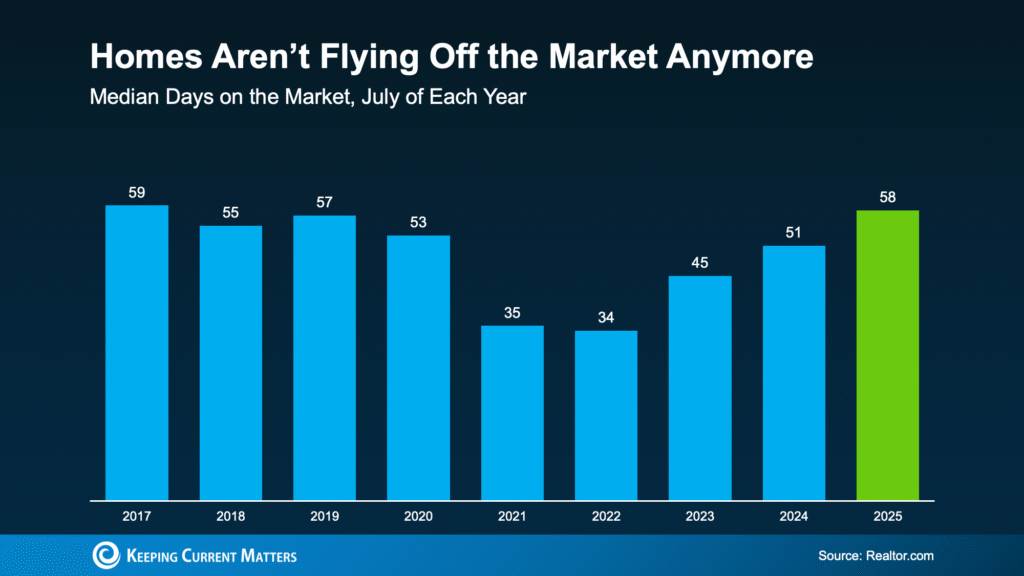
    According to the latest data, homes are spending an average of 58 days on the market. That’s much more normal. And it’s a big improvement compared to the height of the pandemic, when homes were flying off the shelves in a matter of days (see graph below):

    Alt text: Graph showing homes taking longer to sell, giving buyers more time to buy a home in 2025.

    That means you now have more time to make decisions than you have at any point in the past five years. And that’s a big deal. Now, you’ve got:

    Time to think.

    Time to negotiate.

    Time to make a smart move without all the pressure.

    More Time to Buy, Means Less Stress (and More Leverage)

    Based on the data in the graph above, you have an extra week to decide compared to last year. And nearly double the time you would have had at the market’s peak.

    Back then, fear of missing out drove buyers to act fast, sometimes too fast. Today, the pace is slower, which means you’re in control. As Bankrate puts it:

    “For years, buyers have been racing to snag homes because of the fierce competition. But the market’s cooled off a bit now, and that gives buyers some breathing room. Homes are staying listed longer, so buyers can slow down, weigh their options and make more confident decisions.”

    With more homes on the market and fewer buyers, you have more time to buy a home and not having to race to grab them, the balance has shifted. Bidding wars aren’t as common, and that means you may have room to negotiate. And you can actually take a breath before you make your decision.

    More listings + a slower pace = less stress and more opportunity

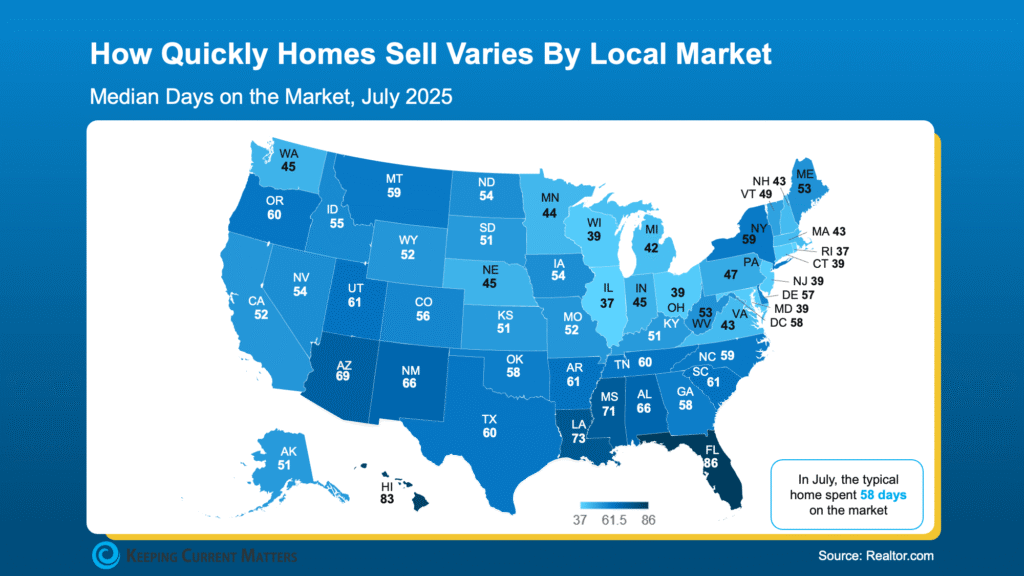
    But, and this is important, it still depends on where you’re buying. Nationally, homes are moving slower. But your local market sets your real pace. Some states are moving faster than others. It may even vary down to the specific zip code or neighborhood you’re looking at. And that’s why working with an agent to know what’s happening in your area is more important than ever. 

    To see how your state compares to the national average (58 days), check out the map below:

    Map of U.S. showing median days on market by state, highlighting more time to buy a home in most areas.

    As Realtor.com explains:

    While national headlines might suggest a buyer’s market is taking hold, the reality on the ground depends heavily on where and what you’re trying to buy. Local trends can diverge sharply from national averages, especially when you factor in price range, property type, and post-pandemic market dynamics.”

    A smart local agent can tell you exactly when to move fast and when you can take your time, so you never miss the right home for you.

    Bottom Line

    If the chaos of the past few years drove you to hit pause, this is your green light. The market’s pace has shifted. You have more time. More options. More power.

    And with the right agent guiding you, you’re in the best position you’ve been in for years.

    Connect with a local agent to talk about what the pace looks like in your area, and if now could be the right time for you to re-enter the market.

  • Buy Now or Wait? The Real Tradeoff With Mortgage Rates.

    Buy Now or Wait? The Real Tradeoff With Mortgage Rates.

    Buy Now or Wait? The Real Tradeoff With Mortgage Rates | Let’s Talk Home Mortgage

    Buy Now or Wait? The Real Tradeoff With Mortgage Rates.

    Waiting for a lower rate may reduce the payment. Buying sooner may offer more choices, less competition, and stronger negotiating power. The smartest answer depends on the entire tradeoff—not one number.

    “Should I buy now or wait for mortgage rates to come down?” sounds like a rate question. It is actually a decision about rates, home prices, competition, negotiating power, timing, and your personal finances.

    A lower mortgage rate can absolutely improve affordability. But waiting for that rate may also mean shopping in a different market—with more buyers, fewer seller concessions, and possibly higher home prices.

    That is the tradeoff. You are not deciding between today’s rate and tomorrow’s rate in a vacuum. You are deciding between today’s entire opportunity and whatever the market looks like later.

    The key takeaway

    Do not ask only, “Will rates fall?” Ask, “Will waiting improve my complete financial position enough to justify the risks and costs of waiting?”

    The real question is not whether rates will move

    Mortgage rates move constantly. They can rise or fall after inflation reports, employment data, Federal Reserve expectations, Treasury-market changes, and other economic news.

    The problem is that no one can consistently identify the lowest rate in advance. You usually recognize the bottom only after rates have already moved away from it.

    So the goal is not to perfectly time the mortgage market. The goal is to buy when the home, payment, cash requirement, and timing work for you—and when the risks are understood.

    You can refinance a mortgage rate later. You cannot refinance the price you paid for the home.

    Pat Collins

    That does not mean you should buy a house you cannot comfortably afford. It means the interest rate is one part of the decision, not the entire decision.

    Where mortgage rates are today—and what the forecast shows

    Freddie Mac reported that the average 30-year fixed mortgage rate was 6.55% for the week ending July 16, 2026. That was up from 6.49% one week earlier but below the 6.75% average from the same week a year ago.

    Fannie Mae’s July 2026 housing forecast projects the 30-year fixed rate to average approximately 6.4% during the third and fourth quarters of 2026. Forecasts can change, but the current outlook does not assume an immediate or dramatic collapse in rates.

    6.55% Current 30-year fixed average Freddie Mac, July 16, 2026
    6.4% Fannie Mae forecast for late 2026 Quarterly average forecast
    5.5M More households potentially qualified at 6% NAR estimate versus rates near 7%

    The National Association of REALTORS® has estimated that a decline from roughly 7% to 6% could allow about 5.5 million additional households to qualify for a mortgage, including approximately 1.6 million renters. NAR estimated that roughly 550,000 of those newly qualified households could enter the market within 12 to 18 months.

    That is important because the same rate improvement that helps your payment may also help hundreds of thousands of competing buyers.

    What waiting for a lower rate may save

    Let’s use a simplified example with a $400,000 loan and a 30-year fixed mortgage. Principal and interest at 6.55% is approximately $2,541 per month. At 6.00%, it is approximately $2,398 per month.

    Buy at 6.55%

    About $2,541

    Estimated monthly principal and interest on a $400,000, 30-year fixed-rate loan.

    Wait for 6.00%

    About $2,398

    Approximately $143 less per month if the loan amount and all other assumptions remain unchanged.

    A $143 monthly reduction is meaningful. It can improve qualification, cash flow, and comfort. But the phrase “all other assumptions remain unchanged” is doing a lot of work.

    While you wait, the price of the home, loan amount, available inventory, seller concessions, rent payments, and competition may all change.

    Payment example

    If the loan amount increased by 3% to $412,000 while the rate fell to 6.00%, principal and interest would be about $2,470—not $2,398. The payment advantage compared with buying at 6.55% would shrink to roughly $71 per month.

    This example is not a prediction that prices will rise 3%. It simply shows why the rate should never be analyzed without the future purchase price and loan amount.

    What waiting may cost

    More buyers may qualify at the same time

    When rates improve, buyers who were previously priced out can return. Buyers who were waiting on the sidelines may also decide that the moment has arrived. That can increase showings, offers, and competition.

    You may lose seller concessions

    In a slower market, a seller may be more willing to pay closing costs, fund a temporary rate buydown, make repairs, or accept a lower price. When demand increases, those concessions can become harder to obtain.

    The home price may change

    A lower rate does not guarantee a lower payment if the future home costs more. Even modest price growth can offset part of the rate savings.

    You continue paying for your current housing

    Waiting may mean additional rent or remaining in a home that no longer fits your needs. Rent is not “wasted,” because it provides housing, but it should still be included in the cost of delaying the purchase.

    Your personal situation may change

    Employment, income, debt, credit, savings, family needs, and property availability can all change. A future rate may be better while your future qualification is not.

    A prospective homebuyer reviewing information while deciding whether to buy now or wait
    The right time to buy is based on your full financial picture—not one mortgage-rate headline.

    When buying now may make sense—and when waiting may be smarter

    Buying now may fit

    You are financially ready

    You have stable income, adequate reserves, a comfortable payment, and you expect to remain in the home long enough for ownership to make sense.

    Waiting may fit

    Your foundation needs work

    You need to reduce high monthly debt, improve credit, build emergency savings, stabilize income, or clarify where you want to live.

    Buying now can be reasonable when the payment is affordable today—not only after a hoped-for refinance. A future refinance should be treated as a potential benefit, not the plan required to survive the payment.

    Waiting can be the right decision when it meaningfully improves your finances. Paying off a car loan, reducing credit-card minimums, increasing reserves, or correcting credit issues may improve your buying power more than a small rate decline.

    Waiting only because you are trying to predict the exact bottom in rates is different. That is market timing, and market timing comes with risks.

    Build your decision plan before choosing

    Calculate the payment you can comfortably afford today

    Include principal, interest, property taxes, homeowners insurance, mortgage insurance, HOA dues, utilities, and a realistic maintenance allowance.

    Compare at least three scenarios

    Run today’s rate and price, a lower-rate scenario with the same price, and a lower-rate scenario with a higher purchase price.

    Measure local competition and seller flexibility

    Review days on market, price reductions, multiple-offer activity, and the concessions sellers are currently accepting in your target area.

    Identify what waiting will accomplish

    Put a measurable goal behind the delay: eliminate a payment, save a specific amount, improve credit, or stabilize employment. “I hope rates fall” is not a complete plan.

    Stress-test the decision

    Make sure buying still works if rates do not fall soon, the home needs repairs, or your monthly expenses increase. A good purchase should leave room for real life.

    Compare the complete tradeoff

    Let’s run your “buy now versus wait” numbers side by side.

    We can compare payments, cash needed, debt-to-income ratio, possible seller concessions, and realistic future-rate scenarios so you can make the decision with facts.

    Talk With Pat

    Bottom line

    Waiting for lower mortgage rates may produce a lower payment. But it may also bring more competition, fewer concessions, and a higher purchase price. Buying now may offer negotiating advantages, but only when the payment is comfortable and your finances are ready.

    There is no universal answer. The right answer comes from comparing the complete cost of buying today with the complete cost—and uncertainty—of waiting.

    Do not buy because you fear missing out. Do not wait because you expect a perfect rate. Build a plan that works under today’s conditions, understand what could change, and act when the numbers support your life.

    Sources: Freddie Mac Primary Mortgage Market Survey, Fannie Mae July 2026 Housing Forecast, and National Association of REALTORS® affordability analysis. Payment examples are rounded estimates of principal and interest only and exclude taxes, insurance, mortgage insurance, HOA dues, points, closing costs, and other expenses.

    Freddie Mac’s published rate is a national survey average and is not an advertised or guaranteed rate. This article is for educational purposes only and is not a commitment to lend. Qualification, available programs, rates, payments, and terms depend on the borrower’s complete financial profile, property, credit, income, assets, and underwriting approval. Forecasts and market conditions may change without notice.
    Article link copied
    Buy Now or Wait - Senior homeowner sitting on a porch swing reading a tablet, representing lifestyle benefits of homeownership

    “Should I buy now or wait for mortgage rates to drop?”

    One of the biggest questions buyers are asking me right now

    Let’s look at the facts and the tradeoffs of buying now or waiting.  What you need to consider.

    Well, let’s break it down…

    Where are Mortgage Rates Today, if You were to Buy Now

    After the latest jobs report came in weaker than expected, the bond market reacted quickly — and rates dropped to 6.55%, the lowest so far this year.

    That dip has many people wondering: “Is now a good time to buy a house 2025, or should I wait for mortgage rates to fall further?”

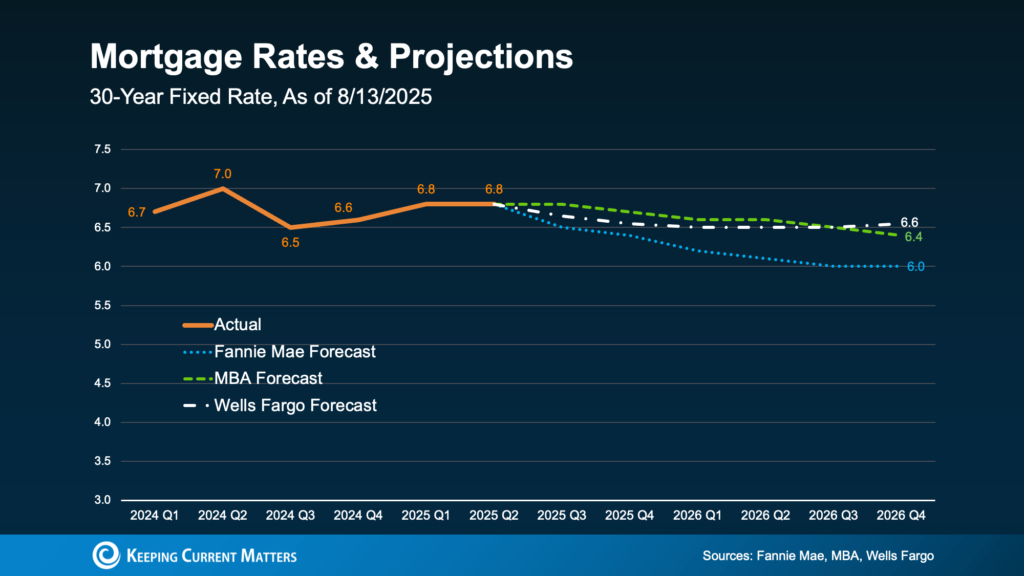
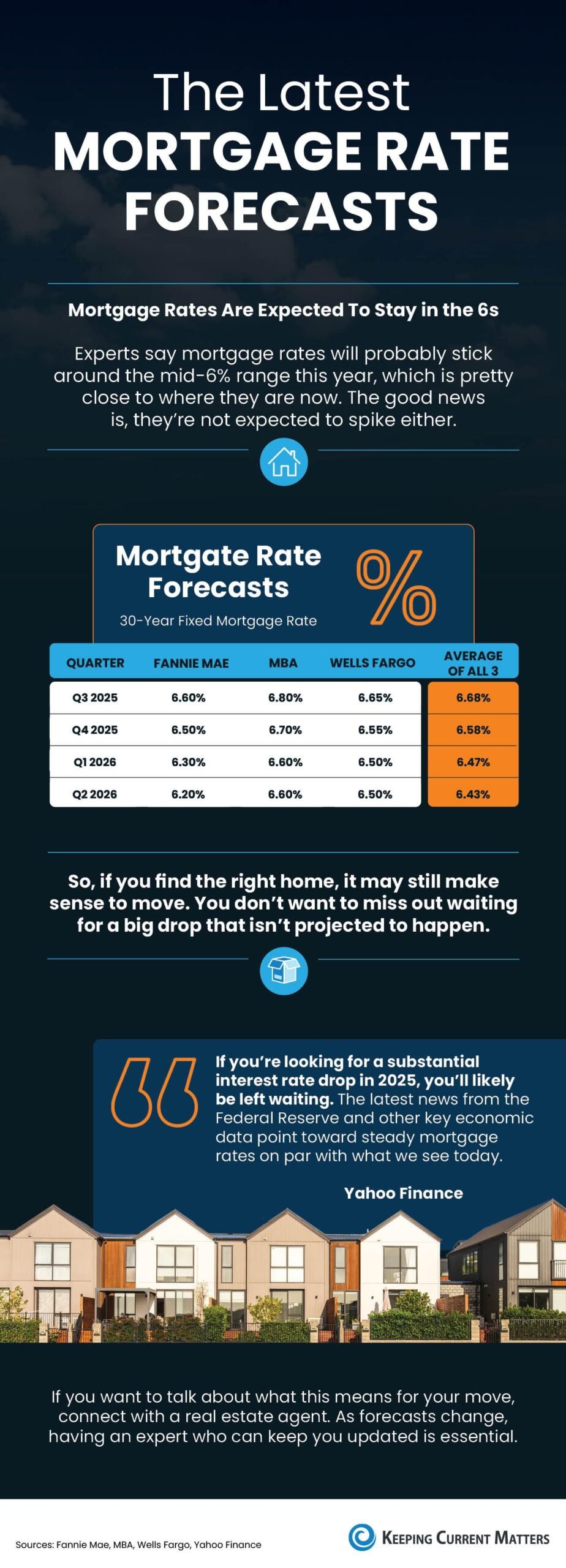
    According to the latest mortgage rate forecast 2025 housing market outlook, most experts agree we won’t see a dramatic drop. Projections suggest rates will hover in the mid-to-low 6% range through 2026.

    So while there may be small ups and downs, a major plunge isn’t likely anytime soon.

    Now, that may not seem like a massive drop, but trust me, buyers have been waiting for any sign of movement. Even small changes like this light a fire under the market because they hint that rates might be heading lower.

    But here’s the reality: 

    Most experts aren’t expecting rates latest forecast to drop dramatically anytime soon. Projections show rates hanging in the mid-to-low 6% range through 2026. That means, yes, we’ll see ups and downs, but no massive plunge overnight.

    Buy Now or Wait - Graph showing mortgage rate projections for 2025 and 2026 from Fannie Mae, MBA, and Wells Fargo.

    The Magic Number: 6%

    For many buyers, the tipping point is 6%. And it’s not just psychological — it’s real math.

    NAR data shows that if rates hit 6%:

    • 5.5 million more households could afford a median-priced home

    • Around 550,000 buyers would jump into the market within 12–18 months

    That’s a lot of pent-up demand waiting for the same moment.

    Should you wait to buy a home until interest rates fall to 6%? (See Infographic)
    Here’s the catch: if you’re waiting, millions of others are too.


    The Tradeoff of Buying Now Instead Waiting

    When rates eventually inch closer to 6%, here’s what will happen:

    • Competition will heat up

    • Inventory will shrink

    • Home prices will rise

    Right now, buyers actually have an edge:
    ✅ More homes available to choose from
    ✅ Slower home price growth
    ✅ Better negotiating power with sellers

    These opportunities may disappear once demand surges.

    Bottom Line

    So… buy a house now or wait for mortgage rates to drop?
    Rates aren’t expected to hit 6% this year, but when they do, you’ll likely face bidding wars and higher prices.

    If you’d rather shop with less competition, more options, and stronger negotiating leverage, the window of opportunity is open right now.

    The real question is: Do you want to buy when the market is calm, or when the race is on?


  • How Homeowners Gained $28K in Equity Over the Past Year

    How Homeowners Gained $28K in Equity Over the Past Year

    "Stacks of coins with a small plant growing on top, symbolizing financial growth and investment."

    If you’re a homeowner, there’s a good chance your net worth has seen a substantial increase over the past year thanks to rising home prices. Here’s a closer look at how homeowners are building equity faster than many might expect.

    Understanding Home Equity

    Equity is essentially the difference between the current market value of your home and the amount you owe on your mortgage. As home prices increase, so does your home equity.

    Over the past year, the demand for homes has consistently outstripped supply, pushing home prices upward. This surge has directly translated into increased home equity for countless homeowners.

    The Current Landscape of Home Equity Gains

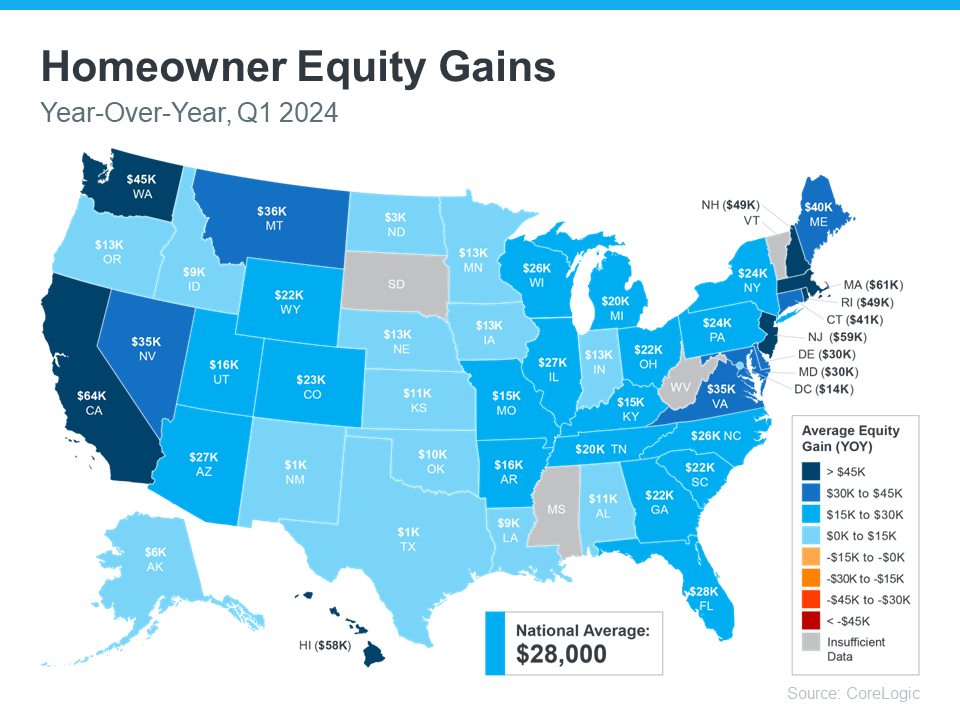
    According to the latest Homeowner Equity Insights from CoreLogic, the average homeowner has seen their equity increase by $28,000 in just the last year. This is a national average, but regional variations exist. For a detailed look at how much equity has grown in each state, refer to the map included below, which uses data from CoreLogic to illustrate the equity gains across the country.

    "Map of the United States showing average homeowner equity gains year-over-year for Q1 2024, with a national average of $28,000."

    Equity Growth Since Before the Pandemic

    For those who purchased their homes before the pandemic, the equity increase is even more pronounced. Data from Realtor.com indicates that home prices have surged by 37.5% from May 2019 to May 2024. Ralph McLaughlin, Senior Economist at Realtor.com, highlights the substantial equity boosts homeowners have witnessed:

    “Homeowners have seen extraordinary gains in home equity over the past five years.”

    Selma Hepp, Chief Economist at CoreLogic, further elaborates on the equity scenario:

    “With home prices continuing to reach new highs, owners are also seeing their equity approach the historic peaks of 2023, close to a total of $305,000 per owner.”

    Leveraging Your Home Equity

    This significant buildup of equity offers several practical benefits. Homeowners can utilize their increased equity to start a business, fund education, or even facilitate the purchase of their next home. Upon selling, the equity you’ve accumulated can substantially cover—or possibly exceed—the down payment for your next property.

    Bottom Line


    For those considering a move, the equity you’ve gained over recent years can be a powerful asset in facilitating your transition. If you’re curious about your home’s current equity and how you can leverage it for your next purchase, reaching out to a local real estate agent is a great starting point.


  • Should You Move Now or Wait? Expert Insights on Home Prices and Mortgage Rates

    Should You Move Now or Wait? Expert Insights on Home Prices and Mortgage Rates

    "A miniature model house with a green roof sitting on a wooden floor, representing future trends in home prices."

    If you’re thinking of making a move this year, there are two housing market factors that are probably on your mind: home prices and mortgage rates. You’re wondering what’s going to happen next and if it’s worth it to move now or better to wait it out.

    “The only thing you can really do is make the best decision you can based on the latest information available. So, here’s what experts are saying about both prices and rates.”

    1. What’s Next for Home Prices?

    One reliable place you can turn to for information on home price forecasts is the Home Price Expectations Survey from Fannie Mae – a survey of over one hundred economists, real estate experts, and investment and market strategists.


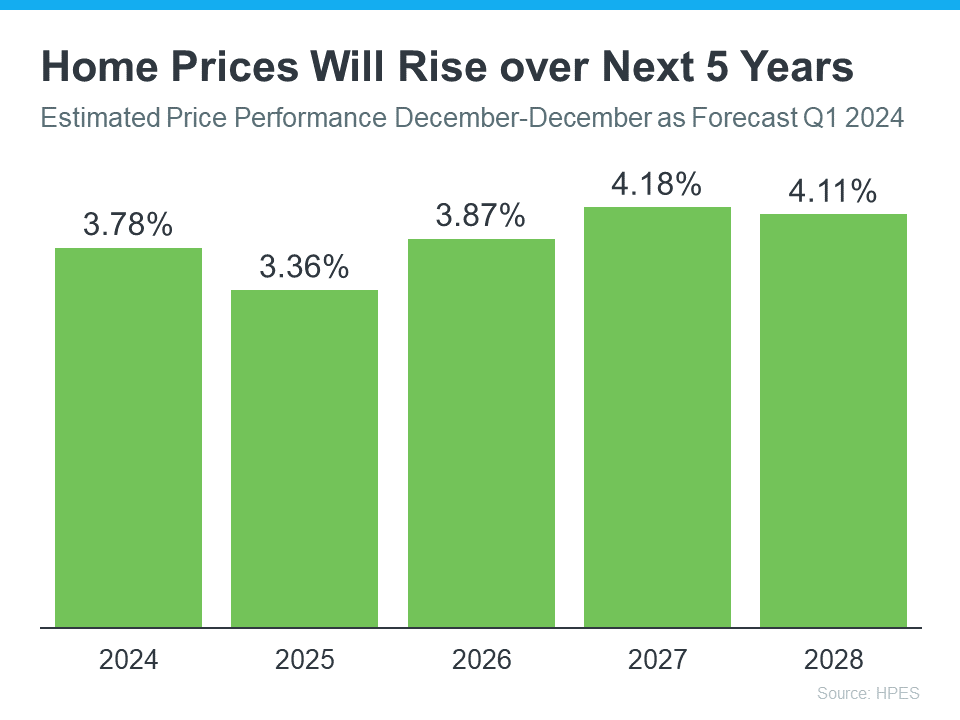
    Home prices are expected to rise steadily over the next five years, with annual increases ranging from 3.36% to 4.18% as per the Q1 2024 forecast.

    "Bar chart showing the forecasted rise in home prices over the next 5 years, with percentages for each year from 2024 to 2028."

    While the percent of appreciation varies year-to-year, this survey indicates that we’ll see prices rise (not fall) for at least the next 5 years, and at a much more normal pace.

    What does that mean for your move? If you buy now, your home will likely grow in value and you should gain equity in the years ahead. But, based on these forecasts, if you wait and prices continue to climb, the price of a home will only be higher later on.

    2. When Will Mortgage Rates Come Down?

    This is the million-dollar question in the industry. And there’s no easy way to answer it. That’s because there are a number of factors contributing to the volatile mortgage rate environment, we’re in. Odeta Kushi, Deputy Chief Economist at First American, explains:

    “Every month brings a new set of inflation and labor data that can influence the direction of mortgage rates. Ongoing inflation deceleration, a slowing economy, and even geopolitical uncertainty can contribute to lower mortgage rates. On the other hand, data that signals upside risk to inflation may result in higher rates.”

    What happens next will depend on where each of those factors goes from here. Experts are optimistic rates should still come down later this year but acknowledge that changing economic indicators will continue to have an impact. As a CNET article says:

    “Though mortgage rates could still go down later in the year, housing market predictions change regularly in response to economic data, geopolitical events and more.”

    So, if you’re ready, willing, see how much home you can afford by clicking here and partner with a trusted real estate advisor to weigh your options and decide what’s right for you.

    Bottom Line

    Connect with a trusted mortgage advisor to make sure you have the latest information available on home prices and mortgage rate expectations. Together you’ll go over what the experts are saying so you can make an informed decision on your move.

  • Control What You Can: Navigating Mortgage Rates with Confidence

    Control What You Can: Navigating Mortgage Rates with Confidence

    "A man with curly hair and a floral shirt reviewing mortgage rate documents at home, using a laptop with a piece of toast beside him."

    You’re likely hearing a lot about mortgage rates lately, perhaps influenced by recent discussions about the Federal Reserve’s meetings. It’s a common misconception that the Fed directly controls these rates.

    In reality, “mortgage rates are impacted by a lot of factors: geo-political uncertainty, inflation and the economy, and more.” Trying to predict when these elements will align to lower rates is a complex task, making it futile to attempt timing the market.

    Focus on What You Can Control

    With many variables out of your hands, the best approach is to manage what you can — the controllables.

    Your Credit Score

    Credit scores can play a big role in your mortgage rate. As an article from CNET explains:

    You can’t control the economic factors influencing interest rates. But you can get the best rate for your situation, and improving your credit score is the right place to start. Lenders look at your credit score to decide whether to approve you for a loan and at what interest rate. A higher credit score can help you secure a lower interest rate, maybe even better than the average.”

    Given the current economic climate, it’s crucial to maintain or enhance your credit score. To improve your score effectively, seek guidance from a trusted loan officer who can provide expert advice tailored to your financial situation.

    Your Loan Type

    There are many types of loans, each offering different terms for qualified buyers. The Consumer Financial Protection Bureau (CFPB) says:

    There are several broad categories of mortgage loans, such as conventional, FHA, USDA, and VA loans. Lenders decide which products to offer, and loan types have different eligibility requirementsRates can be significantly different depending on what loan type you choose.”

    It’s vital to explore all available loan options with your real estate team to determine the best fit for your financial goals.

    Your Loan Term

    The term of your loan is another critical factor to consider According to Freddie Mac,

    “When choosing the right home loan for you, it’s important to consider the loan term, which is the length of time it will take you to repay your loan before you fully own your home. Your loan term will affect your interest rate, monthly payment, and the total amount of interest you will pay over the life of the loan.”

    Selecting the right loan term can significantly affect your financial health over time, so it’s crucial to make an informed decision based on your specific circumstances.

    Bottom Line

    While you cannot control the broader economic forces or policy decisions that influence mortgage rates, you can make informed choices about your credit management, loan type, and loan term. “Remember, you can’t control what happens in the broader economy. But you can control the controllables.”

    Connect with us to discuss how you can strategically manage these factors to secure the most favorable mortgage rates available in today’s market.

  • Exploring Home Equity Loans: Unlock the Value of Your Home

    Exploring Home Equity Loans: Unlock the Value of Your Home

    Let’s break it down. Home equity is essentially the current value of your property minus any mortgage balances you owe. Given the rising home prices over recent years, you might be sitting on more equity than you realize—in fact, the average homeowner has about $297,000 in home equity!

    Now, you might be wondering, “How can I use this equity without selling my home?” Great question! There are several options like a cash-out refinance, a home equity line of credit (HELOC), or a home equity loan (HELOAN). Each option serves different financial needs and goals, but today, let’s focus on home equity loans.

    What’s a Home Equity Loan? Think of a home equity loan as a type of second mortgage. It allows you to convert part of your equity into cash without altering your existing mortgage. It’s pretty straightforward—you receive a lump sum to use as you see fit and pay it back at a fixed interest rate over a set period, typically 5-20 years. Remember, this comes in addition to your regular mortgage payments, so planning is key to manage the extra monthly expense comfortably.

    How Do You Get a Home Equity Loan? First up, you need to figure out how much cash you need. Home equity loans are great for large, one-time expenses like consolidating debts or making home improvements. You’ll need to have a clear idea of your project costs because the loan amount is fixed.

    Most lenders will ask that you have at least 20% equity in your home to qualify. However, some may offer flexibility, allowing you to borrow up to 90% of your home’s value, especially if your down payment was less than 20%.

    HELOC vs. Home Equity Loan While both let you tap into your home equity, they differ in how you access the funds. A HELOC is more like a credit card, giving you a credit line to draw from as needed, whereas a home equity loan gives you all the funds upfront.

    Understanding these differences can help you make the best choice for your financial situation. If you’re curious about tapping into your home equity or have any questions, don’t hesitate to reach out. I’m here to help you navigate these options and find the best path forward.

    Learn More Here


  • Let’s Talk:  The Cost of Caring for an Aging Parent

    Let’s Talk: The Cost of Caring for an Aging Parent

    picture of women caring for her mother

    Are you feeling overwhelmed by the financial strains of caring for aging parents? You’re not alone. Many of us in our forties and fifties are grappling with the challenges of the “sandwich generation.” From financial strains to emotional hurdles, the journey of caring for elderly loved ones can be daunting. As a Reverse Mortgage Professional and a caregiver, myself, I understand the complexities firsthand. Allow me to share some insights that may resonate with your own experiences.

    Understanding the Financial Burden

    Raising children comes with its financial demands, but the costs of caring for aging parents can often exceed those. Medicare, while a vital support for medical expenses, falls short when it comes to long-term care. The reality is stark: the average cost of nurturing a child to adulthood pales in comparison to the expenses associated with elder care.

    According to the Genworth 2021 Cost of Care Survey, a private room in a nursing home commands an average monthly fee of $9,034, with a semi-private room not far behind at $7,908. These figures translate into annual costs ranging from $94,896 to $108,408. The financial implications extend beyond institutional care, encompassing expenses like home modifications and caregiver support.

    Navigating the Emotional Terrain

    The toll of caring for aging parents extends beyond the financial realm. It’s an emotional journey fraught with uncertainties and complexities. Marguerita M. Cheng, a fellow Certified Financial Planner (CFP) who balances caring for her father with her professional commitments,

    “…highlights the importance of accessing resources like employee assistance programs (EAPs). These programs offer invaluable support through caseworkers who can provide vetted resources tailored to your family’s unique needs.

    Patti B. Black, another CFP who has walked the path of caring for her parents, emphasizes:

    “…the need for open communication within families. Honest discussions about caregiving responsibilities and potential scenarios can pave the way for informed decisions.”  

    Whether it’s exploring in-home care options or considering a reverse mortgage, transparency and collaboration are key.

    Utilizing Reverse Mortgages for Elder Care

    For some families, a reverse mortgage can be a viable solution for funding elder care expenses. This financial instrument allows homeowners aged 62 or older to convert part of their home equity into cash, which can then be used to cover ongoing care costs or make necessary home modifications to accommodate aging parents. While a reverse mortgage may reduce the potential inheritance for heirs, it provides a way to access funds without tapping into personal savings or retirement accounts. (Click here to Learn More)

    Preserving Your Financial Future

    As you navigate the intricacies of caring for aging parents, it’s essential to safeguard your own financial well-being. Discussing long-term plans as a family can unearth creative solutions, such as multigenerational living arrangements or exploring financial instruments like reverse mortgages. These strategies can alleviate the strain on your finances while ensuring quality care for your loved ones.

    Seeking Support

    Remember, you don’t have to navigate this journey alone. There are resources available to guide you through the maze of caregiving responsibilities. Reach out to local agencies and nonprofit organizations specializing in elder care to explore available support services in your area.


    In closing, I want to assure you that while the road ahead may seem daunting, you have the strength and resilience to navigate it. Together, we can find solutions that honor our commitments to our families while safeguarding our financial futures.

  • Unlocking the Power of Home Equity: A Path to Achieving Your Dreams

    Unlocking the Power of Home Equity: A Path to Achieving Your Dreams

    Discover the Hidden Wealth in Your Home

    Have you been living in your home for a few years? If yes, you’re sitting on a gold mine called home equity. Unsure what that means? Let’s break it down with a simple definition from Freddie Mac:

    “. . . your home’s equity is the difference between how much your home is worth and how much you owe on your mortgage.”

    Think of it as a savings account that grows with every mortgage payment and as your home value increases. Last year, there was a slight dip in home prices, but guess what? They’re on the rise again in many regions. This increase is fantastic news for homeowners like you!

    Selma Hepp, CoreLogic’s Chief Economist, highlights this in the latest Equity Insights Report: 

    With price gains continuing to help homeowners build wealth, equity has reached a new high and regained losses that resulted from declines last year. And while the average U.S. homeowner gained over $20,000 in additional equity compared with the third quarter of 2022, some markets are seeing larger increases as price growth catches up.”

    To put this into perspective, the average homeowner with a mortgage is sitting on over $300,000 in equity. That’s a significant amount of money that can open new doors for you. Here’s how:

    1. Time for a Change? Buy a New Home Are you feeling cramped in your current home, or is it too big now? Use your equity as a down payment to find a home that’s just the right size for your evolving needs. Click here to learn more

    2. Invest in Your Current Home Not ready to move? Your home equity can fund improvements in your current house. Remember, not all upgrades are created equal. Consult a real estate agent to figure out which renovations will boost your home’s value the most.  Click here to learn more

    3. Fuel Your Dreams Ever dreamt of starting a business, retiring in style, or furthering your education? Your home equity can be the key to these ambitions. However, use this resource wisely – it’s not for splurging, but for making impactful life changes.  Click here to learn more

    4. Maybe consider a Home Equity Conversion Mortgage if you are retired or about to retire: Understanding your equity can be a lifeline in tough financial times, especially for seniors and a reverse may help.  With rising inflation, medical costs or managing debt.  Or maybe you want to move closer to your grandkids or travel more.  The Golden years should be the years you should enjoy the most. Click here to learn more.

    Next Steps Curious about your home’s equity? Contact me here and I can provide a professional equity assessment, showing you how much you’ve accumulated and how to use it to achieve your goals.

  • Why Experts Predict a Modest Increase in Home Prices in 2024

    Why Experts Predict a Modest Increase in Home Prices in 2024

    In today’s real estate market, the fear of falling home prices is a concern shared by many. A recent survey conducted by Fannie Mae revealed that a staggering 24% of people believe that home prices will decline in the next 12 months. If you find yourself among those who share this concern, let’s take a closer look at what experts predict for home prices in 2024 and why you might not need to worry.

    Expert Consensus: To alleviate your concerns, let’s turn to the insights of experts who closely monitor the housing market. We’ve compiled data from eight different sources to provide you with a comprehensive view of the situation.


    According to the data (as shown in the graph below), the consensus among experts is clear. On average, they anticipate that home prices will increase by over 2% by the end of this year. In other words, they expect prices to rise, not fall.

    Why Prices Are Expected to Rise: The optimistic outlook for home prices in 2024 is rooted in several key factors. It’s important to note that prices are unlikely to depreciate this year due to two main drivers: tight inventory and favorable mortgage rates.

    1. Tight Inventory: Housing inventory remains limited, creating a situation where the demand for homes significantly outweighs the available supply. This scarcity naturally pushes prices upward.

    2. Lower Mortgage Rates: The current trend of decreasing mortgage rates has spurred strong buyer demand. As Selma Hepp, Chief Economist at CoreLogic, explains, “With mortgage rates dropping, demand for homes in early 2024 is likely to be strong and will again put pressure on prices, similar to trends observed in early 2023 . . . Most markets will continue to reach new home price highs over the course of 2024.”

    What Does This Mean for You? So, what does all of this mean for you, especially if you’re considering buying a home? The experts’ consensus that home prices will rise in 2024 brings some positive implications:

    1. Home Value Appreciation: As a homeowner, you want the value of your property to increase over time. This appreciation builds equity and makes homeownership a sound long-term investment.

    2. Cost of Waiting: If you’re ready to become a homeowner, waiting could come at a cost. With prices expected to rise, delaying your purchase may mean paying more for the same property later.

    Bottom Line: In conclusion, if the fear of falling home prices has been on your mind, it’s time to put those worries to rest. The consensus among experts is that home prices are likely to rise in 2024. However, if you have specific questions or concerns about the real estate market in your area, it’s always a good idea to consult with a knowledgeable real estate agent. They can provide you with localized insights and guidance to make informed decisions in today’s dynamic housing market.

    Remember, the key to successful homeownership is staying informed and making decisions based on expert analysis and market trends. Don’t let the fear of falling prices deter you from taking steps toward your homeownership goals.