Author: Patrick Collins

  • Why Selling Your House This Winter Gives You an Edge

    Why Selling Your House This Winter Gives You an Edge

    Why Selling Your House This Winter Gives You an Edge | Let’s Talk Home Mortgage

    Why Selling Your House This Winter Gives You an Edge.

    Spring gets most of the attention. But a well-prepared winter listing may face less competition, attract buyers with a real reason to move, and give your home a cleaner opportunity to stand out.

    The winter
    seller advantage

    The quieter season can create a louder opportunity.

    Most homeowners picture spring when they think about selling. The grass is green, the flowers are blooming, and buyers seem to be everywhere. But more activity does not always mean a better opportunity for your house.

    Winter can create a different kind of advantage. There are often fewer homes competing for attention, and the buyers who are still shopping usually have a real reason to move. When your home is priced correctly, presented well, and supported by a clear plan, the quieter season may work in your favor.

    The key takeaway

    You do not need the busiest market. You need the right buyers to notice your home, understand its value, and feel confident enough to make a strong offer.

    Winter is not a dead market. It is a different market.

    Real estate activity typically slows during the winter. Some homeowners postpone listing because of the holidays, travel, weather, school schedules, or the belief that spring is always better.

    That slowdown can feel like a disadvantage. But it also removes some of the noise.

    In spring, buyers may have more homes to choose from. They can compare your kitchen, yard, price, upgrades, and location against a growing list of new properties. In winter, the selection is often smaller. A home that fits a buyer’s needs may receive more focused attention simply because there are fewer similar choices available.

    “The goal is not to list when everyone else lists. The goal is to list when your home can compete well and the timing supports your next move.”

    Pat Collins

    The winter market will not be identical in every city, neighborhood, or price range. That is why the decision should start with local inventory, recent comparable sales, current days on market, and the number of competing homes buyers can see right now.

    Less competition can give your home more visibility.

    Imagine two open houses.

    At the first, your home is one of twelve similar listings that came on the market the same week. At the second, your home is one of three realistic options in the area and price range.

    Which one has the better chance of being remembered?

    Spring market

    More buyers—and more sellers

    Higher traffic may come with more competing listings, more side-by-side comparisons, and greater pressure to make your home look like the strongest value.

    Winter opportunity

    Less noise around your listing

    When inventory is thinner, a properly priced and well-presented home may receive a larger share of buyer attention.

    Visibility does not guarantee an offer, and fewer listings do not excuse poor preparation. Buyers still compare condition, location, payment, and price. But when your home is competing against fewer alternatives, the work you put into presentation can have more impact.

    This is especially important if your home has a feature that is hard to replace: a desirable school district, a flexible floor plan, a large lot, a home office, a single-story layout, a remodeled kitchen, or a price point with limited inventory.

    Winter buyers often have a reason to make a decision.

    Some spring buyers are exploring. They may visit open houses for months before deciding whether they are ready.

    Winter buyers are often working with a more immediate timeline. Their lease may be ending. A job transfer may be starting. Their family may need more space. They may be relocating, separating households, completing a sale, or trying to move before the next school term.

    That does not mean every winter buyer will move quickly or pay any price. It means the buyers who stay active during a slower season are more likely to have a specific problem they are trying to solve.

    Why motivation matters

    A motivated buyer is not automatically a desperate buyer. It is usually a buyer with a defined goal, a real timeline, and a stronger reason to act when the right home appears.

    For a seller, that can lead to more focused showings, clearer feedback, and quicker decisions. It can also reduce the number of casual visitors who like the house but are nowhere near ready to write an offer.

    Winter will not sell the home for you. Preparation still matters.

    The season may give you an opening. Your pricing and preparation determine whether you take advantage of it.

    Price for the market you have

    Do not price based on what you hope spring buyers might pay. Review current competition, recent sales, condition, and the payment buyers will face at your price.

    Create warmth and light

    Open the blinds, replace dim bulbs, remove heavy clutter, and make the home feel bright. Winter buyers should walk in and feel comfortable—not closed in.

    Make the first impression clean

    Keep the entry, driveway, walkway, porch, and landscaping neat. The exterior still sets the tone even when the yard is not at its seasonal best.

    Use professional presentation

    Strong photography, accurate room descriptions, a clear floor plan, and thoughtful online marketing matter even more when buyers begin their search from home.

    Know what happens after the sale

    Before listing, understand your estimated proceeds, moving costs, next-home payment, financing options, and whether you need the sale to close before you buy.

    A winter listing also needs a practical showing plan. Holiday schedules, shorter daylight hours, travel, rain, snow, and family events can affect access. The easier the home is to show, the more opportunities buyers have to see it.

    Do not overlook the next-home strategy

    Selling is only half of the decision if you also plan to buy.

    You need to know how much equity may be available after closing, whether you can qualify before the current home sells, how a temporary housing gap would affect you, and what payment you are comfortable carrying on the next property.

    A strong offer on your home is helpful. A strong offer combined with a clear plan for what happens next is better.

    Plan both sides of the move

    Know the numbers before the “For Sale” sign goes up.

    I can help you think through estimated proceeds, the next-home payment, available financing strategies, and the timing between selling and buying.

    Talk With Pat

    How do you know whether winter is right for you?

    Winter may be worth considering when your home has limited competition, your local market still has active buyers, the property shows well during the season, and you have a personal or financial reason to move.

    Waiting may make more sense when the home needs repairs you cannot complete yet, seasonal weather makes the property difficult to access or present, your next-home plan is unclear, or local demand is unusually weak.

    Ask these questions before deciding:

    • How many homes like mine are currently for sale?
    • How long are similar homes taking to sell?
    • Are sellers receiving price reductions, credits, or multiple offers?
    • What would my estimated net proceeds look like at a realistic selling price?
    • Where will I live next, and how will that purchase be financed?
    • Would waiting improve the property—or simply add more competing listings?

    The answers are more useful than a general rule about the “best” month to sell.

    Bottom line

    Spring may bring more buyers. It may also bring more sellers.

    Winter can give a prepared homeowner a quieter lane: fewer competing listings, more attention from serious buyers, and an opportunity to move before the seasonal rush.

    That does not mean you should list simply because the calendar says winter. It means you should not automatically wait for spring without comparing the tradeoffs.

    Look at your local market. Prepare the house. Price it correctly. Understand your proceeds and your next-home strategy.

    Sometimes the season everyone overlooks is the season that gives you the clearest advantage.

    Educational disclosure: This article is for general educational purposes. Real estate conditions, property values, buyer demand, marketing results, loan options, and closing timelines vary by location and individual circumstances. Nothing here is a guarantee that a property will sell, receive a particular offer, or qualify for specific financing. Consult qualified real estate, mortgage, tax, legal, and financial professionals regarding your situation.

    Article link copied.
    Young child smiling while holding parents’ hands during winter—symbolizing the joy and opportunity families can find when selling a home in the winter housing market.

    When most people think about selling their home, they automatically picture spring the yard is green, the flowers are out, and everyone seems to be in house-hunting mode.

    But here’s the truth: spring isn’t always the smartest time to sell.
    In fact, selling your house this winter may actually give you a major advantage especially if you’re trying to stand out and make a confident financial move.

    Let’s break down why winter might be the opportunity most homeowners overlook.

    Winter Is When Your House Finally Stands Out

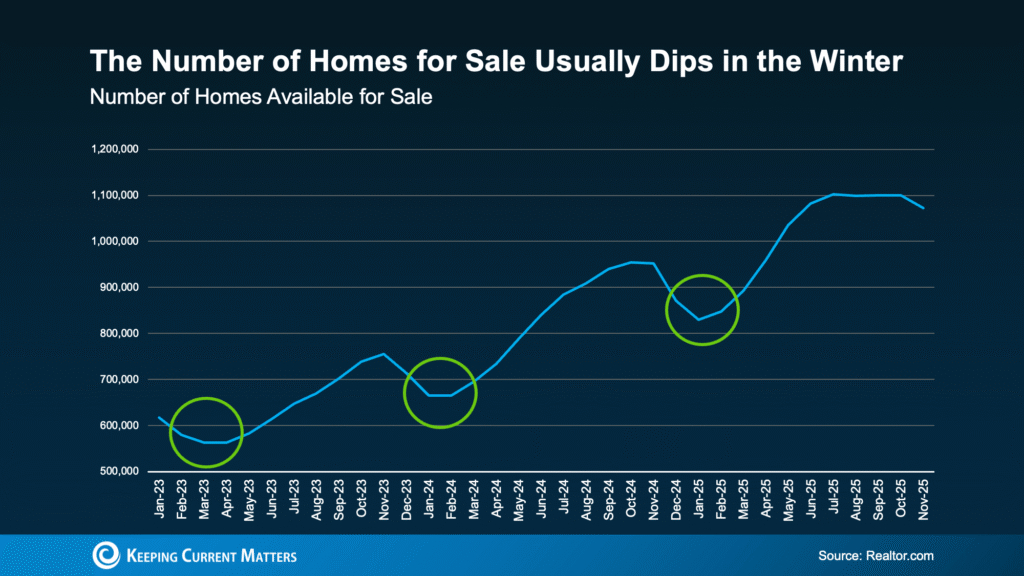
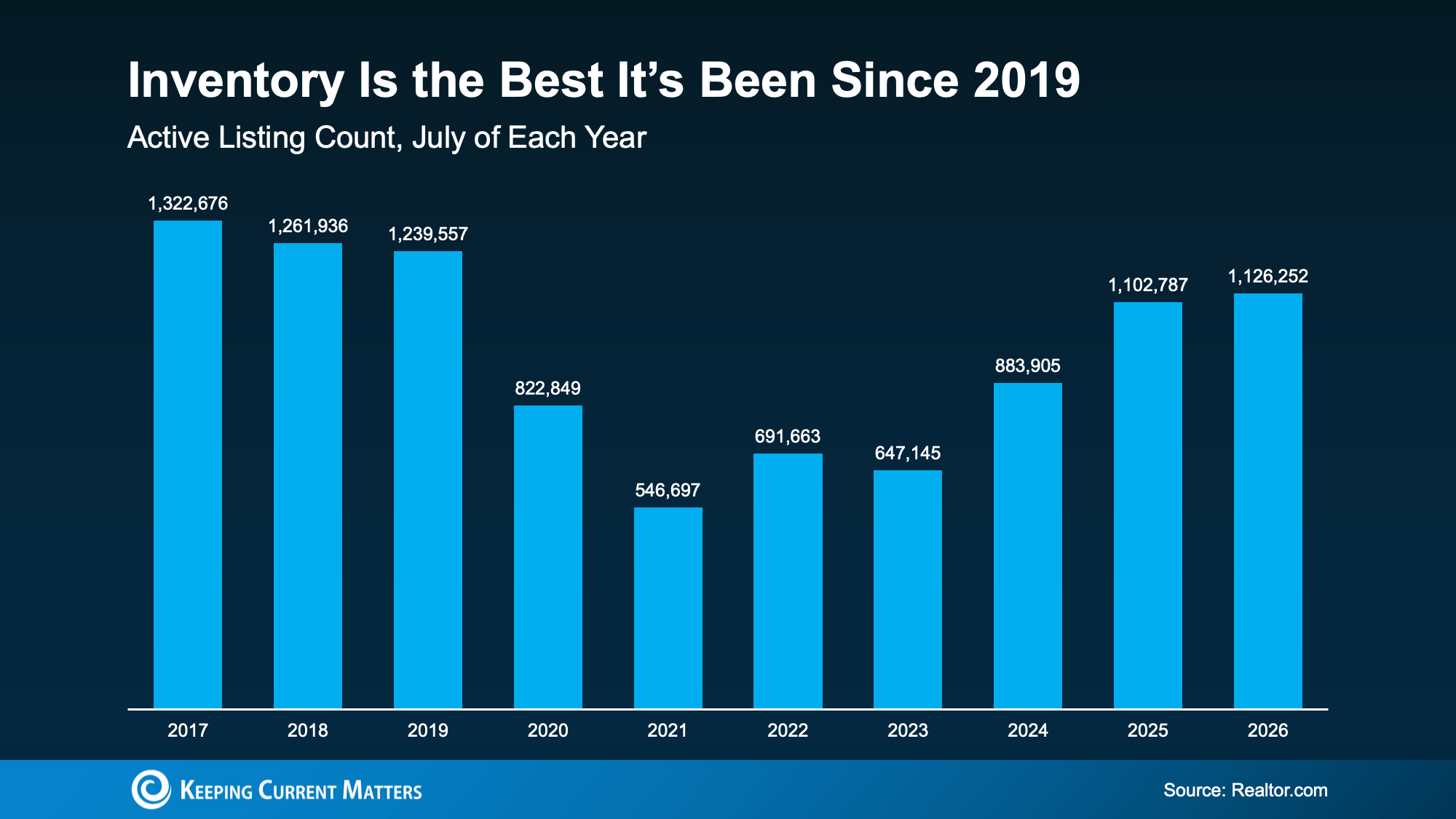
    Every year almost without fail the number of homes for sale drops as winter approaches. Realtor.com’s data shows the same pattern year after year: inventory dips in the winter, then rises again as spring arrives.

    And based on the latest numbers rolling in for 2025, we’re seeing that same trend start again.

    Listings are beginning to decrease as we close out the year and if history repeats itself (which it usually does), inventory will drop even further through winter.

    Here’s why this matters for you:

    Line graph showing how housing inventory consistently dips in the winter months, based on data from Realtor.com.

    Even with more listings than last year, we still aren’t anywhere near a “normal” market.

    Compared to 2017–2019 levels, today’s housing supply is still too low.
    So when winter inventory dips again, your home has less competition and more visibility.

    Think of it like this:

    Less competition = More attention on your home.

    If you list now before everyone else rushes back into the market in spring you get ahead of the crowd.

    Winter Buyers Are More Motivated Buyers

    Another big advantage to selling your house this winter?

    The buyers who are shopping right now are serious.

    They’re not browsing because it’s fun.
    They’re looking because they need to move for a job relocation, a lease ending, a life change, or a growing family.

    U.S. News puts it this way:

    “Buyers who brave the cold usually have a good reason they need to move and can make quick decisions.”

    And with fewer homes available in winter, they have fewer options to choose from. If you price and prep your house well, there’s a good chance your home becomes the one that checks their boxes.

    Motivated buyers + low inventory = stronger offers and quicker decisions.

    Why Not Wait Until Spring? Why This Matters for Buyers Trying To Stretch Their Budget

    Most homeowners wait to list until spring because it “feels” like the right time.
    But that’s exactly why waiting could hurt you.

    Spring brings more buyers – yes.
    But it also brings a flood of new listings.

    Suddenly, you’re competing with every homeowner who waited all winter.

    Winter gives you the opposite experience:

    • Less noise
    • Less competition
    • More motivated buyers
    • A cleaner shot at standing out

    Bottom Line: Winter Gives Sellers a Quiet Advantage

    If you’re thinking about selling, winter may be your best opportunity to:

    • Stand out in a less crowded market

    • Attract serious, motivated buyers

    • Avoid spring competition

    • Sell with more confidence and clarity

    You don’t have to wait for the “busy” season to make a smart move.
    Sometimes the quiet seasons work in your favor.

    If you want to understand what listing your home this winter could look like or whether it fits your financial goals connect with a trusted real estate agent in your area.

    A good agent can help you make sense of the numbers and take your next step with confidence.

  • Self Inflicted Inflation: The Inflation No One Talks About

    Self Inflicted Inflation: The Inflation No One Talks About

    Self-Inflicted Inflation: The Inflation No One Talks About | Let’s Talk Home Mortgage

    Self-Inflicted Inflation: The Inflation No One Talks About.

    Your paycheck can go up while your financial breathing room disappears. The problem is not always the economy. Sometimes it is the collection of monthly payments your lifestyle quietly added along the way.

    The hidden
    affordability leak

    Your income grew. So did the cost of your lifestyle.

    We all know what economic inflation feels like. Groceries cost more. Insurance costs more. Gas, utilities, repairs, and eating out cost more. But there is another kind of inflation that does not show up in the Consumer Price Index.

    I call it self-inflicted inflation.

    It happens when your income rises, your lifestyle rises with it, and the new monthly obligations slowly consume the raise. A newer car. A second car payment. Furniture on credit. A personal loan. More subscriptions. More dining out. A vacation balance that never quite goes away.

    Each decision may feel manageable by itself. Together, they can reduce your savings, raise your debt-to-income ratio, and quietly move homeownership farther away.

    The key takeaway

    The bank does not care whether a payment feels normal for your income. It cares that the payment must be made every month before the new mortgage is added.

    There are two kinds of inflation affecting your budget.

    The first is economic inflation. The Bureau of Labor Statistics uses the Consumer Price Index to measure the average change over time in prices paid by consumers for a market basket of goods and services.

    You cannot personally control the price of food, electricity, insurance, or gasoline.

    The second is lifestyle inflation. That is the increase in your own standard of living as income grows. Lifestyle improvement is not automatically bad. You work hard. You should enjoy your life.

    The problem begins when every improvement becomes a permanent monthly payment.

    “A raise should create more choices. It should not automatically create more bills.”

    Pat Collins

    Self-inflicted inflation is not about blaming people for enjoying their money. It is about recognizing the difference between a lifestyle you can afford today and a collection of payments that blocks the life you say you want tomorrow.

    Economic inflation

    Prices rise around you

    Food, housing, energy, transportation, insurance, and services become more expensive across the broader economy.

    Self-inflicted inflation

    Your obligations rise with you

    New car loans, card balances, personal loans, financing plans, and recurring spending absorb income that could support savings and a mortgage.

    The monthly-payment trap

    Most big purchases are not sold by total cost anymore. They are sold by monthly payment.

    “It is only $699 a month.”

    “The furniture is interest-free for 24 months.”

    “The phone is just another $42.”

    “The vacation can go on the card, and we will pay it off later.”

    That language makes the purchase feel smaller. But your budget experiences the total of every payment at the same time.

    A $700 car payment may fit. A $350 second car payment may fit. A $175 personal loan may fit. A $240 minimum credit-card payment may fit. A few subscriptions may fit.

    Then you add them together.

    Now the household has more than $1,500 in monthly obligations before rent, food, utilities, insurance, childcare, savings, retirement, or a future mortgage payment.

    The danger

    Affordable individually does not always mean affordable collectively.

    The balance is not the only number that matters

    People often focus on how much debt they owe. Mortgage lenders also focus on the required monthly payment.

    A large debt with a small required payment may affect qualification less than a smaller debt with a large payment. That is why paying off debt strategically can matter more than simply sending extra money to the account with the highest balance.

    The question is not only, “How much do I owe?”

    It is also, “How much of my gross monthly income is already committed before the mortgage begins?”

    How lenders see your lifestyle debt

    One of the numbers lenders evaluate is your debt-to-income ratio, commonly called DTI.

    The Consumer Financial Protection Bureau defines DTI as your total monthly debt payments divided by your gross monthly income. It is one way lenders evaluate your ability to manage the monthly payments on the money you want to borrow.

    The general calculation looks like this:

    Basic DTI formula

    Total monthly debt obligations ÷ gross monthly income = debt-to-income ratio.

    Depending on the loan program and underwriting rules, monthly obligations may include:

    • Car and other installment-loan payments.
    • Required minimum credit-card payments.
    • Student-loan payments calculated under the applicable loan guidelines.
    • Personal loans and financed purchases.
    • Alimony or child-support obligations when applicable.
    • The proposed housing payment, including principal, interest, taxes, insurance, mortgage insurance, and homeowners association dues when applicable.

    Every recurring debt payment leaves less room for the proposed housing payment.

    This is why two couples with the same income and similar credit scores can receive very different mortgage results. One may have $500 in monthly debt. The other may have $2,000.

    The income looks the same.

    The available mortgage capacity is not.

    The affordability math can be surprising.

    Consider a household earning $130,000 per year.

    That is approximately $10,833 in gross monthly income.

    Now imagine the household has:

    • $825 in car payments.
    • $425 in minimum credit-card payments.
    • $275 in student-loan payments.
    • $180 for a personal loan.

    That is $1,705 in monthly debt before a mortgage payment is added.

    Those debts do not necessarily mean the household cannot buy. The exact result depends on the loan program, credit profile, reserves, down payment, property taxes, insurance, interest rate, and underwriting.

    But the example shows the problem: a six-figure income can look strong while a significant part of it has already been promised to previous purchases.

    What the couple sees

    “We make good money.”

    The income feels high enough for homeownership because the household earns considerably more than it did a few years ago.

    What underwriting sees

    “A large share is already committed.”

    The lender must account for required monthly obligations before determining how much housing payment may fit.

    The down payment is only one side of readiness

    Many couples save aggressively for a down payment while ignoring the payments reducing their qualification.

    Saving is important. But there are situations where eliminating a monthly debt payment may improve the mortgage picture more than adding the same dollars to the down payment fund.

    That does not mean everyone should drain savings to pay off debt. Cash reserves matter. Emergency savings matter. Closing costs matter. The correct sequence depends on the complete financial profile.

    This is exactly why the decision should be calculated before the money is moved.

    See what the lender sees

    Find out which monthly payments are reducing your buying power.

    I can help you review your income, minimum payments, estimated housing expense, cash available, and the debts that may make the biggest difference.

    Talk With Pat

    How to reverse self-inflicted inflation

    You do not need to stop enjoying your life. You need to make sure your lifestyle and your homeownership goal are moving in the same direction.

    List every required monthly payment

    Include the payments that feel too small to matter. The mortgage calculation sees the total, not the story behind each account.

    Separate expenses from debt obligations

    Groceries and utilities affect your real-life budget. Car loans, credit cards, and installment debts may also affect mortgage underwriting.

    Measure payment relief—not only balance reduction

    Before paying extra, determine which account could be eliminated and how much required monthly payment would disappear.

    Stop adding new payments during preparation

    A new car, furniture financing, personal loan, or credit-card balance can change qualification—even after preapproval.

    Give every raise a job

    Direct part of increased income toward debt reduction, reserves, the down payment, retirement, or another intentional goal before the lifestyle expands.

    Run the mortgage numbers before making moves

    Do not close accounts, transfer balances, pay off loans, or move large amounts of cash without understanding the credit, reserve, and underwriting effects.

    A practical rule for future raises

    When income rises, decide in advance how much will improve your life today and how much will improve your financial position tomorrow.

    For example, you might direct part of every raise toward debt reduction or home savings before increasing recurring spending. The exact percentage is personal. The principle is what matters.

    Do not allow every dollar of new income to become a new monthly obligation.

    Bottom line

    Economic inflation may be outside your control.

    Self-inflicted inflation is different.

    It is the quiet expansion of monthly payments that can make a strong income feel weak, reduce your savings, and limit the mortgage payment a lender can approve.

    The answer is not guilt. It is awareness.

    Know the payments. Understand the mortgage math. Decide which debts are costing you the most buying power. Then create a plan that supports both the home you want and the life you want after closing.

    Because earning more money should move you closer to homeownership—not make you wonder where all the money went.

    Educational disclosure: This article is for general educational purposes and is not individualized financial, tax, legal, credit, or mortgage advice. It is not a commitment to lend or a guarantee of qualification, approval, rate, payment, property value, or loan amount. Debt treatment and debt-to-income calculations vary by loan program and underwriting requirements. Consult qualified professionals before changing credit accounts, paying off debt, moving funds, or applying for financing.

    Reference sources: The U.S. Bureau of Labor Statistics Consumer Price Index and the Consumer Financial Protection Bureau’s explanation of debt-to-income ratio.

    Article link copied.
    Illustration explaining self-inflicted inflation caused by lifestyle debt, showing how car payments, credit cards, and everyday spending reduce home buying power.

    Inflation is everywhere right now.
    Gas. Groceries. Insurance. Rent.

    But there’s another kind of inflation most people don’t want to talk about.

    Self Inflicted Inflation.

    This is the inflation we create ourselves through choices — not policies, not the Fed, not the economy.

    And with Christmas coming up, this problem is about to explode.

    Christmas Debt Is the Quiet Budget Killer

    Here’s a hard truth:

    Millions of people are still paying off 2023 and 2024 Christmas credit card debt
    and they’re about to add 2025 Christmas on top of it.

    That’s not inflation.
    That’s compounding bad decisions.

    A $3,000 Christmas at 22% interest can easily turn into $4,000+ by the time it’s paid off. Multiply that over multiple years, and now you’re stuck in a cycle where affordability feels impossible — because you’re financing yesterday’s memories with tomorrow’s income.

    🎯 Dollars & Sense Rule:
    If Christmas requires debt, the budget is lying.

    Renting, Driving Luxury, and Saying “I Can’t Afford a Home”

    Let’s talk about the elephant in the parking lot.

    Someone says:
    “I can’t afford a house.”

    But they’re renting…
    With a $900 car payment
    On a depreciating asset…
    While paying someone else’s mortgage.

    That’s not a housing problem.
    That’s an affordability choice problem.

    A car doesn’t build wealth.
    A home does.

    Dollars & Sense doesn’t make sense of choosing lifestyle flex over long-term freedom.

    The Top 3 Ways to Control Your Own Inflation

    1. Stop Financing Holidays

    Set a Christmas sinking fund.
    If the cash isn’t there, the gift list gets smaller.

    2. Delay the Car, Accelerate the House

    Drive boring now.
    Live free later.

    3. Kill Lifestyle Creep

    Raises should buy margin, not payments.

    Freedom comes from breathing room, not bigger bills.

    Final Thought

    Inflation hurts.
    But Self Inflicted Inflation is optional.

    Dollars & Sense is about making today’s choices make sense for tomorrow’s freedom.

    If homeownership is the goal — your money has to agree.

  • How To Find the Best Deal Possible on a Home Right Now

    How To Find the Best Deal Possible on a Home Right Now

    How To Find the Best Deal Possible on a Home Right Now | Let’s Talk Home Mortgage

    How To Find the Best Deal Possible on a Home Right Now.

    The strongest opportunity may not be the brand-new listing everyone is watching. It may be the home that has been sitting long enough for the seller to become more flexible—and for you to negotiate the whole transaction.

    The overlooked
    listing strategy

    Stop chasing the newest home. Find the best opportunity.

    Most buyers open a real estate app and immediately sort by “newest.” That is understandable. New listings feel exciting, clean, and full of possibility. They also tend to attract the most attention—and often give the seller the most leverage.

    The best deal may be hiding in the opposite direction.

    Look at the homes other buyers have already scrolled past. A listing that has been on the market longer, received a price reduction, fallen out of escrow, or failed to attract multiple offers may give you room to negotiate price, closing costs, repairs, a rate buydown, or better contract terms.

    But days on market alone do not make a home a bargain. The goal is to find an overlooked property where the condition, price, seller motivation, financing, and your long-term needs all make sense.

    The key takeaway

    The best deal is not necessarily the lowest price. It is the strongest combination of purchase price, monthly payment, cash required, property condition, contract protection, and long-term value.

    The hidden opportunity is often an overlooked listing.

    A brand-new listing may have several showings scheduled before you arrive. The seller may expect multiple offers and may be less willing to discuss credits, repairs, or flexible terms.

    A home that has been listed for several weeks or months tells a different story. The seller has already experienced the market. The original excitement has passed. Carrying costs continue. Moving plans may be delayed. The seller may be more open to a serious buyer with a clean, well-structured offer.

    “Do not ask only, ‘What is new?’ Ask, ‘What has been sitting—and why has no one solved the problem yet?’”

    Pat Collins

    That does not mean you should automatically submit a low offer. It means you have a reason to investigate.

    Single-story home representing a longer-term listing that may offer room for negotiation
    Older listings may create negotiating opportunities, but buyers still need to evaluate price, condition, disclosures, financing, and local market data.

    Why has the home been sitting?

    Longer days on market are a clue. Your agent’s job is to help determine what the clue means.

    Potential opportunity

    The original price was too ambitious

    The home may be perfectly acceptable, but the seller began above the market and lost the attention that normally comes during the first weeks.

    Potential warning

    The property has a real problem

    Condition, location, insurance, title, permitting, appraisal, financing, or disclosure issues may be limiting the buyer pool.

    Common reasons a home may remain available include:

    • The initial list price was higher than comparable sales supported.
    • The photos, staging, access, or marketing did not present the property well.
    • The home needs cosmetic repairs that make buyers underestimate its potential.
    • The seller has not responded to changing market conditions.
    • A previous buyer canceled because of financing, inspection, appraisal, or personal circumstances.
    • The property has functional, insurance, title, permit, or condition issues.
    • The neighborhood, lot, floor plan, or location serves a smaller group of buyers.

    Questions your agent should investigate

    Before you decide the seller must be desperate, ask for the full listing history. Find out when the property first entered the market, whether it was canceled and relisted, how many price changes occurred, whether it previously went under contract, and why the prior transaction ended when that information is available.

    Also compare the home with recent closed sales—not only other asking prices.

    A $25,000 price reduction can look impressive. It means very little if the original price was $50,000 above market value.

    Remember

    A discount from an unrealistic list price is not the same as buying below fair market value.

    Negotiate the whole deal—not only the price.

    Buyers often treat the offer price as the only place to save money. It is not.

    A motivated seller may be willing to negotiate several parts of the transaction:

    • A lower purchase price.
    • Seller-paid closing costs, subject to loan-program limits.
    • A temporary or permanent interest-rate buydown.
    • Repairs completed before closing.
    • A credit for repairs you complete after closing, when allowed.
    • A home warranty or other negotiated expenses.
    • Appliances or personal property handled appropriately in the contract.
    • A closing date, possession date, or rent-back that solves the seller’s timing problem.

    Sometimes the seller cares more about certainty and timing than squeezing out the last dollar.

    A fully underwritten or well-documented buyer, a reasonable inspection period, clear communication, and a closing date that fits the seller’s move may create value beyond price.

    Do not remove protection just to make the offer look strong

    Negotiating strategically does not mean ignoring risk.

    Inspection, appraisal, financing, title, insurance, and disclosure review can protect you from turning a “deal” into an expensive mistake. The appropriate contingencies and timelines depend on the property, competition, contract, local practice, and your professional advice.

    A bargain is not a bargain when the roof, foundation, sewer, electrical system, insurance eligibility, or unpermitted work creates costs you did not understand.

    A price reduction and a seller credit solve different problems.

    A lower purchase price may reduce the loan amount, monthly payment, property-tax basis where applicable, and total amount paid over time.

    A seller credit may preserve your cash or help pay allowable closing costs, discount points, or a rate buydown. Depending on the numbers, the credit may create more immediate payment relief than using the same amount solely as a price reduction.

    Here is a simplified illustration.

    Option A

    Negotiate a lower price

    A price reduction lowers the amount financed, but the monthly change may be smaller than many buyers expect. It can still produce meaningful long-term savings.

    Option B

    Negotiate seller-paid costs

    A credit may reduce the cash needed at closing or fund an eligible rate strategy. Limits and treatment depend on the loan program and transaction.

    The right choice depends on your available cash, interest rate, loan type, expected time in the home, tax and insurance costs, appraisal, and the amount of credit the program permits.

    Do not decide based on the size of the concession alone. Compare the actual monthly payment, cash to close, break-even period, and long-term cost.

    Compare the real savings

    See whether price, credits, or a rate strategy gives you the better result.

    I can help you compare the estimated payment, cash required, seller-credit options, loan structures, and break-even period before you finalize the offer.

    Talk With Pat

    Use this six-step framework to find the opportunity.

    Set the comfortable payment first

    Know the full housing payment you can comfortably manage, including taxes, insurance, mortgage insurance, homeowners association dues, maintenance, and utilities.

    Search beyond the newest listings

    Ask your agent to identify high days-on-market listings, price reductions, back-on-market homes, expired or relisted properties, and homes with limited competition.

    Investigate the listing history

    Review price changes, prior contracts, property disclosures, comparable sales, showing feedback when available, and the reason the home has not sold.

    Estimate the true cost of repairs

    Separate cosmetic changes from structural, mechanical, safety, insurance, title, and permitting issues. Use qualified inspectors and contractors where appropriate.

    Learn what the seller needs

    Price matters, but timing, certainty, possession, and convenience may help you structure an offer that works for both sides.

    Compare every offer component in dollars

    Calculate the price, cash to close, payment, credits, repairs, rate strategy, reserves after closing, and long-term cost before calling it a deal.

    What a strong buyer should have ready

    Opportunity moves faster when you are prepared.

    Have your income, assets, credit, debts, and down-payment funds reviewed before negotiating. Understand the maximum purchase price, but also establish your comfortable payment and cash-reserve target.

    A buyer who knows the numbers can negotiate confidently. A buyer who is guessing may win the house and lose the budget.

    Bottom line

    The best deal may not be the home with the flashiest price reduction.

    It may be the listing that has been overlooked, where the seller’s expectations have adjusted and the property gives you room to negotiate the entire transaction.

    Look at days on market. Study the listing history. Understand why the home has not sold. Compare price, credits, repairs, financing, and monthly payment together.

    Then make an offer based on facts—not excitement and not the assumption that an older listing must be a bargain.

    When everyone else is chasing what is new, you may find your best opportunity by looking at what is still available.

    Educational disclosure: This article is for general educational purposes and is not individualized mortgage, financial, tax, legal, real estate, inspection, appraisal, insurance, or contracting advice. It is not a commitment to lend or a guarantee of qualification, approval, rate, payment, property value, seller concessions, or transaction results. Concession limits, loan treatment, underwriting, appraisal, property eligibility, and contract requirements vary. Consult qualified professionals regarding your transaction.

    Article link copied.
    Single-story home in a quiet neighborhood representing real estate listings that stay on the market longer and offer negotiation opportunities.

    If you’ve been wondering how to find the best deal possible on a home in today’s housing market, here’s the truth most buyers never hear:

    The real savings aren’t on the brand-new listings…
    They’re on the homes that have been sitting on the market.

    That’s where the most flexible sellers are.
    That’s where the biggest price cuts happen.
    And that’s where savvy buyers are finding homes other people scroll right past.

    In a market where every dollar matters, this strategy could be the difference between feeling stretched thin or finally breathing again.

    Let’s break it down.

    The Hidden Opportunity: 1 in 5 Homes Has Reduced Its Price This Year

    Here’s a number worth paying attention to:

    20.2% of homes for sale have already dropped their asking price (Realtor.com).

    Even better?
    This trend is consistent nationwide, not just in select cities. That means:

    No matter where you live, there’s a real chance to score a better deal on a home.

    The challenge is knowing where to look — and that’s where your agent becomes your secret weapon.

    The Strategy: Target Homes That Have Been Sitting the Longest

    Homes that sit on the market longer than expected often tell a story.

    Sometimes the seller listed too high.
    Sometimes the marketing wasn’t strong.
    Sometimes buyers just moved on to the next shiny listing.

    But here’s the part most buyers miss:

    The longer a home sits, the more motivated the seller becomes.

    And that’s where opportunities open up for you.

    Your real estate agent can pull up listings with:

    • High days-on-market

    • Price cuts

    • Seller concessions

    • Fewer competing buyers

    These are the homes where you have real negotiating power.

    Why This Matters

    Realtor.com explains:

    “Less competition means fewer bidding wars and more power to negotiate the extras that add up… repair concessions, warranties, and closing credits.”

    And Bankrate backs it up:

    “During the quieter fall and winter months… sellers may be more willing to lower prices or offer concessions.”

    Translation? You can save thousands just by targeting the right listings.

    The Data Is Clear: The Longer a Home Sits, the Bigger the Savings

    Bar graph showing how a home’s sales price decreases the longer it stays on the market, from 100% of list price to 94% after 17+ weeks.

    According to the National Association of Realtors (NAR):

    Homes that stay on the market longer tend to sell for less than their original asking price.

    Even small percentages make a big difference.

    Example:

    If you buy a home at 94% of the original asking price, that discount may not feel dramatic, but:

    On a median-priced home, that’s roughly $24,000 in savings.

    Imagine what $24,000 could do:

    • Reduce debt

    • Grow your savings

    • Allow you to buy furniture

    • Lower your monthly payment

    • Give you breathing room

    This is why experienced buyers don’t chase the “fresh” listings…
    They look for the motivated ones.

    Chart showing how homebuyers save more money the longer a house sits on the market, with potential savings from $4,000 to $24,000.

    As Zillow puts it:

    “If you’re hoping to strike a deal, look for homes that have been on the market for a while… You may find a motivated seller who is more willing to negotiate.”

    Why This Matters for Buyers Trying To Stretch Their Budget

    If you’re trying to maximize every dollar — especially as a young family working toward stability — this strategy gives you:

    • More control

    • More negotiating power

    • More room in your budget

    • Less competition

    When everyone else is running to the newest listings, you’re moving strategically and intentionally.

    Bottom Line

    If you want to find the best deal possible in today’s housing market, don’t follow the crowd. Look where others aren’t looking.

    With 1 in 5 sellers cutting prices and more homeowners becoming flexible by the week, the listings that have been sitting a little longer may be your smartest path to saving money — and getting more home for your dollar.

    Your next step?

    Talk to a local agent about the homes in your area that have been on the market the longest. Those are the listings that could put you closer to the home — and financial breathing room — you’ve been working toward.

  • The Top 2 Things Homeowners Need To Know Before Selling

    The Top 2 Things Homeowners Need To Know Before Selling

    The Top 2 Things Homeowners Need To Know Before Selling | Let’s Talk Home Mortgage

    The Top 2 Things Homeowners Need To Know Before Selling.

    The sale is often decided before the first showing. Your opening price shapes buyer attention, and your expectations determine whether you respond strategically or emotionally when the market gives you feedback.

    The seller’s
    two-part plan

    Start with clarity. Respond to the market with discipline.

    Homeowners often begin the selling process by asking one question: “How much can I get?” That is understandable. Your equity may fund the next home, retirement, debt reduction, an investment, or the next chapter of your life.

    But the strongest sale does not begin with the highest possible number.

    It begins with two decisions:

    Price the home correctly from the beginning.
    Give the market enough time to respond.

    These sound simple. They are also where many sellers get into trouble.

    The key takeaway

    You control the preparation, the pricing strategy, the presentation, and how you respond to feedback. You do not control what buyers are willing and able to pay.

    Before you list, separate your goals from the market value.

    You may need a certain amount of money to buy your next home. You may have invested heavily in improvements. A neighbor may have sold for more. An online estimate may show an exciting number.

    All of that is useful context.

    None of it independently determines what a buyer will pay for your property today.

    Market value is influenced by recent comparable sales, current competing listings, condition, location, lot, floor plan, upgrades, buyer demand, financing conditions, insurance costs, property taxes, and the number of realistic alternatives available to buyers.

    “The market does not know what you paid, what you spent, or what you need next. It responds to the value buyers see today.”

    Pat Collins
    Wooden house, money, and clock representing home value, pricing, and timing when selling
    A successful sale requires both value and timing: a price buyers understand and enough time for the right buyer to act.

    Number 1: Price it right from day one.

    The first days on the market are valuable.

    Your listing is new. Buyers receive alerts. Agents notice it. People who have been waiting for a home like yours may schedule showings quickly.

    That attention is strongest when the price makes sense.

    When the home is priced too high, buyers may not schedule a showing. They may compare it with better-equipped homes at the same price. They may wait for a reduction. Or they may assume the seller is not realistic and move on.

    Strategic pricing

    Creates a reason to act

    The home appears competitive beside recent sales and current alternatives, which can increase showings, interest, and useful buyer feedback.

    Overpricing

    Can waste the launch period

    The listing may sit while buyers choose other properties. Later reductions can help, but they cannot recreate the original first impression.

    Pricing high “to leave room” can create the opposite result

    Some sellers believe they should begin above market value because buyers will negotiate.

    Sometimes that works.

    But it can also reduce the number of people who see the home. Buyers search within price ranges. A property listed above its competitive range may appear beside homes with larger lots, newer renovations, better locations, or additional bedrooms.

    Instead of creating negotiating room, the higher price may create a weaker comparison.

    A buyer cannot negotiate on a home they never decide to visit.

    Online estimates are a starting point—not a pricing plan

    Automated estimates cannot fully evaluate the condition of your kitchen, the quality of a renovation, deferred maintenance, the view, the street, the floor plan, unpermitted work, or how buyers are responding to nearby listings this week.

    A thoughtful pricing analysis should include:

    • Recent closed sales that are genuinely comparable.
    • Active listings buyers will compare with your home.
    • Pending sales that show what is attracting offers.
    • Expired, canceled, or withdrawn listings that reveal what did not work.
    • Price reductions and days on market in your area.
    • Your home’s condition, improvements, location, and unique features.
    Important

    The best opening price is not designed to make the seller feel good for one day. It is designed to create the strongest possible buyer response.

    The market gives feedback. Read it early.

    Once the home is listed, buyer behavior becomes data.

    High online activity but very few showings may indicate the price or presentation is not strong enough to move buyers from interest to action.

    Showings without offers may point to condition, layout, location, price, or a mismatch between the photos and the in-person experience.

    Very little online engagement may mean the home is not reaching the right audience, the marketing needs work, or the price is outside the range buyers are searching.

    One comment does not determine value. Patterns matter.

    Your agent should help you review showing activity, online engagement, buyer feedback, competing listings, new sales, price changes, and any shifts in the local market.

    A price adjustment is not automatically a failure. It can be a strategic response to new information.

    The mistake is waiting so long that the listing becomes stale while competing homes continue to sell.

    Number 2: Give the selling process enough time.

    Many homeowners still compare every market with the unusually fast conditions of 2020 and 2021.

    Those years trained sellers to expect immediate showings, multiple offers, waived protections, and contracts within a few days.

    That is not the normal standard for every market.

    In a more balanced environment, buyers may take longer to compare properties, calculate the payment, review insurance costs, study the neighborhood, and decide whether the home fits their lives.

    That can be healthy.

    A home that does not sell during the first weekend is not automatically a failed listing.

    Useful patience

    Lets the plan work

    The home is properly priced and marketed, showings are occurring, feedback is being reviewed, and the seller is making measured decisions.

    Costly delay

    Ignores clear market signals

    Activity is weak, buyers consistently reject the value, competing homes sell, and no adjustment is made because the seller is waiting for one special buyer.

    Patience does not mean doing nothing

    Giving the market time means following a plan—not leaving the listing untouched indefinitely.

    Your agent should establish checkpoints before the home is listed:

    • When will you review online activity and showing volume?
    • How will buyer and agent feedback be evaluated?
    • What competing listings will be monitored?
    • What conditions would support a price or presentation change?
    • How will your timeline affect future decisions?

    This keeps you from reacting emotionally to one quiet weekend or ignoring several weeks of consistent feedback.

    Your carrying costs belong in the pricing conversation

    Every additional month may include mortgage payments, property taxes, insurance, utilities, maintenance, homeowners association dues, and the cost of delaying your next move.

    Holding out for a higher price can be reasonable when the data supports it.

    Holding out for an additional amount that is smaller than the cost and risk of waiting may not be.

    Plan the sale and the next purchase together

    Know what you need from the sale before you choose the list price.

    I can help you think through estimated proceeds, the next-home payment, available financing strategies, and the timing between selling and buying.

    Talk With Pat

    Use this seller action plan before the listing goes live.

    Calculate the estimated net proceeds

    Review the likely selling price, mortgage payoff, commissions, closing costs, repairs, credits, taxes, moving expenses, and cash needed for the next step.

    Study the real competition

    Compare your home with recent sales and the properties buyers can choose today—not only the highest sale in the neighborhood.

    Complete the highest-impact preparation

    Address cleanliness, clutter, lighting, curb appeal, minor repairs, staging, photography, and anything that could distract buyers from the home’s value.

    Choose the opening price strategically

    Use the local market, buyer search ranges, condition, competition, and your timeline to create a price that attracts serious attention.

    Create review checkpoints

    Decide in advance when activity, feedback, price, presentation, and strategy will be evaluated so you do not react from fear or frustration.

    Prepare the next-home financing plan

    Understand whether you must sell first, how much equity may be available, what payment is comfortable, and how temporary housing or overlapping ownership could affect you.

    Price and timing work together

    A well-priced home can still require patience.

    A home given plenty of time can still fail when the price is disconnected from the market.

    That is why these two lessons cannot be separated.

    Price determines whether buyers see the value.

    Time gives the right buyers an opportunity to act.

    Bottom line

    Before you sell, remember two things.

    Price the home for the market you have—not the market you remember or the number you hope to receive.

    Give the process enough time—but stay willing to respond when the market gives you consistent feedback.

    The listings that struggle are not always bad homes.

    Many are simply launched with the wrong price, the wrong expectations, or no clear plan for what happens when buyers respond differently than the seller expected.

    Start with facts. Prepare the property. Understand your proceeds. Set review points. Then work the plan.

    A successful sale is not about guessing the perfect day. It is about making disciplined decisions from the first day.

    Educational disclosure: This article is for general educational purposes and is not individualized mortgage, financial, tax, legal, real estate, appraisal, inspection, insurance, or contracting advice. It is not a guarantee of property value, marketability, selling price, timing, proceeds, financing approval, or transaction results. Real estate conditions vary by property and local market. Consult qualified professionals regarding your sale and future purchase.

    Article link copied.
    Wooden house structure holding a money bag and rolled cash next to a small shopping cart with a blue alarm clock, symbolizing home value and timing in real estate.

    Price It Right from Day One

    Before you sell your home, there’s one truth you should hold onto: the homeowners who succeed in today’s market aren’t the ones waiting for “the perfect moment.” They’re the ones who start with clarity, realistic expectations, and a plan that fits the real world not the highlight reels on social media.

    This year, a lot of homeowners walked away disappointed. Not because the market was broken… but because their expectations were.

    Realtor.com reports that 57% more homes were taken off the market compared to last year. These were homes that listed… but didn’t sell.

    And in most cases, it came down to two things:
    price and timing.

    The good news?
    When you understand these early, you step into the selling process feeling calmer, more confident, and more in control instead of stressed or blindsided later.

    Here are the top two lessons you can learn from the sellers who struggled this year.

    Let’s talk about pricing, the part most sellers wrestle with.

    Today, 8 in 10 sellers expect to get their asking price or more.
    But the reality is different.

    Doughnut chart showing that only 25.3% of home sellers are receiving more than their asking price.

    Redfin shows that only 1 in 4 (25.3%) sellers actually end up selling for above list price.

    So where’s the gap?

    A few years ago, you could set almost any number and buyers would rush in. Homes were selling in hours, and bidding wars were the norm. Today, buyers have options more than they’ve had in years which means they can be selective.

    If your price feels even a little too high, buyers scroll right past it.

    That’s exactly what happened to many homeowners this year. Instead of making a small, strategic price adjustment, they pulled their listings entirely and missed out on real opportunities.

    Here’s the part most sellers never hear:

    According to HousingWire, the average price cut right now is just 4%.

    That’s it. Four percent is often the difference between “no activity” and “multiple showings.”

    If those sellers had priced strategically from the start or made a simple adjustment sooner they likely would’ve sold.

    And here’s the part that brings the pressure down. If you’ve built equity over the years, you can price competitively and still come out ahead financially.

    Before listing, work with a trusted real estate agent to analyze comparable homes in your area. Together, you can find a price that’s competitive, realistic, and aligned with your goals.

    Don’t Rush the Process — Selling Takes Time

    Another common mistake is expecting your home to sell in a weekend.

    Many sellers are still comparing today’s market to the lightning-fast pace of 2020 and 2021. But those days were the exception, not the rule.

    Bar chart showing median days on market for homes from 2017 to 2025, illustrating that home selling timelines are returning to normal.

    Right now, the average timeline is closer to 60 days from listed to sold.
    And that’s normal.

    Think of it like going from highway speed to neighborhood speed.
    You’re not going slow you’re going the right speed for where you are.

    Today’s buyers are more intentional. They’re slowing down, comparing homes, and making thoughtful decisions. This is actually healthier for the market, and for you.

    So if you’re planning to sell:

    • Don’t panic if your home doesn’t go under contract the first weekend.

    • Don’t assume something’s wrong if you don’t get an immediate offer.

    • Don’t rush the process and sabotage your own results.

    If you want your home to stand out, talk with your agent about strategic upgrades staging, photography, minor fixes, or value-driven pricing. Small improvements can create big momentum.

    With the right preparation and the right expectations, your home can still sell quickly.

    Bottom Line

    If you’re thinking about selling, don’t let fear shape your decisions let clarity guide them.

    The listings that struggled this year weren’t doomed…
    they were simply misaligned.

    You can still win in this market if you price with intention, stay patient, and work with an agent who understands what buyers are responding to right now.

    Success isn’t about waiting for the market to change.
    It’s about starting the process with the right plan and the right expectations from day one.

  • More Time to Buy a Home

    More Time to Buy a Home

    More Time to Buy a Home: Why Today’s Slower Market Helps Buyers | Let’s Talk Home Mortgage

    More Time to Buy a Home. More Room to Make a Smart Decision.

    Homes are not flying off the market the way they did during the pandemic frenzy. For buyers, that slower pace can mean more time to compare, inspect, negotiate, and buy with confidence.

    If the speed of the housing market made you step back a few years ago, take another look. Buyers now have something that was almost impossible to find during the pandemic housing rush: time.

    Time to tour a home more than once. Time to compare it with other listings. Time to read the disclosures, complete inspections, review the payment, and decide whether the house actually fits your life.

    That does not mean every home will sit on the market or every seller will accept a discount. Well-priced homes in desirable neighborhoods can still move quickly. But the national pace is much closer to normal, and that can create a healthier decision-making environment for prepared buyers.

    The key takeaway

    A slower market gives you breathing room—not permission to become unprepared. The buyers who benefit most are financially ready before the right home appears.

    The market has shifted back toward a more normal pace

    According to Realtor.com’s June 2026 housing report, the typical home spent 53 days on the market. That matched June of the previous year and was also in line with the pre-pandemic norm.

    The same report showed more than 1.1 million active listings nationwide, while the median listing price was down 2.5% from a year earlier. Those numbers do not automatically make every city a buyer’s market. But they do show that buyers generally have more inventory and less pressure than they faced at the market’s peak.

    53 Median days on market Same as June 2025
    1.1M+ Active listings nationwide Approximately 1,102,615 listings
    -2.5% Annual change in median list price June 2026 versus June 2025

    The goal is not to move slowly. The goal is to use the available time to move intelligently.

    Pat Collins

    During the fastest part of the pandemic market, some buyers had hours—not days—to decide. They waived protections, stretched budgets, and made offers based on fear of missing out. Today’s pace gives more buyers a chance to replace emotion with information.

    What more time can mean for you

    Extra days on the market can improve the buying process in several practical ways.

    1. You can compare the house—not just react to it

    When homes sell immediately, buyers start treating every listing like it is the last available house. A slower pace allows you to compare price, condition, location, taxes, insurance, commute, schools, maintenance, and resale potential.

    2. You can complete real due diligence

    An inspection is not just a formality. It can reveal roof, plumbing, electrical, foundation, drainage, HVAC, moisture, and safety issues. More time gives you room to understand the report, gather estimates, and decide which problems are acceptable.

    3. You can review the complete monthly cost

    The mortgage payment is only one part of ownership. Property taxes, homeowners insurance, mortgage insurance, HOA dues, utilities, repairs, and maintenance all affect affordability. A little breathing room makes it easier to evaluate the entire payment instead of focusing only on the purchase price.

    4. You can make a decision without letting fear make it for you

    Urgency and panic are not the same thing. You should still respond quickly when the right opportunity appears. But a good decision should be based on your numbers, your priorities, and the condition of the home—not simply on what another buyer might do.

    A couple reviewing homebuying information together
    More time can help buyers compare options, review the numbers, and make a decision together.

    A slower pace can create leverage—but not automatically

    The longer a property sits, the more likely a seller may become open to a reasonable conversation. Depending on the home and local market, that conversation could include:

    Fast market

    React first

    Limited time, fewer comparisons, multiple offers, reduced negotiating room, and more pressure to waive protections.

    Slower market

    Evaluate first

    More time for inspections, payment analysis, seller conversations, and an offer based on facts instead of panic.

    But leverage depends on the listing. A house that is new to the market, priced correctly, and located in a highly desirable area may still attract multiple offers. A home that has been listed for several weeks, needs repairs, or has already reduced its price may give you more room.

    This is where strategy matters. The question is not, “Can I ask for something?” You can always ask. The better question is, “What request is supported by the condition of the home, comparable sales, days on market, and the seller’s situation?”

    Your local market sets the real clock

    National numbers are useful, but they are averages. They combine fast-moving markets, slower markets, starter homes, luxury properties, condos, rural areas, and major cities.

    Realtor.com reported that homes in the hottest June 2026 markets sold in a median of about 31 days—more than three weeks faster than the national norm. That is a reminder that your city, price range, and neighborhood may move very differently from the national headline.

    Even within one county, the pace may change block by block. A turnkey starter home near good schools may sell quickly. A larger home at a higher price point may sit longer. A condo with a high HOA payment may face different demand than a detached home nearby.

    Local strategy

    Before writing an offer, ask how long comparable homes are taking to sell, how often sellers are reducing prices, and what concessions are actually being accepted.

    How to use the extra time wisely

    More time becomes an advantage only when you have a plan. Here is the order I recommend:

    Get fully preapproved before shopping seriously

    Know your loan options, estimated cash needed, and comfortable monthly payment before emotion enters the picture.

    Set your payment ceiling—not just your price ceiling

    Interest rate, taxes, insurance, HOA dues, and mortgage insurance can make two similarly priced homes feel very different each month.

    Study the local pace

    Review days on market, price reductions, comparable sales, and recent seller concessions in the exact area and price range you are targeting.

    Inspect the home and investigate the neighborhood

    Use the available time to understand the property, future maintenance, insurance considerations, traffic, noise, commute, and nearby development.

    Negotiate from evidence

    Build the offer around market data and the home’s condition. A fair, well-supported request is stronger than an aggressive number with no explanation.

    Do not confuse having more time with having unlimited time. The best homes can still move quickly. Preparation lets you act promptly without feeling rushed because the important financial decisions were made before you found the house.

    Know your numbers first

    Let’s build your homebuying plan before the right house appears.

    We can review your payment range, cash needed, debt-to-income ratio, and loan options so you know when to move quickly—and when to walk away.

    Talk With Pat

    Bottom line

    Buyers finally have more breathing room than they did during the housing frenzy. Homes are taking longer to sell, inventory is more available, and some sellers are more willing to negotiate.

    That does not mean you should wait forever or assume every seller is desperate. It means you may have a better opportunity to slow down just enough to inspect the home, understand the payment, negotiate intelligently, and make a decision you can live with.

    More time does not guarantee the perfect deal. But used correctly, it can help you make a better one.

    Sources: Realtor.com, “June 2026 Monthly Housing Market Trends Report” and “June 2026 Hottest Housing Markets.” National figures are educational and may not represent conditions in your city or neighborhood.

    This article is for educational purposes only and is not a commitment to lend. Loan qualification, available programs, rates, payments, and terms depend on the borrower’s complete financial profile, property, credit, income, assets, and underwriting approval. Programs and market conditions may change without notice.
    Article link copied

    If you’ve been waiting for the right moment, here it is: buyers finally have more time to buy a home. Unlike the frenzy of a few years ago—when houses sold within hours—today’s slower pace gives you breathing room. That means extra time to compare options, negotiate terms, and make confident decisions instead of rushing into a purchase.

    You Have More Time to Buy

    According to the latest data, homes are spending an average of 58 days on the market. That’s much more normal. And it’s a big improvement compared to the height of the pandemic, when homes were flying off the shelves in a matter of days (see graph below):

    Alt text: Graph showing homes taking longer to sell, giving buyers more time to buy a home in 2025.

    That means you now have more time to make decisions than you have at any point in the past five years. And that’s a big deal. Now, you’ve got:

    Time to think.

    Time to negotiate.

    Time to make a smart move without all the pressure.

    More Time to Buy, Means Less Stress (and More Leverage)

    Based on the data in the graph above, you have an extra week to decide compared to last year. And nearly double the time you would have had at the market’s peak.

    Back then, fear of missing out drove buyers to act fast, sometimes too fast. Today, the pace is slower, which means you’re in control. As Bankrate puts it:

    “For years, buyers have been racing to snag homes because of the fierce competition. But the market’s cooled off a bit now, and that gives buyers some breathing room. Homes are staying listed longer, so buyers can slow down, weigh their options and make more confident decisions.”

    With more homes on the market and fewer buyers, you have more time to buy a home and not having to race to grab them, the balance has shifted. Bidding wars aren’t as common, and that means you may have room to negotiate. And you can actually take a breath before you make your decision.

    More listings + a slower pace = less stress and more opportunity

    But, and this is important, it still depends on where you’re buying. Nationally, homes are moving slower. But your local market sets your real pace. Some states are moving faster than others. It may even vary down to the specific zip code or neighborhood you’re looking at. And that’s why working with an agent to know what’s happening in your area is more important than ever. 

    To see how your state compares to the national average (58 days), check out the map below:

    Map of U.S. showing median days on market by state, highlighting more time to buy a home in most areas.

    As Realtor.com explains:

    While national headlines might suggest a buyer’s market is taking hold, the reality on the ground depends heavily on where and what you’re trying to buy. Local trends can diverge sharply from national averages, especially when you factor in price range, property type, and post-pandemic market dynamics.”

    A smart local agent can tell you exactly when to move fast and when you can take your time, so you never miss the right home for you.

    Bottom Line

    If the chaos of the past few years drove you to hit pause, this is your green light. The market’s pace has shifted. You have more time. More options. More power.

    And with the right agent guiding you, you’re in the best position you’ve been in for years.

    Connect with a local agent to talk about what the pace looks like in your area, and if now could be the right time for you to re-enter the market.

  • Buy Now or Wait? The Real Tradeoff With Mortgage Rates.

    Buy Now or Wait? The Real Tradeoff With Mortgage Rates.

    Buy Now or Wait? The Real Tradeoff With Mortgage Rates | Let’s Talk Home Mortgage

    Buy Now or Wait? The Real Tradeoff With Mortgage Rates.

    Waiting for a lower rate may reduce the payment. Buying sooner may offer more choices, less competition, and stronger negotiating power. The smartest answer depends on the entire tradeoff—not one number.

    “Should I buy now or wait for mortgage rates to come down?” sounds like a rate question. It is actually a decision about rates, home prices, competition, negotiating power, timing, and your personal finances.

    A lower mortgage rate can absolutely improve affordability. But waiting for that rate may also mean shopping in a different market—with more buyers, fewer seller concessions, and possibly higher home prices.

    That is the tradeoff. You are not deciding between today’s rate and tomorrow’s rate in a vacuum. You are deciding between today’s entire opportunity and whatever the market looks like later.

    The key takeaway

    Do not ask only, “Will rates fall?” Ask, “Will waiting improve my complete financial position enough to justify the risks and costs of waiting?”

    The real question is not whether rates will move

    Mortgage rates move constantly. They can rise or fall after inflation reports, employment data, Federal Reserve expectations, Treasury-market changes, and other economic news.

    The problem is that no one can consistently identify the lowest rate in advance. You usually recognize the bottom only after rates have already moved away from it.

    So the goal is not to perfectly time the mortgage market. The goal is to buy when the home, payment, cash requirement, and timing work for you—and when the risks are understood.

    You can refinance a mortgage rate later. You cannot refinance the price you paid for the home.

    Pat Collins

    That does not mean you should buy a house you cannot comfortably afford. It means the interest rate is one part of the decision, not the entire decision.

    Where mortgage rates are today—and what the forecast shows

    Freddie Mac reported that the average 30-year fixed mortgage rate was 6.55% for the week ending July 16, 2026. That was up from 6.49% one week earlier but below the 6.75% average from the same week a year ago.

    Fannie Mae’s July 2026 housing forecast projects the 30-year fixed rate to average approximately 6.4% during the third and fourth quarters of 2026. Forecasts can change, but the current outlook does not assume an immediate or dramatic collapse in rates.

    6.55% Current 30-year fixed average Freddie Mac, July 16, 2026
    6.4% Fannie Mae forecast for late 2026 Quarterly average forecast
    5.5M More households potentially qualified at 6% NAR estimate versus rates near 7%

    The National Association of REALTORS® has estimated that a decline from roughly 7% to 6% could allow about 5.5 million additional households to qualify for a mortgage, including approximately 1.6 million renters. NAR estimated that roughly 550,000 of those newly qualified households could enter the market within 12 to 18 months.

    That is important because the same rate improvement that helps your payment may also help hundreds of thousands of competing buyers.

    What waiting for a lower rate may save

    Let’s use a simplified example with a $400,000 loan and a 30-year fixed mortgage. Principal and interest at 6.55% is approximately $2,541 per month. At 6.00%, it is approximately $2,398 per month.

    Buy at 6.55%

    About $2,541

    Estimated monthly principal and interest on a $400,000, 30-year fixed-rate loan.

    Wait for 6.00%

    About $2,398

    Approximately $143 less per month if the loan amount and all other assumptions remain unchanged.

    A $143 monthly reduction is meaningful. It can improve qualification, cash flow, and comfort. But the phrase “all other assumptions remain unchanged” is doing a lot of work.

    While you wait, the price of the home, loan amount, available inventory, seller concessions, rent payments, and competition may all change.

    Payment example

    If the loan amount increased by 3% to $412,000 while the rate fell to 6.00%, principal and interest would be about $2,470—not $2,398. The payment advantage compared with buying at 6.55% would shrink to roughly $71 per month.

    This example is not a prediction that prices will rise 3%. It simply shows why the rate should never be analyzed without the future purchase price and loan amount.

    What waiting may cost

    More buyers may qualify at the same time

    When rates improve, buyers who were previously priced out can return. Buyers who were waiting on the sidelines may also decide that the moment has arrived. That can increase showings, offers, and competition.

    You may lose seller concessions

    In a slower market, a seller may be more willing to pay closing costs, fund a temporary rate buydown, make repairs, or accept a lower price. When demand increases, those concessions can become harder to obtain.

    The home price may change

    A lower rate does not guarantee a lower payment if the future home costs more. Even modest price growth can offset part of the rate savings.

    You continue paying for your current housing

    Waiting may mean additional rent or remaining in a home that no longer fits your needs. Rent is not “wasted,” because it provides housing, but it should still be included in the cost of delaying the purchase.

    Your personal situation may change

    Employment, income, debt, credit, savings, family needs, and property availability can all change. A future rate may be better while your future qualification is not.

    A prospective homebuyer reviewing information while deciding whether to buy now or wait
    The right time to buy is based on your full financial picture—not one mortgage-rate headline.

    When buying now may make sense—and when waiting may be smarter

    Buying now may fit

    You are financially ready

    You have stable income, adequate reserves, a comfortable payment, and you expect to remain in the home long enough for ownership to make sense.

    Waiting may fit

    Your foundation needs work

    You need to reduce high monthly debt, improve credit, build emergency savings, stabilize income, or clarify where you want to live.

    Buying now can be reasonable when the payment is affordable today—not only after a hoped-for refinance. A future refinance should be treated as a potential benefit, not the plan required to survive the payment.

    Waiting can be the right decision when it meaningfully improves your finances. Paying off a car loan, reducing credit-card minimums, increasing reserves, or correcting credit issues may improve your buying power more than a small rate decline.

    Waiting only because you are trying to predict the exact bottom in rates is different. That is market timing, and market timing comes with risks.

    Build your decision plan before choosing

    Calculate the payment you can comfortably afford today

    Include principal, interest, property taxes, homeowners insurance, mortgage insurance, HOA dues, utilities, and a realistic maintenance allowance.

    Compare at least three scenarios

    Run today’s rate and price, a lower-rate scenario with the same price, and a lower-rate scenario with a higher purchase price.

    Measure local competition and seller flexibility

    Review days on market, price reductions, multiple-offer activity, and the concessions sellers are currently accepting in your target area.

    Identify what waiting will accomplish

    Put a measurable goal behind the delay: eliminate a payment, save a specific amount, improve credit, or stabilize employment. “I hope rates fall” is not a complete plan.

    Stress-test the decision

    Make sure buying still works if rates do not fall soon, the home needs repairs, or your monthly expenses increase. A good purchase should leave room for real life.

    Compare the complete tradeoff

    Let’s run your “buy now versus wait” numbers side by side.

    We can compare payments, cash needed, debt-to-income ratio, possible seller concessions, and realistic future-rate scenarios so you can make the decision with facts.

    Talk With Pat

    Bottom line

    Waiting for lower mortgage rates may produce a lower payment. But it may also bring more competition, fewer concessions, and a higher purchase price. Buying now may offer negotiating advantages, but only when the payment is comfortable and your finances are ready.

    There is no universal answer. The right answer comes from comparing the complete cost of buying today with the complete cost—and uncertainty—of waiting.

    Do not buy because you fear missing out. Do not wait because you expect a perfect rate. Build a plan that works under today’s conditions, understand what could change, and act when the numbers support your life.

    Sources: Freddie Mac Primary Mortgage Market Survey, Fannie Mae July 2026 Housing Forecast, and National Association of REALTORS® affordability analysis. Payment examples are rounded estimates of principal and interest only and exclude taxes, insurance, mortgage insurance, HOA dues, points, closing costs, and other expenses.

    Freddie Mac’s published rate is a national survey average and is not an advertised or guaranteed rate. This article is for educational purposes only and is not a commitment to lend. Qualification, available programs, rates, payments, and terms depend on the borrower’s complete financial profile, property, credit, income, assets, and underwriting approval. Forecasts and market conditions may change without notice.
    Article link copied
    Buy Now or Wait - Senior homeowner sitting on a porch swing reading a tablet, representing lifestyle benefits of homeownership

    “Should I buy now or wait for mortgage rates to drop?”

    One of the biggest questions buyers are asking me right now

    Let’s look at the facts and the tradeoffs of buying now or waiting.  What you need to consider.

    Well, let’s break it down…

    Where are Mortgage Rates Today, if You were to Buy Now

    After the latest jobs report came in weaker than expected, the bond market reacted quickly — and rates dropped to 6.55%, the lowest so far this year.

    That dip has many people wondering: “Is now a good time to buy a house 2025, or should I wait for mortgage rates to fall further?”

    According to the latest mortgage rate forecast 2025 housing market outlook, most experts agree we won’t see a dramatic drop. Projections suggest rates will hover in the mid-to-low 6% range through 2026.

    So while there may be small ups and downs, a major plunge isn’t likely anytime soon.

    Now, that may not seem like a massive drop, but trust me, buyers have been waiting for any sign of movement. Even small changes like this light a fire under the market because they hint that rates might be heading lower.

    But here’s the reality: 

    Most experts aren’t expecting rates latest forecast to drop dramatically anytime soon. Projections show rates hanging in the mid-to-low 6% range through 2026. That means, yes, we’ll see ups and downs, but no massive plunge overnight.

    Buy Now or Wait - Graph showing mortgage rate projections for 2025 and 2026 from Fannie Mae, MBA, and Wells Fargo.

    The Magic Number: 6%

    For many buyers, the tipping point is 6%. And it’s not just psychological — it’s real math.

    NAR data shows that if rates hit 6%:

    • 5.5 million more households could afford a median-priced home

    • Around 550,000 buyers would jump into the market within 12–18 months

    That’s a lot of pent-up demand waiting for the same moment.

    Should you wait to buy a home until interest rates fall to 6%? (See Infographic)
    Here’s the catch: if you’re waiting, millions of others are too.


    The Tradeoff of Buying Now Instead Waiting

    When rates eventually inch closer to 6%, here’s what will happen:

    • Competition will heat up

    • Inventory will shrink

    • Home prices will rise

    Right now, buyers actually have an edge:
    ✅ More homes available to choose from
    ✅ Slower home price growth
    ✅ Better negotiating power with sellers

    These opportunities may disappear once demand surges.

    Bottom Line

    So… buy a house now or wait for mortgage rates to drop?
    Rates aren’t expected to hit 6% this year, but when they do, you’ll likely face bidding wars and higher prices.

    If you’d rather shop with less competition, more options, and stronger negotiating leverage, the window of opportunity is open right now.

    The real question is: Do you want to buy when the market is calm, or when the race is on?


  • How Homeowners Gained $28K in Equity Over the Past Year

    How Homeowners Gained $28K in Equity Over the Past Year

    "Stacks of coins with a small plant growing on top, symbolizing financial growth and investment."

    If you’re a homeowner, there’s a good chance your net worth has seen a substantial increase over the past year thanks to rising home prices. Here’s a closer look at how homeowners are building equity faster than many might expect.

    Understanding Home Equity

    Equity is essentially the difference between the current market value of your home and the amount you owe on your mortgage. As home prices increase, so does your home equity.

    Over the past year, the demand for homes has consistently outstripped supply, pushing home prices upward. This surge has directly translated into increased home equity for countless homeowners.

    The Current Landscape of Home Equity Gains

    According to the latest Homeowner Equity Insights from CoreLogic, the average homeowner has seen their equity increase by $28,000 in just the last year. This is a national average, but regional variations exist. For a detailed look at how much equity has grown in each state, refer to the map included below, which uses data from CoreLogic to illustrate the equity gains across the country.

    "Map of the United States showing average homeowner equity gains year-over-year for Q1 2024, with a national average of $28,000."

    Equity Growth Since Before the Pandemic

    For those who purchased their homes before the pandemic, the equity increase is even more pronounced. Data from Realtor.com indicates that home prices have surged by 37.5% from May 2019 to May 2024. Ralph McLaughlin, Senior Economist at Realtor.com, highlights the substantial equity boosts homeowners have witnessed:

    “Homeowners have seen extraordinary gains in home equity over the past five years.”

    Selma Hepp, Chief Economist at CoreLogic, further elaborates on the equity scenario:

    “With home prices continuing to reach new highs, owners are also seeing their equity approach the historic peaks of 2023, close to a total of $305,000 per owner.”

    Leveraging Your Home Equity

    This significant buildup of equity offers several practical benefits. Homeowners can utilize their increased equity to start a business, fund education, or even facilitate the purchase of their next home. Upon selling, the equity you’ve accumulated can substantially cover—or possibly exceed—the down payment for your next property.

    Bottom Line


    For those considering a move, the equity you’ve gained over recent years can be a powerful asset in facilitating your transition. If you’re curious about your home’s current equity and how you can leverage it for your next purchase, reaching out to a local real estate agent is a great starting point.


  • Should You Move Now or Wait? Expert Insights on Home Prices and Mortgage Rates

    Should You Move Now or Wait? Expert Insights on Home Prices and Mortgage Rates

    "A miniature model house with a green roof sitting on a wooden floor, representing future trends in home prices."

    If you’re thinking of making a move this year, there are two housing market factors that are probably on your mind: home prices and mortgage rates. You’re wondering what’s going to happen next and if it’s worth it to move now or better to wait it out.

    “The only thing you can really do is make the best decision you can based on the latest information available. So, here’s what experts are saying about both prices and rates.”

    1. What’s Next for Home Prices?

    One reliable place you can turn to for information on home price forecasts is the Home Price Expectations Survey from Fannie Mae – a survey of over one hundred economists, real estate experts, and investment and market strategists.


    Home prices are expected to rise steadily over the next five years, with annual increases ranging from 3.36% to 4.18% as per the Q1 2024 forecast.

    "Bar chart showing the forecasted rise in home prices over the next 5 years, with percentages for each year from 2024 to 2028."

    While the percent of appreciation varies year-to-year, this survey indicates that we’ll see prices rise (not fall) for at least the next 5 years, and at a much more normal pace.

    What does that mean for your move? If you buy now, your home will likely grow in value and you should gain equity in the years ahead. But, based on these forecasts, if you wait and prices continue to climb, the price of a home will only be higher later on.

    2. When Will Mortgage Rates Come Down?

    This is the million-dollar question in the industry. And there’s no easy way to answer it. That’s because there are a number of factors contributing to the volatile mortgage rate environment, we’re in. Odeta Kushi, Deputy Chief Economist at First American, explains:

    “Every month brings a new set of inflation and labor data that can influence the direction of mortgage rates. Ongoing inflation deceleration, a slowing economy, and even geopolitical uncertainty can contribute to lower mortgage rates. On the other hand, data that signals upside risk to inflation may result in higher rates.”

    What happens next will depend on where each of those factors goes from here. Experts are optimistic rates should still come down later this year but acknowledge that changing economic indicators will continue to have an impact. As a CNET article says:

    “Though mortgage rates could still go down later in the year, housing market predictions change regularly in response to economic data, geopolitical events and more.”

    So, if you’re ready, willing, see how much home you can afford by clicking here and partner with a trusted real estate advisor to weigh your options and decide what’s right for you.

    Bottom Line

    Connect with a trusted mortgage advisor to make sure you have the latest information available on home prices and mortgage rate expectations. Together you’ll go over what the experts are saying so you can make an informed decision on your move.

  • Control What You Can: Navigating Mortgage Rates with Confidence

    Control What You Can: Navigating Mortgage Rates with Confidence

    "A man with curly hair and a floral shirt reviewing mortgage rate documents at home, using a laptop with a piece of toast beside him."

    You’re likely hearing a lot about mortgage rates lately, perhaps influenced by recent discussions about the Federal Reserve’s meetings. It’s a common misconception that the Fed directly controls these rates.

    In reality, “mortgage rates are impacted by a lot of factors: geo-political uncertainty, inflation and the economy, and more.” Trying to predict when these elements will align to lower rates is a complex task, making it futile to attempt timing the market.

    Focus on What You Can Control

    With many variables out of your hands, the best approach is to manage what you can — the controllables.

    Your Credit Score

    Credit scores can play a big role in your mortgage rate. As an article from CNET explains:

    You can’t control the economic factors influencing interest rates. But you can get the best rate for your situation, and improving your credit score is the right place to start. Lenders look at your credit score to decide whether to approve you for a loan and at what interest rate. A higher credit score can help you secure a lower interest rate, maybe even better than the average.”

    Given the current economic climate, it’s crucial to maintain or enhance your credit score. To improve your score effectively, seek guidance from a trusted loan officer who can provide expert advice tailored to your financial situation.

    Your Loan Type

    There are many types of loans, each offering different terms for qualified buyers. The Consumer Financial Protection Bureau (CFPB) says:

    There are several broad categories of mortgage loans, such as conventional, FHA, USDA, and VA loans. Lenders decide which products to offer, and loan types have different eligibility requirementsRates can be significantly different depending on what loan type you choose.”

    It’s vital to explore all available loan options with your real estate team to determine the best fit for your financial goals.

    Your Loan Term

    The term of your loan is another critical factor to consider According to Freddie Mac,

    “When choosing the right home loan for you, it’s important to consider the loan term, which is the length of time it will take you to repay your loan before you fully own your home. Your loan term will affect your interest rate, monthly payment, and the total amount of interest you will pay over the life of the loan.”

    Selecting the right loan term can significantly affect your financial health over time, so it’s crucial to make an informed decision based on your specific circumstances.

    Bottom Line

    While you cannot control the broader economic forces or policy decisions that influence mortgage rates, you can make informed choices about your credit management, loan type, and loan term. “Remember, you can’t control what happens in the broader economy. But you can control the controllables.”

    Connect with us to discuss how you can strategically manage these factors to secure the most favorable mortgage rates available in today’s market.

  • Exploring Home Equity Loans: Unlock the Value of Your Home

    Exploring Home Equity Loans: Unlock the Value of Your Home

    Let’s break it down. Home equity is essentially the current value of your property minus any mortgage balances you owe. Given the rising home prices over recent years, you might be sitting on more equity than you realize—in fact, the average homeowner has about $297,000 in home equity!

    Now, you might be wondering, “How can I use this equity without selling my home?” Great question! There are several options like a cash-out refinance, a home equity line of credit (HELOC), or a home equity loan (HELOAN). Each option serves different financial needs and goals, but today, let’s focus on home equity loans.

    What’s a Home Equity Loan? Think of a home equity loan as a type of second mortgage. It allows you to convert part of your equity into cash without altering your existing mortgage. It’s pretty straightforward—you receive a lump sum to use as you see fit and pay it back at a fixed interest rate over a set period, typically 5-20 years. Remember, this comes in addition to your regular mortgage payments, so planning is key to manage the extra monthly expense comfortably.

    How Do You Get a Home Equity Loan? First up, you need to figure out how much cash you need. Home equity loans are great for large, one-time expenses like consolidating debts or making home improvements. You’ll need to have a clear idea of your project costs because the loan amount is fixed.

    Most lenders will ask that you have at least 20% equity in your home to qualify. However, some may offer flexibility, allowing you to borrow up to 90% of your home’s value, especially if your down payment was less than 20%.

    HELOC vs. Home Equity Loan While both let you tap into your home equity, they differ in how you access the funds. A HELOC is more like a credit card, giving you a credit line to draw from as needed, whereas a home equity loan gives you all the funds upfront.

    Understanding these differences can help you make the best choice for your financial situation. If you’re curious about tapping into your home equity or have any questions, don’t hesitate to reach out. I’m here to help you navigate these options and find the best path forward.

    Learn More Here